Hayabusa2 Reveals Asteroid Torifune's Double Lobed Mystery
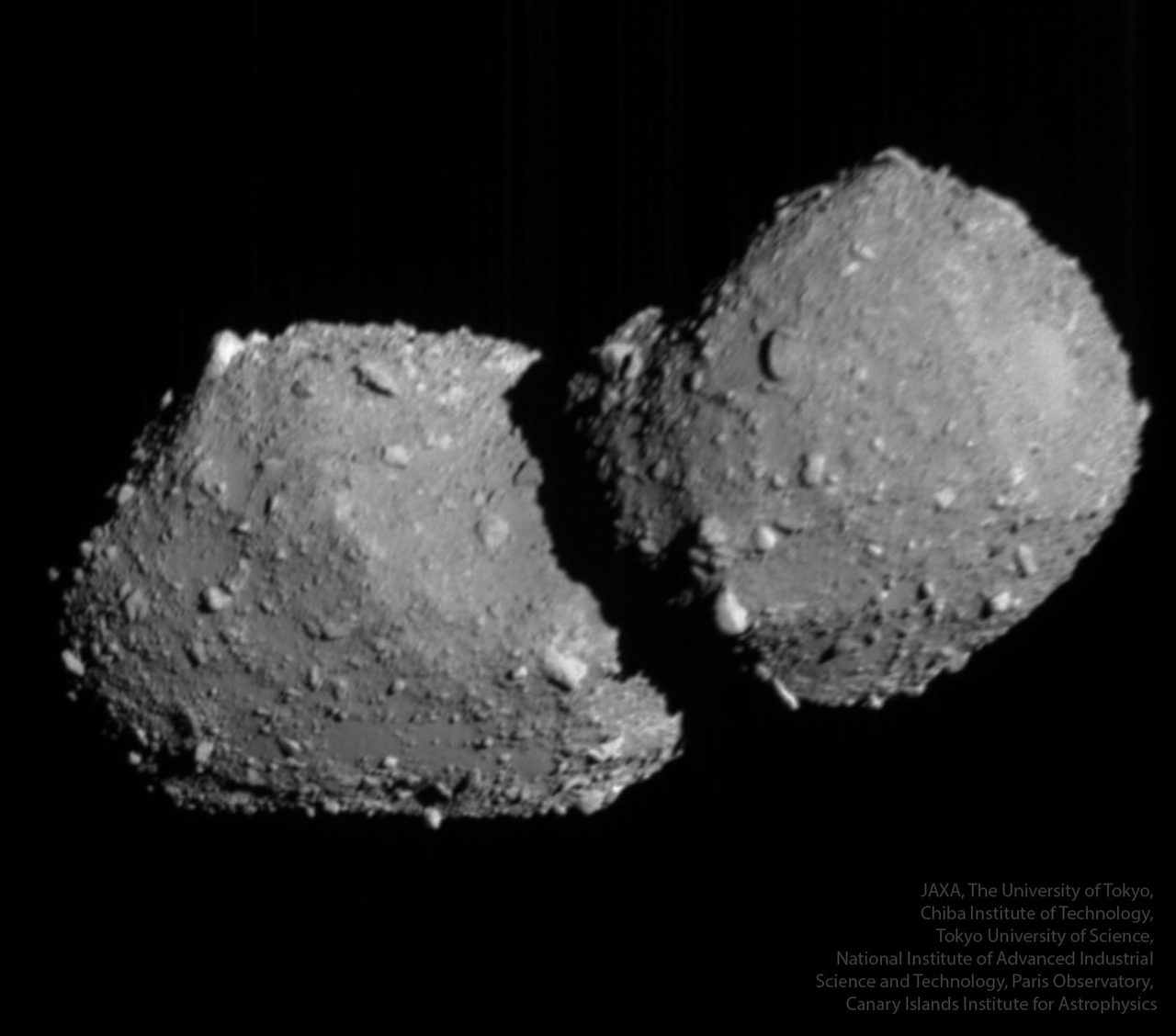
Hayabusa2's flyby of asteroid 98943 Torifune unveils its double lobed structure, offering insights into its formation and composition.
The Japanese spacecraft Hayabusa2 has provided a striking view of asteroid 98943 Torifune, revealing its unexpected double lobed structure. Captured earlier this month, these images challenge prior assumptions that Torifune was merely oblong. Instead, the asteroid, spanning approximately four soccer fields in length, appears to be a contact binary—two separate lobes that collided and fused over time. This discovery echoes the formation theories of other known contact binaries like asteroid Arrokoth.
Understanding Torifune's Unique Structure
Torifune's surface, littered with boulders yet devoid of discernible craters, suggests a rubble pile composition. Such characteristics provide valuable clues about the asteroid's history and the dynamics of its formation. As Torifune orbits the Sun, it occasionally approaches Earth, yet poses no threat. Hayabusa2's mission, which previously explored asteroid Ryugu, continues to contribute significantly to our understanding of small bodies in space. The spacecraft's next target, 1998 KY26, promises further revelations about fast-rotating asteroids and potential ice reservoirs.
Connecting the Dots in Space Exploration
Hayabusa2's findings on Torifune enrich our broader understanding of asteroid formation and evolution. For those interested in tracking such celestial bodies, Orbital Radar's Near-Earth Objects database provides real-time information on asteroids like Torifune. Additionally, the Launch Schedule offers insights into upcoming missions that may further explore these fascinating remnants of the early solar system.
Frequently Asked Questions
What is asteroid 98943 Torifune?
What did Hayabusa2 discover about Torifune?
📎 Cite this article
Orbital Radar Newsroom. (2026). Hayabusa2 Reveals Asteroid Torifune's Double Lobed Mystery. Orbital Radar. https://orbitalradar.com/blog/cosmic-gallery-2026-05-05"Hayabusa2 Reveals Asteroid Torifune's Double Lobed Mystery." Orbital Radar, 5 May 2026, https://orbitalradar.com/blog/cosmic-gallery-2026-05-05.@misc{orbitalradar_cosmic_gallery_2026_05_05,
title = {Hayabusa2 Reveals Asteroid Torifune's Double Lobed Mystery},
author = {{Orbital Radar}},
year = {2026},
howpublished = {\url{https://orbitalradar.com/blog/cosmic-gallery-2026-05-05}}
}