Exploring Messier 33: A Cosmic Yardstick in Triangulum
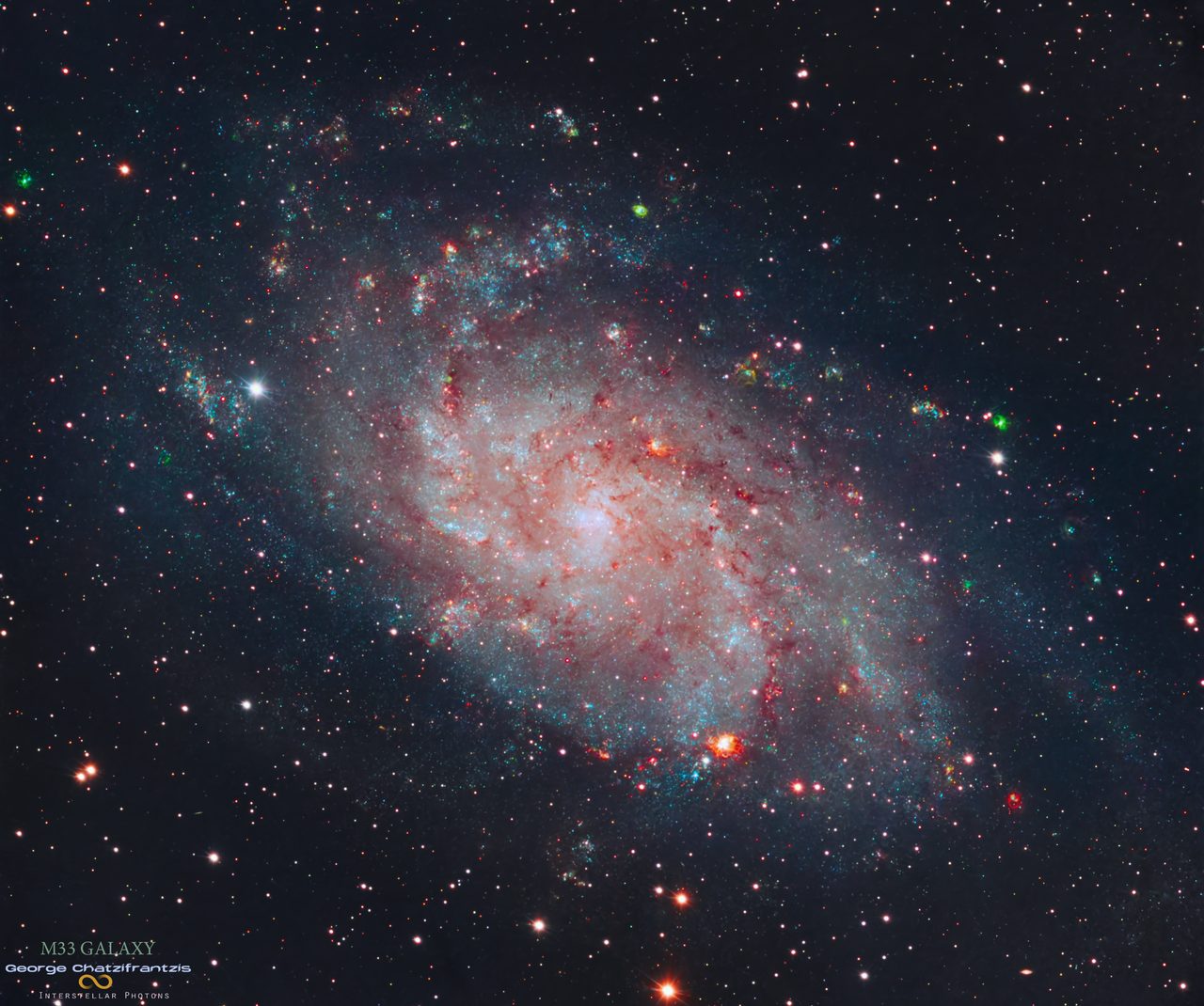
Messier 33, the Triangulum Galaxy, is a face-on spiral galaxy in the Local Group, serving as a cosmic yardstick with its well-measured variable stars.
| Active satellites | 15,731 |
| Catalogued objects | 31,390 |
| Starlink active | 9,835 |
Messier 33, also known as the Triangulum Galaxy, is a stunning face-on spiral galaxy located in the small northern constellation of Triangulum. With a diameter exceeding 50,000 light-years, it ranks as the third largest member of the Local Group of galaxies, following the Andromeda Galaxy (M31) and our Milky Way. Situated approximately 3 million light-years from us, M33 is thought to be a satellite of Andromeda, offering astronomers a spectacular view of its loosely wound spiral arms, blue star clusters, and pinkish star-forming regions.
The galaxy's brightest star-forming region, NGC 604, is prominently visible at the 5 o'clock position from the centre. This region, along with M33's population of well-measured variable stars, plays a crucial role in establishing the distance scale of the Universe. Such measurements help astronomers refine their understanding of cosmic distances and the expansion rate of the Universe.
A Broader Perspective on Cosmic Distances
Messier 33's significance extends beyond its visual appeal. Its well-documented variable stars serve as a cosmic yardstick, aiding in the calibration of distance measurements across the Universe. This process is essential for understanding the scale and structure of the cosmos. The galaxy's proximity to the Milky Way and Andromeda makes it an ideal candidate for such studies, providing a reliable reference point for astronomers.
In the realm of orbital mechanics and current missions, understanding cosmic distances is vital for the planning and execution of deep space missions. As we continue to explore our solar system and beyond, precise distance measurements enable spacecraft to navigate vast interstellar distances accurately. For those interested in tracking current missions or observing celestial events, tools like the Orbital Radar pass predictor offer valuable insights.
Frequently Asked Questions
How far is Messier 33 from the Milky Way?
Why is Messier 33 important for cosmic distance measurements?
📎 Cite this article · data available
Orbital Radar Newsroom. (2026). Exploring Messier 33: A Cosmic Yardstick in Triangulum. Orbital Radar. https://orbitalradar.com/blog/cosmic-gallery-2026-09-19"Exploring Messier 33: A Cosmic Yardstick in Triangulum." Orbital Radar, 19 September 2026, https://orbitalradar.com/blog/cosmic-gallery-2026-09-19.@misc{orbitalradar_cosmic_gallery_2026_09_19,
title = {Exploring Messier 33: A Cosmic Yardstick in Triangulum},
author = {{Orbital Radar}},
year = {2026},
howpublished = {\url{https://orbitalradar.com/blog/cosmic-gallery-2026-09-19}}
}