Exploring Messier 33: A Cosmic Spiral in Triangulum
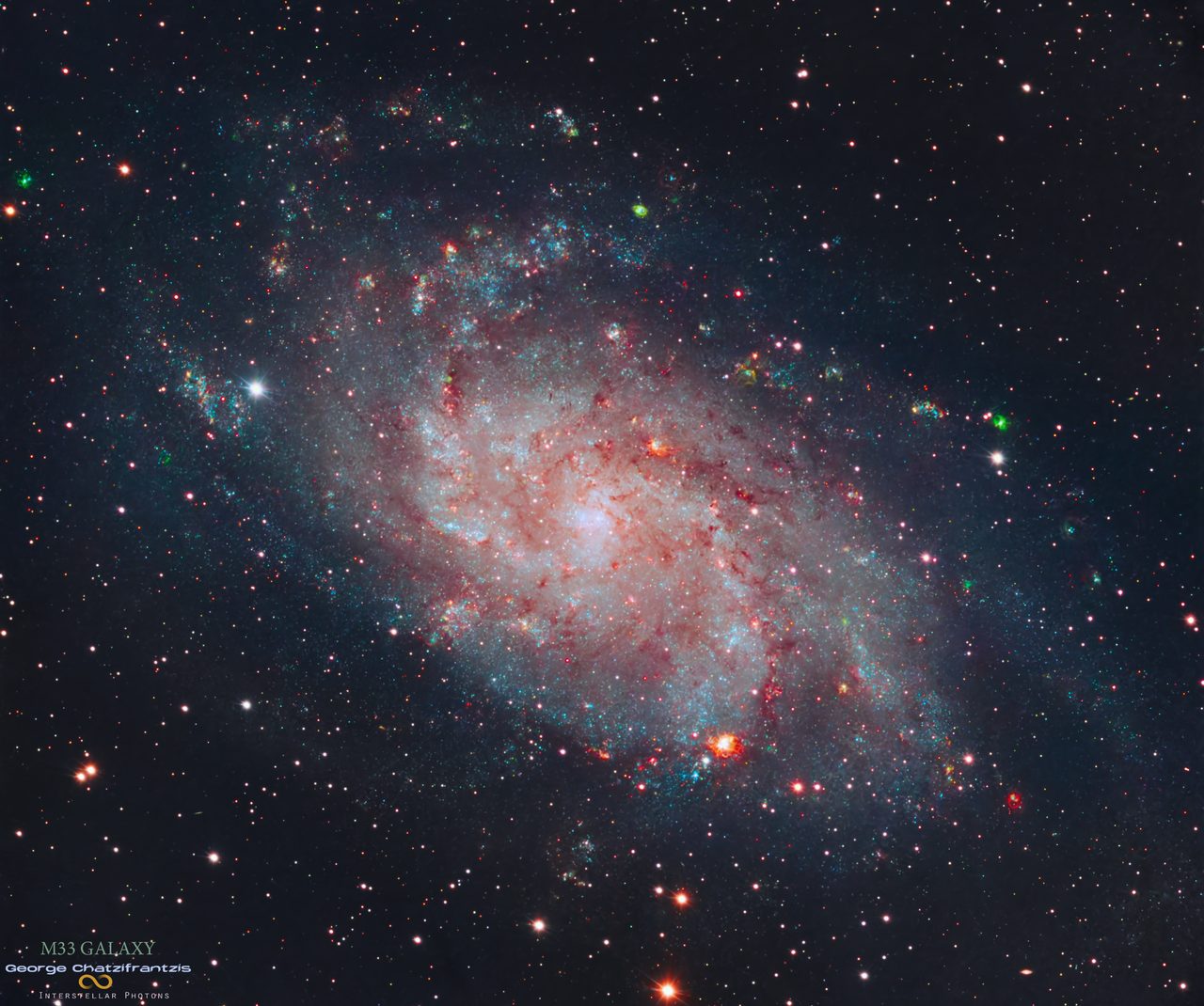
Messier 33, the Triangulum Galaxy, is a face-on spiral galaxy 3 million light-years away, offering insights into cosmic distances.
| Active satellites | 15,723 |
| Catalogued objects | 31,391 |
| Starlink active | 9,839 |
Messier 33, also known as the Triangulum Galaxy, is a stunning face-on spiral galaxy located in the small constellation Triangulum. With a diameter exceeding 50,000 light-years, it ranks as the third largest galaxy in the Local Group, after the Andromeda Galaxy and our own Milky Way. Situated approximately 3 million light-years from the Milky Way, M33 is thought to be a satellite of Andromeda, providing a spectacular view of each other's spiral structures. This image captures the galaxy's blue star clusters and pinkish star-forming regions, with the prominent NGC 604 star-forming region visible at the 5 o'clock position from the centre.
The Role of M33 in Cosmic Measurements
Messier 33 plays a crucial role in establishing the cosmic distance scale, thanks to its population of well-measured variable stars. These stars serve as a 'cosmic yardstick', helping astronomers determine distances across the Universe. This galaxy's proximity and structure make it an ideal subject for studying spiral galaxy dynamics and star formation processes. The ongoing study of M33 contributes to our understanding of galactic evolution and interactions within the Local Group, which also includes the Milky Way and Andromeda.
Observing Messier 33
For those interested in observing Messier 33, it is best viewed from the Northern Hemisphere during autumn months. The galaxy is visible with binoculars under dark skies, though a telescope will reveal its intricate spiral arms and star-forming regions. To explore other celestial objects and their orbits, consider using the Orbital Radar pass predictor for optimal viewing times.
Frequently Asked Questions
What is Messier 33?
How does Messier 33 help measure cosmic distances?
📎 Cite this article · data available
Orbital Radar Newsroom. (2026). Exploring Messier 33: A Cosmic Spiral in Triangulum. Orbital Radar. https://orbitalradar.com/blog/cosmic-gallery-2026-09-18"Exploring Messier 33: A Cosmic Spiral in Triangulum." Orbital Radar, 18 September 2026, https://orbitalradar.com/blog/cosmic-gallery-2026-09-18.@misc{orbitalradar_cosmic_gallery_2026_09_18,
title = {Exploring Messier 33: A Cosmic Spiral in Triangulum},
author = {{Orbital Radar}},
year = {2026},
howpublished = {\url{https://orbitalradar.com/blog/cosmic-gallery-2026-09-18}}
}