A Celestial Dance: Mountain Shadows and Rainbows
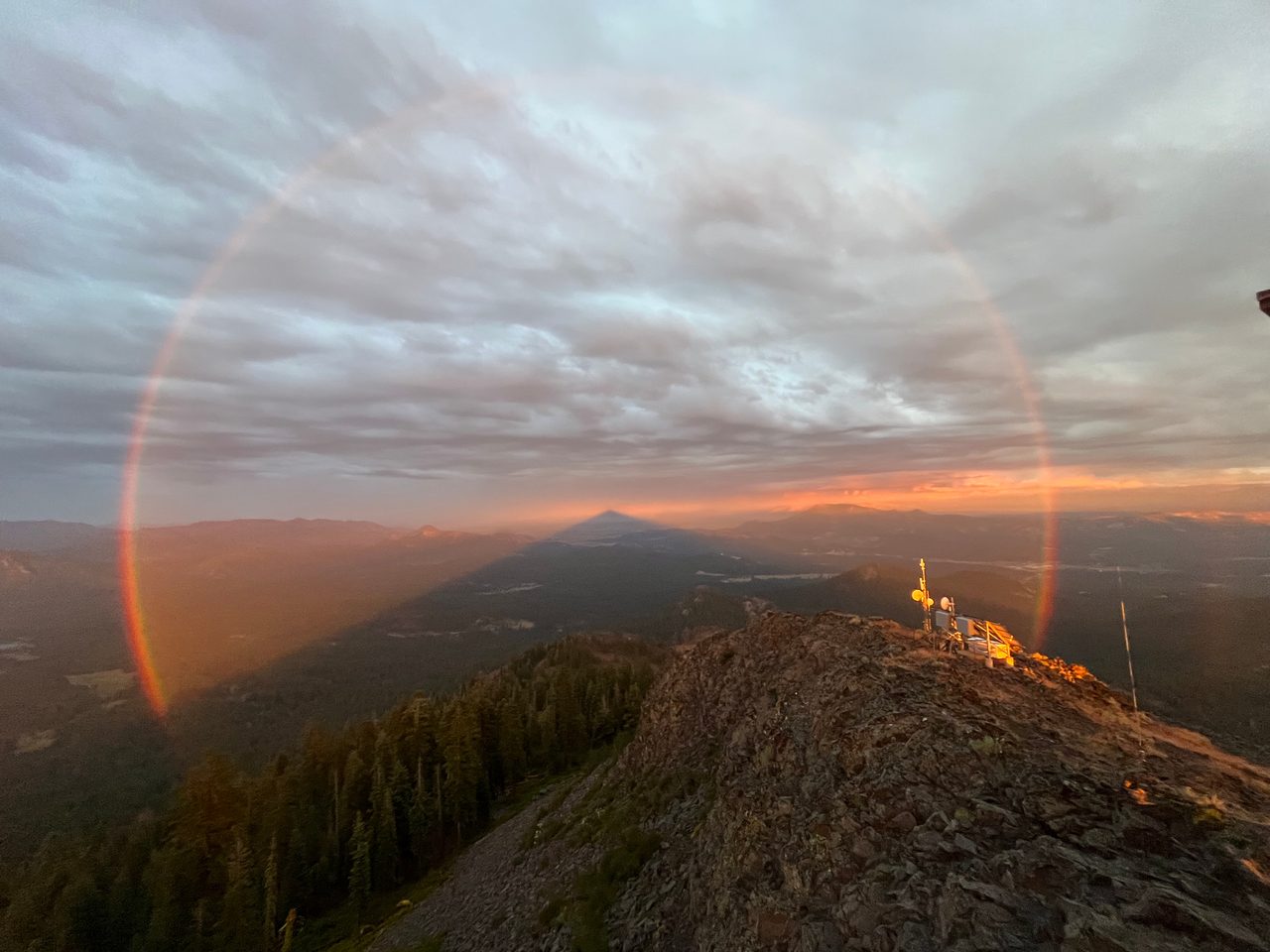
A stunning alignment of a rainbow and mountain shadow captured at sunset reveals the intricate dance of light and perspective.
Captured from a fire lookout on Smith Peak in the Plumas National Forest, this image showcases a rare alignment of natural phenomena. As the Sun set on July 13, a rainbow arched gracefully across the sky, its vibrant hues a result of sunlight being refracted and reflected by atmospheric water droplets. Simultaneously, the shadow of the mountain stretched towards the horizon, its triangular shape pointing to the rainbow's centre. This visual spectacle is a testament to the interplay of light and perspective, with the mountain shadow's apex aligning with the antisolar point, the point directly opposite the Sun.
The Science Behind the Scene
The geometric centre of a rainbow, known as the antisolar point, is a key player in this celestial display. Rainbows form at a consistent angle of 42 degrees from this point, where sunlight interacts with water droplets. The mountain shadow, on the other hand, is a result of the Sun's rays being blocked by the peak, creating a tapering shape that converges at the horizon. This alignment is not only visually striking but also illustrates fundamental principles of optics and geometry. For those interested in tracking celestial phenomena, the Near-Earth Objects page offers insights into other cosmic alignments and events.
Observing Tips
To witness similar atmospheric phenomena, timing and location are crucial. Rainbows are most visible when the Sun is low in the sky, typically in the early morning or late afternoon. Clear skies following a rainstorm provide the ideal conditions. For those interested in tracking satellite passes or planning their next stargazing session, the Pass Predictor is an invaluable tool for determining the best viewing opportunities.
Frequently Asked Questions
How does a rainbow form?
Why do mountain shadows appear triangular?
📎 Cite this article
Orbital Radar Newsroom. (2026). A Celestial Dance: Mountain Shadows and Rainbows. Orbital Radar. https://orbitalradar.com/blog/cosmic-gallery-2026-05-07"A Celestial Dance: Mountain Shadows and Rainbows." Orbital Radar, 7 May 2026, https://orbitalradar.com/blog/cosmic-gallery-2026-05-07.@misc{orbitalradar_cosmic_gallery_2026_05_07,
title = {A Celestial Dance: Mountain Shadows and Rainbows},
author = {{Orbital Radar}},
year = {2026},
howpublished = {\url{https://orbitalradar.com/blog/cosmic-gallery-2026-05-07}}
}