A Year in the Sky: Capturing 2025's Celestial Dance
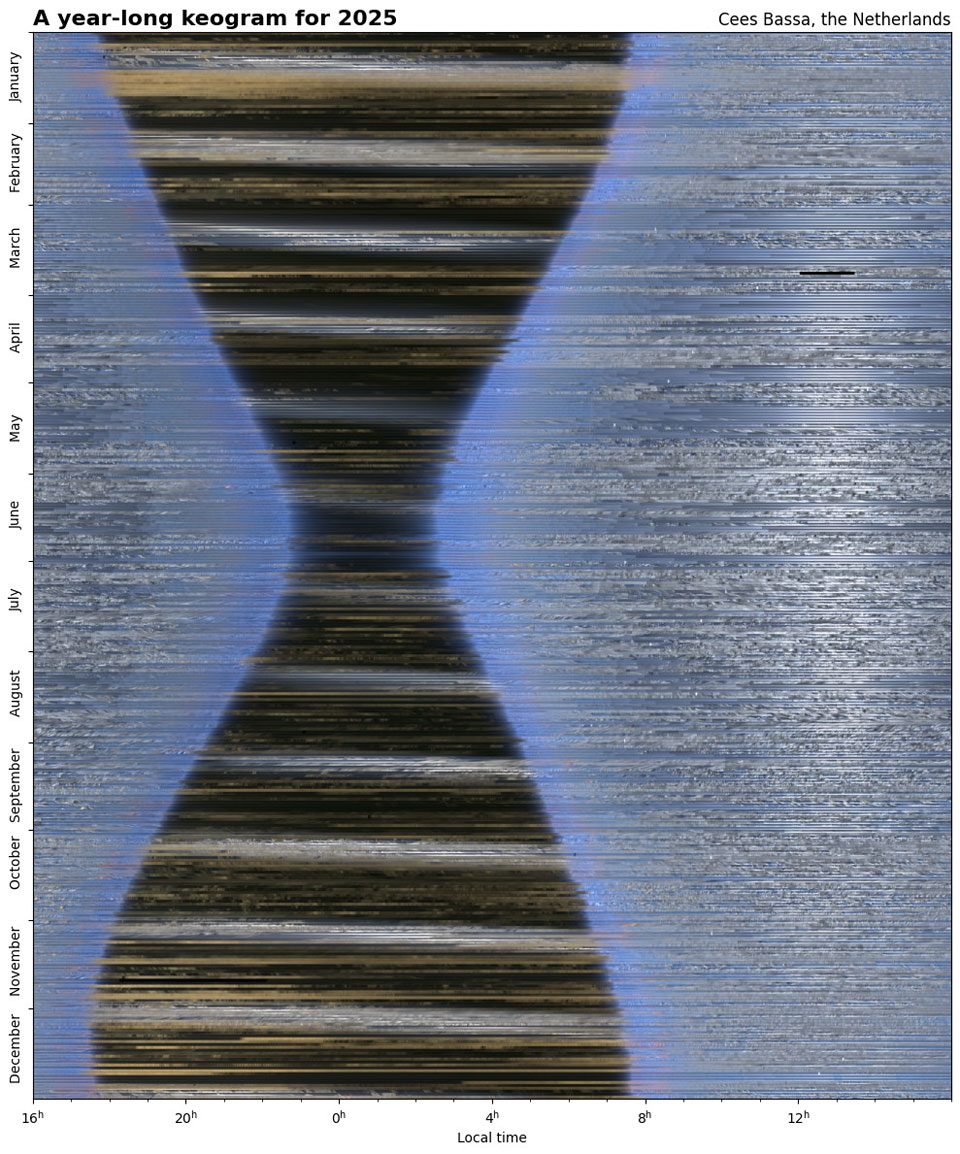
Discover a keogram from 2025 that captures the entire sky over the Netherlands, revealing the Moon's glow and solstice patterns.
The featured image, a keogram, offers a unique perspective on the sky over the Netherlands throughout 2025. Captured by an all-sky camera, this composite visualisation aligns central columns from images taken every 15 seconds over the year. The result is a vertical timeline, with January at the top and December at the bottom, while the middle of the night runs vertically just left of centre. This keogram reveals the cyclical nature of celestial events, such as the Moon's glow forming twelve distinct light bands across the nighttime sky.
Celestial Patterns and Orbital Mechanics
The keogram's depiction of solstices and equinoxes highlights the Earth's axial tilt and orbit around the Sun. The hourglass shape, thinner during the summer solstice and thicker at the winter solstice, illustrates the varying lengths of day and night. Such visualisations are invaluable for understanding celestial mechanics and the Earth's place in the cosmos. With over 18,000 active satellites in orbit, including 10,621 Starlink satellites, our view of the sky is increasingly shared with human-made objects. The Orbital Radar debris map provides insights into the growing complexity of Earth's orbital environment.
Observing the Night Sky
For those inspired to observe the night sky, the keogram serves as a reminder of the predictable yet dynamic celestial events. Tools like the Orbital Radar pass predictor can help identify when satellites will be visible, adding another layer to your stargazing experience. Understanding the interplay between natural and artificial objects in the sky enriches our appreciation of both.
Frequently Asked Questions
What is a keogram?
How does the keogram show solstices and equinoxes?
📎 Cite this article
Orbital Radar Newsroom. (2026). A Year in the Sky: Capturing 2025's Celestial Dance. Orbital Radar. https://orbitalradar.com/blog/cosmic-gallery-2026-06-21"A Year in the Sky: Capturing 2025's Celestial Dance." Orbital Radar, 21 June 2026, https://orbitalradar.com/blog/cosmic-gallery-2026-06-21.@misc{orbitalradar_cosmic_gallery_2026_06_21,
title = {A Year in the Sky: Capturing 2025's Celestial Dance},
author = {{Orbital Radar}},
year = {2026},
howpublished = {\url{https://orbitalradar.com/blog/cosmic-gallery-2026-06-21}}
}