Unveiling the Dark Doodad: A Celestial Silhouette
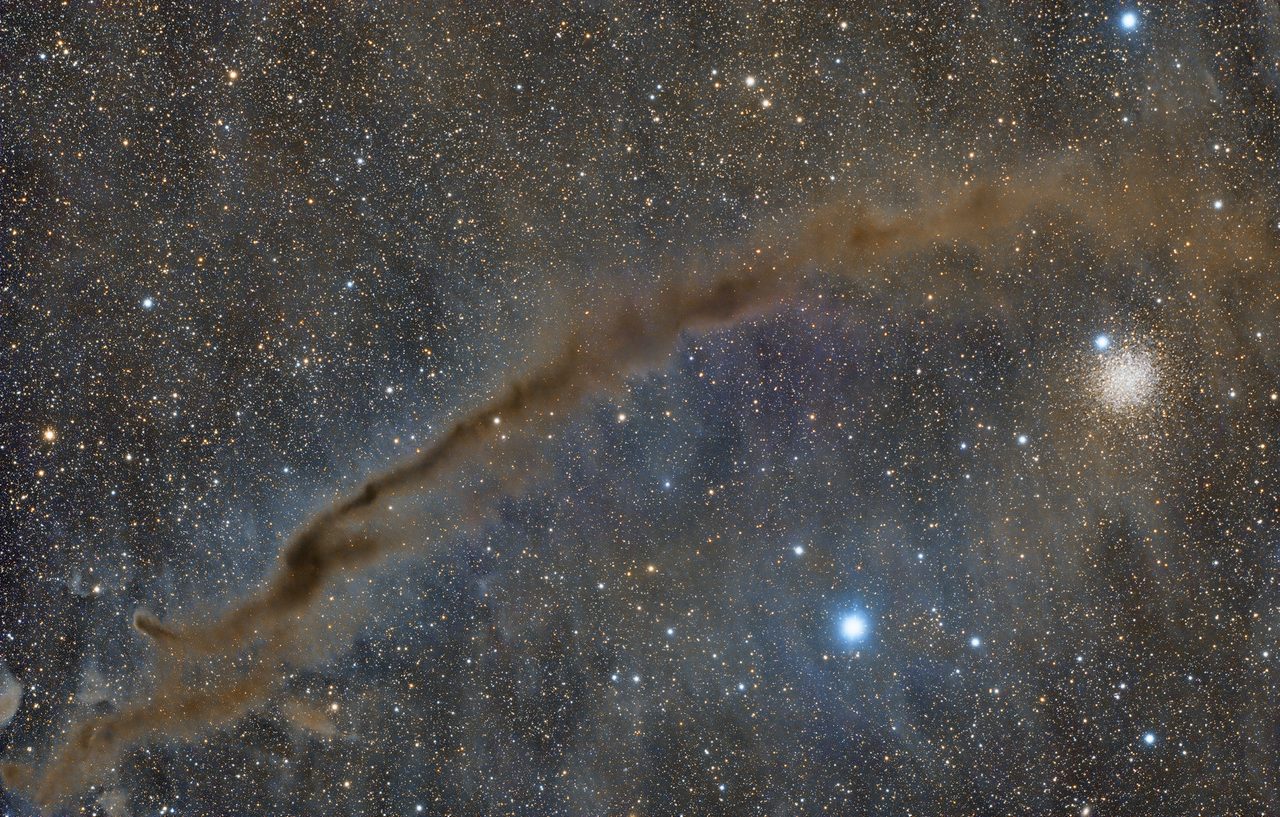
The Dark Doodad Nebula and NGC 4372 star cluster offer a stunning view in Musca, revealing interstellar dynamics.
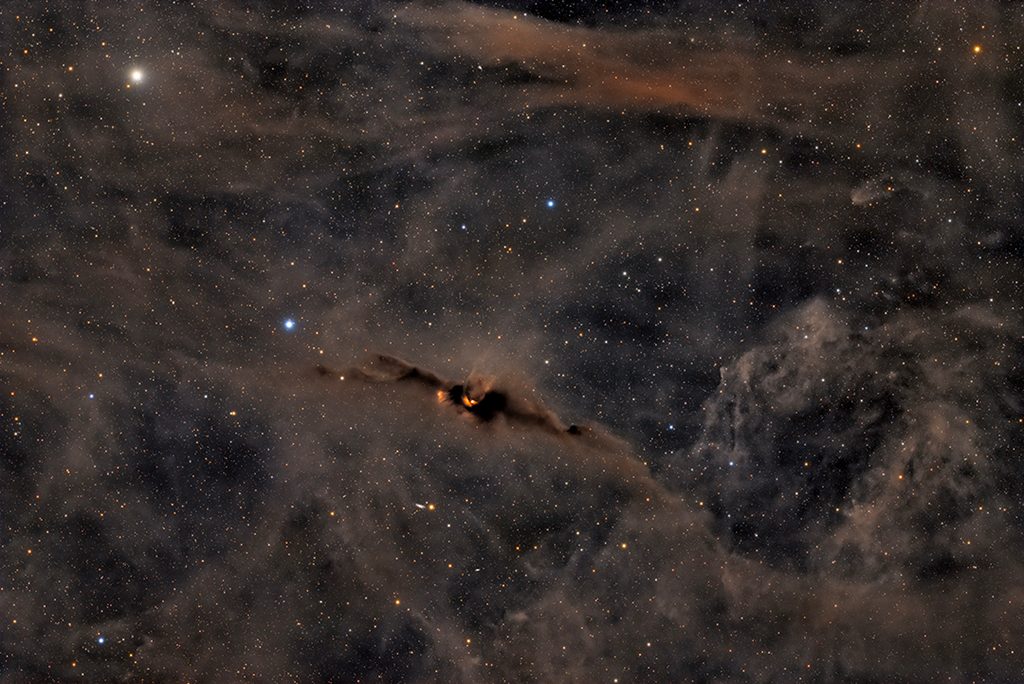
The Dark Doodad Nebula, a striking interstellar cloud, drifts through the southern skies in the constellation Musca. This dusty formation, seen against a backdrop of rich starfields, is a tantalising target for stargazers. It stretches for about 3 degrees across the sky and is punctuated by the yellowish globular star cluster NGC 4372 near its southern tip. NGC 4372, located approximately 20,000 light-years away, is a background object that coincidentally aligns with our line of sight to the Dark Doodad.
The nebula itself is part of the Musca molecular cloud, a region potentially active in star formation. Spanning over 30 light-years and situated about 700 light-years from Earth, its silhouette is a testament to the complex dynamics of interstellar dust and gas. The nebula's name, the Dark Doodad, was coined by astro-imager Dennis di Cicco in 1986, capturing its whimsical yet descriptive nature.
Interstellar Dynamics and Observing Tips
The juxtaposition of the Dark Doodad Nebula and NGC 4372 provides insights into the structure and evolution of our galaxy. Globular clusters like NGC 4372 are ancient, dense collections of stars that orbit the Milky Way's halo, offering clues about the early universe. Meanwhile, molecular clouds such as the Dark Doodad are nurseries for new stars, playing a crucial role in galactic evolution.
For those eager to observe this celestial pairing, the Dark Doodad is best viewed from the Southern Hemisphere. Binoculars or a small telescope will enhance the experience, revealing the intricate details of the nebula and the star cluster. To plan your stargazing session, check the Orbital Radar pass predictor for optimal viewing times.
Frequently Asked Questions
What is the Dark Doodad Nebula?
How far is NGC 4372 from Earth?
📎 Cite this article
Orbital Radar Newsroom. (2026). Unveiling the Dark Doodad: A Celestial Silhouette. Orbital Radar. https://orbitalradar.com/blog/cosmic-gallery-2026-07-31"Unveiling the Dark Doodad: A Celestial Silhouette." Orbital Radar, 1 August 2026, https://orbitalradar.com/blog/cosmic-gallery-2026-07-31.@misc{orbitalradar_cosmic_gallery_2026_07_31,
title = {Unveiling the Dark Doodad: A Celestial Silhouette},
author = {{Orbital Radar}},
year = {2026},
howpublished = {\url{https://orbitalradar.com/blog/cosmic-gallery-2026-07-31}}
}