Silent Mirror of the Atacama: SEST's Legacy
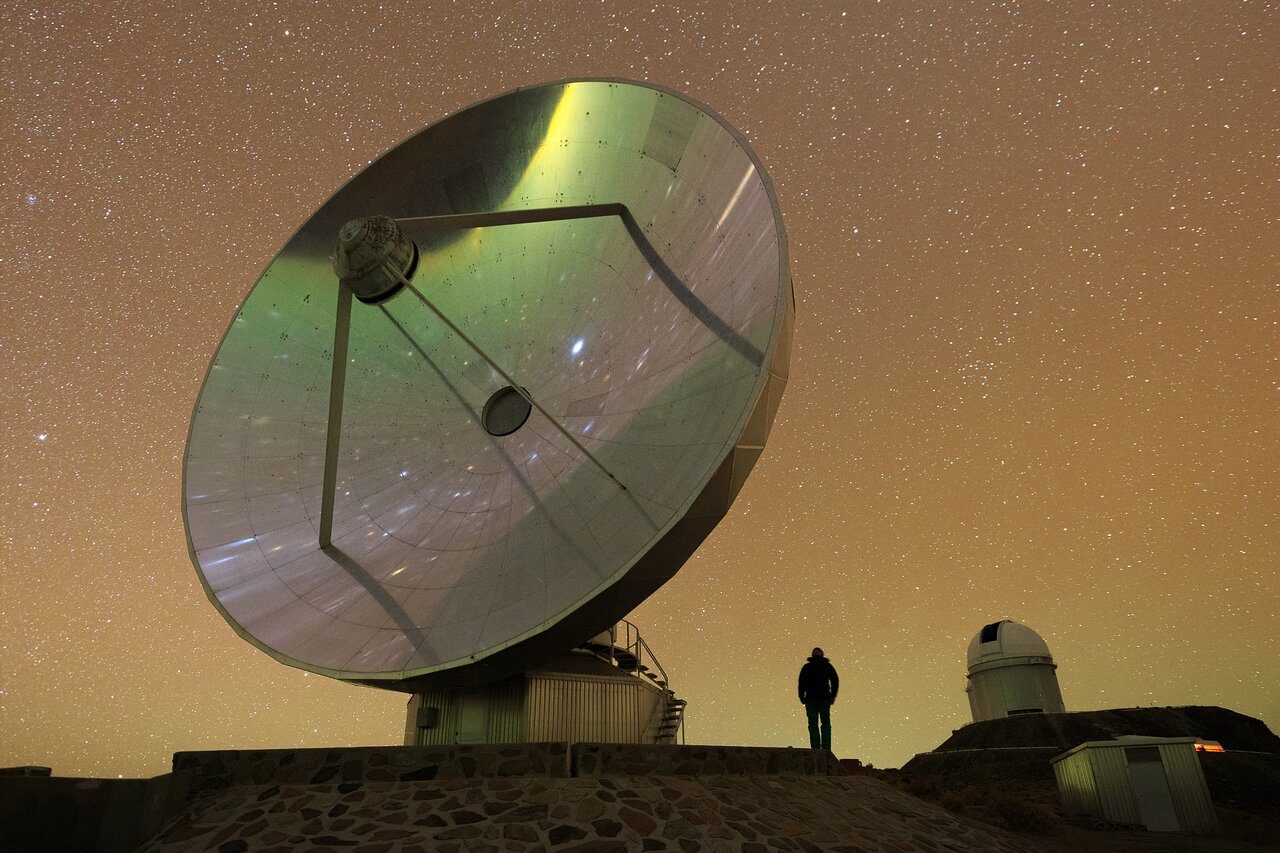
The Swedish-ESO Submillimetre Telescope, once a pioneer in submillimetre astronomy, now reflects the starry skies of Chile's Atacama Desert.
| Active satellites | 15,837 |
| Catalogued objects | 31,445 |
| Starlink active | 10,074 |
The Swedish-ESO Submillimetre Telescope (SEST) stands as a testament to the golden age of submillimetre astronomy. Located at the European Southern Observatory's La Silla site in Chile's Atacama Desert, SEST was the first large telescope in the southern hemisphere dedicated to studying the universe in the submillimetre range. This range of wavelengths, longer than visible light, is crucial for observing the cold, dense regions of space where new stars are born. SEST's 15-metre diameter dish was essential for capturing these faint signals, providing a window into the processes of stellar formation.
Although SEST was decommissioned, its presence at La Silla continues to inspire astronomers and visitors alike. The telescope's large, reflective surface now mirrors the pristine night sky, a reminder of the site's exceptional conditions for astronomical observations. The natural airglow, caused by atmospheric atoms, adds a subtle hue to the scene, enhancing the telescope's silent majesty.
The legacy of SEST is part of a broader narrative in space science, where understanding the universe requires observing beyond visible light. Current missions, such as those tracked in the Orbital Radar Satellite Library, continue to explore these invisible wavelengths. As of now, 15,837 active satellites orbit Earth, contributing to our understanding of space through various observational technologies.
Frequently Asked Questions
What was the purpose of the Swedish-ESO Submillimetre Telescope?
Where is the SEST located?
📎 Cite this article · data available
Orbital Radar Newsroom. (2026). Silent Mirror of the Atacama: SEST's Legacy. Orbital Radar. https://orbitalradar.com/blog/cosmic-gallery-2026-10-16"Silent Mirror of the Atacama: SEST's Legacy." Orbital Radar, 16 October 2026, https://orbitalradar.com/blog/cosmic-gallery-2026-10-16.@misc{orbitalradar_cosmic_gallery_2026_10_16,
title = {Silent Mirror of the Atacama: SEST's Legacy},
author = {{Orbital Radar}},
year = {2026},
howpublished = {\url{https://orbitalradar.com/blog/cosmic-gallery-2026-10-16}}
}