Galaxies Warped by Cosmic Mirrors: A Webb Telescope View
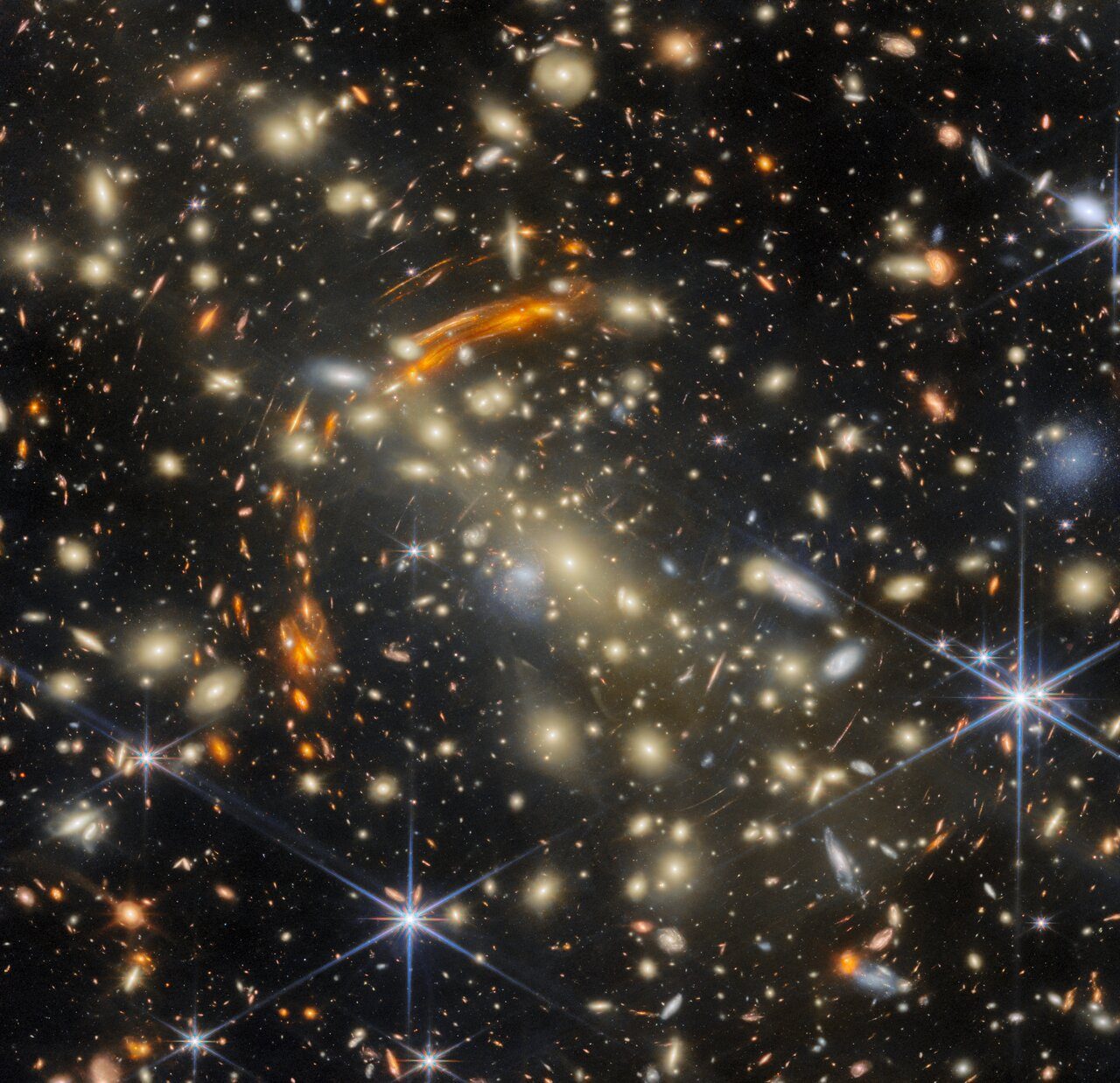
The James Webb Telescope captures the galaxy cluster MACS J0454.1-0300, showcasing gravitational lensing effects that reveal distant cosmic phenomena.
| Active satellites | 15,784 |
| Catalogued objects | 31,426 |
| Starlink active | 10,066 |
The James Webb Space Telescope has provided an extraordinary view of the galaxy cluster MACS J0454.1-0300, showcasing a phenomenon known as gravitational lensing. This effect occurs when the immense mass of a galaxy cluster bends and magnifies the light from more distant galaxies, creating distorted and multiplied images. The light from this cluster has traveled for 8 billion years, allowing us to observe the Universe in its younger days.
Gravitational Lensing: A Cosmic Telescope
Gravitational lensing is a crucial tool for astronomers, enabling the study of galaxies that would otherwise be too distant to observe. In the Webb Telescope's image, the large orange galaxies are foreground objects, while the warped and stretched galaxies are further away, their light bent by the cluster's gravity. This phenomenon can even result in multiple images of the same galaxy, a rare occurrence seen twice in this observation. These insights help astronomers understand galaxy formation and evolution.
Explore the Universe with Orbital Radar
While the James Webb Telescope peers deep into space, you can explore the skies closer to home using Orbital Radar's tools. For instance, our Pass Predictor can help you track visible passes of satellites over your location. As of now, 15,784 active satellites are orbiting Earth, a testament to humanity's expanding reach into space.
Frequently Asked Questions
What is gravitational lensing?
How far is the galaxy cluster MACS J0454.1-0300?
📎 Cite this article · data available
Orbital Radar Newsroom. (2026). Galaxies Warped by Cosmic Mirrors: A Webb Telescope View. Orbital Radar. https://orbitalradar.com/blog/cosmic-gallery-2026-10-14"Galaxies Warped by Cosmic Mirrors: A Webb Telescope View." Orbital Radar, 14 October 2026, https://orbitalradar.com/blog/cosmic-gallery-2026-10-14.@misc{orbitalradar_cosmic_gallery_2026_10_14,
title = {Galaxies Warped by Cosmic Mirrors: A Webb Telescope View},
author = {{Orbital Radar}},
year = {2026},
howpublished = {\url{https://orbitalradar.com/blog/cosmic-gallery-2026-10-14}}
}