Unveiling the Mysteries of the Cosmic Bat Nebula
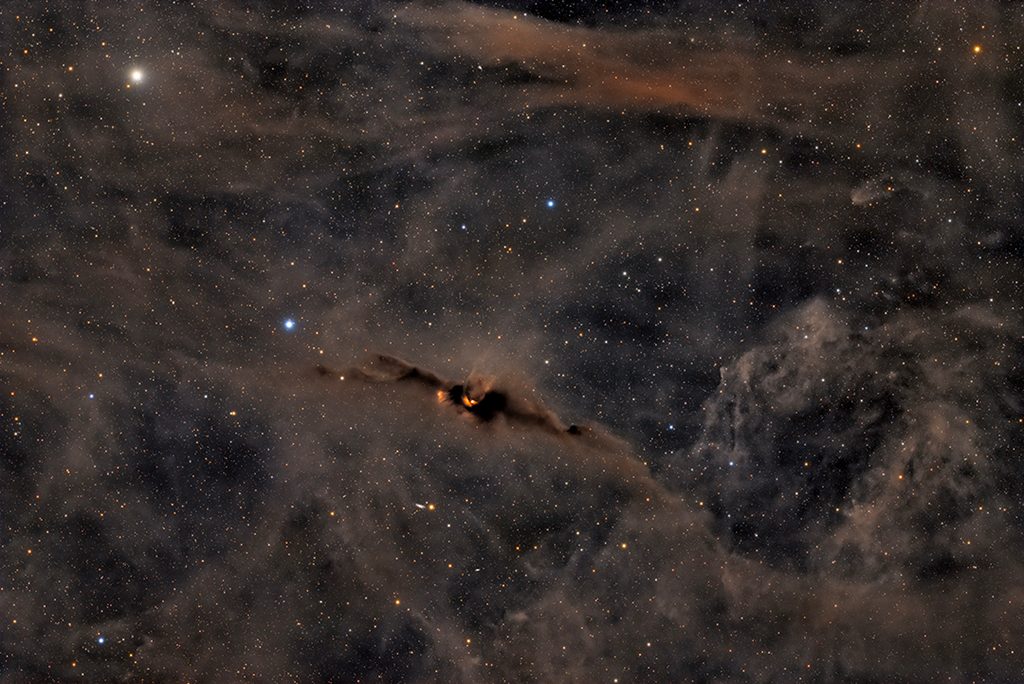
The Cosmic Bat Nebula, a star-forming region, glows ominously red due to hydrogen gas energized by young stars.
The Cosmic Bat Nebula (LDN 43) presents an intriguing spectacle with its expansive 12 light-year wingspan. This nebula, located in the constellation Ophiuchus, is a vibrant star-forming region where young stars illuminate the surrounding gas and dust. The red glow emanates from hydrogen gas excited by ultraviolet light from these nascent stars, hinting at the dynamic processes within. Unlike its namesake, the Bat Nebula (NGC 6995), the Cosmic Bat is a testament to the ongoing creation of stellar bodies in our universe.
The Science Behind the Glow
The red hue of the Cosmic Bat Nebula is a result of ionised hydrogen gas, a common occurrence in star-forming regions. As young stars emerge, their intense radiation energises the surrounding hydrogen, causing it to emit light. This process, known as hydrogen alpha emission, is a key indicator of star formation. The nebula's obscured regions, where light struggles to penetrate, suggest dense pockets of gas and dust where stars are still forming. For those interested in observing such phenomena, the Satellite Eye provides real-time satellite imagery, offering a closer look at similar celestial events.
Connecting to the Broader Universe
Star formation is a fundamental process in the universe, contributing to the evolution of galaxies and the creation of planetary systems. The Cosmic Bat Nebula is one of many such regions where these processes occur. Understanding these regions helps astronomers piece together the life cycles of stars. Currently, there are 17 active close approaches being tracked, highlighting the dynamic nature of our cosmic neighbourhood. For those interested in tracking these events, the Debris Map offers insights into the objects orbiting Earth.
Frequently Asked Questions
What is the Cosmic Bat Nebula?
Why does the Cosmic Bat Nebula glow red?
📎 Cite this article
Orbital Radar Newsroom. (2026). Unveiling the Mysteries of the Cosmic Bat Nebula. Orbital Radar. https://orbitalradar.com/blog/cosmic-gallery-2026-05-03"Unveiling the Mysteries of the Cosmic Bat Nebula." Orbital Radar, 3 May 2026, https://orbitalradar.com/blog/cosmic-gallery-2026-05-03.@misc{orbitalradar_cosmic_gallery_2026_05_03,
title = {Unveiling the Mysteries of the Cosmic Bat Nebula},
author = {{Orbital Radar}},
year = {2026},
howpublished = {\url{https://orbitalradar.com/blog/cosmic-gallery-2026-05-03}}
}