Dragons in the Sky: Unveiling the Mysteries of NGC 6188
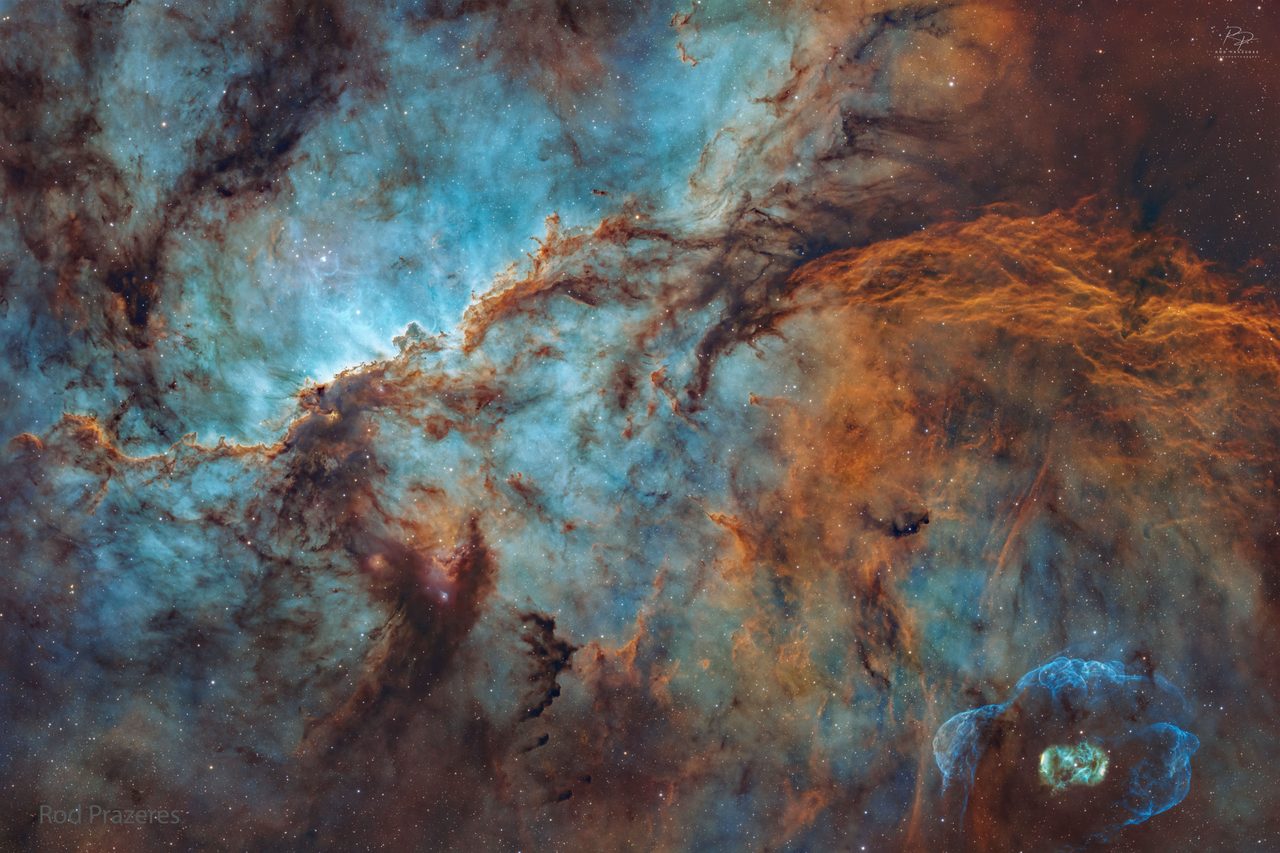
Discover NGC 6188, a nebula in the southern constellation Ara, shaped by young stars and stellar winds.
NGC 6188, known as the Dragons of Ara, is a captivating nebula located about 4,000 light years away in the constellation Ara. This celestial formation is a striking example of the interplay between massive stars and the interstellar medium. The 'dragons' are formed from gas and dust, sculpted by the intense ultraviolet radiation and stellar winds from the young stars of the Ara OB1 association. These stars, only a few million years old, illuminate the nebula, creating a glowing cosmic spectacle.
The nebula is accompanied by NGC 6164, an unusual emission nebula formed by one of the region's massive stars. Together, these structures offer a glimpse into the dynamic processes that shape our universe. Captured from Queensland, Australia, this wide field image spans over 2 degrees of the sky, equivalent to four full Moons.
The Broader Cosmic Context
NGC 6188 is not just a visual marvel; it is a testament to the life cycle of stars and the ongoing creation of cosmic structures. The young stars within the nebula are part of a larger narrative of star formation, where molecular clouds collapse under gravity to form new stars. This process is a cornerstone of galactic evolution, contributing to the enrichment of the interstellar medium with heavier elements.
In the context of our own solar system, understanding such nebulae helps astronomers piece together the history of star formation that ultimately led to the creation of planets and, eventually, life. For those interested in tracking the movement of celestial objects, the Orbital Radar pass predictor can help locate satellites passing over similar regions of the sky.
Frequently Asked Questions
What is NGC 6188?
How are nebulae like NGC 6188 formed?
📎 Cite this article
Orbital Radar Newsroom. (2026). Dragons in the Sky: Unveiling the Mysteries of NGC 6188. Orbital Radar. https://orbitalradar.com/blog/cosmic-gallery-2026-07-07"Dragons in the Sky: Unveiling the Mysteries of NGC 6188." Orbital Radar, 8 July 2026, https://orbitalradar.com/blog/cosmic-gallery-2026-07-07.@misc{orbitalradar_cosmic_gallery_2026_07_07,
title = {Dragons in the Sky: Unveiling the Mysteries of NGC 6188},
author = {{Orbital Radar}},
year = {2026},
howpublished = {\url{https://orbitalradar.com/blog/cosmic-gallery-2026-07-07}}
}