Iapetus: The Moon with Two Faces
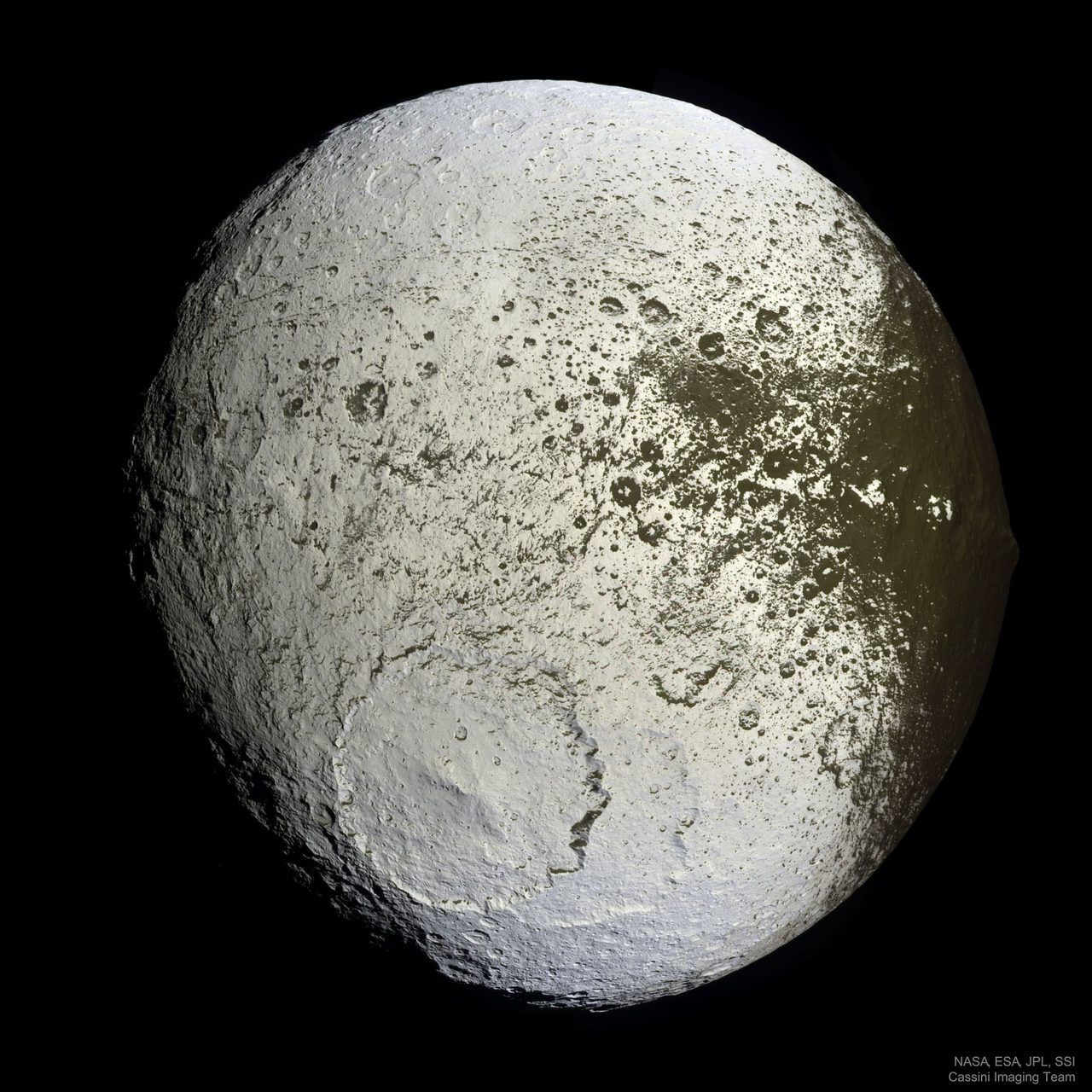
Saturn's moon Iapetus presents a striking contrast with its dual-toned surface. Discover the science behind this unique celestial feature.
Saturn's moon Iapetus is a celestial enigma, presenting a surface of stark contrasts. Captured by NASA's Cassini spacecraft in 2007, Iapetus displays vast regions as dark as coal juxtaposed against areas as bright as snow. This duality is particularly evident on the hemisphere always trailing in its orbit, where a prominent impact crater, 500 kilometres wide, is visible. The dark material coating much of Iapetus is hypothesised to be carbon-rich soil, possibly originating from sublimated dirty ice or debris from other moons.
The Broader Context of Iapetus
The unique appearance of Iapetus provides insights into planetary science and surface processes. The moon's surface dichotomy may result from external accretion of material and internal geological processes. Understanding these processes helps scientists draw parallels with other celestial bodies, enhancing our knowledge of solar system formation. The Cassini mission, which orbited Saturn from 2004 to 2017, has been instrumental in unravelling such mysteries, contributing significantly to our understanding of Saturn's moons.
Observing Saturn's Moons
For those interested in observing Saturn and its moons, the Orbital Radar pass predictor can provide guidance on when these celestial bodies are visible from Earth. While Iapetus itself is not visible to the naked eye, Saturn's position can be tracked, offering opportunities to view its larger moons through telescopes.
Frequently Asked Questions
Why is Iapetus two-toned?
How was Iapetus studied?
📎 Cite this article
Orbital Radar Newsroom. (2026). Iapetus: The Moon with Two Faces. Orbital Radar. https://orbitalradar.com/blog/cosmic-gallery-2026-07-05"Iapetus: The Moon with Two Faces." Orbital Radar, 6 July 2026, https://orbitalradar.com/blog/cosmic-gallery-2026-07-05.@misc{orbitalradar_cosmic_gallery_2026_07_05,
title = {Iapetus: The Moon with Two Faces},
author = {{Orbital Radar}},
year = {2026},
howpublished = {\url{https://orbitalradar.com/blog/cosmic-gallery-2026-07-05}}
}