Unveiling Cosmic Siblings: The Tale of Twin Supernovae
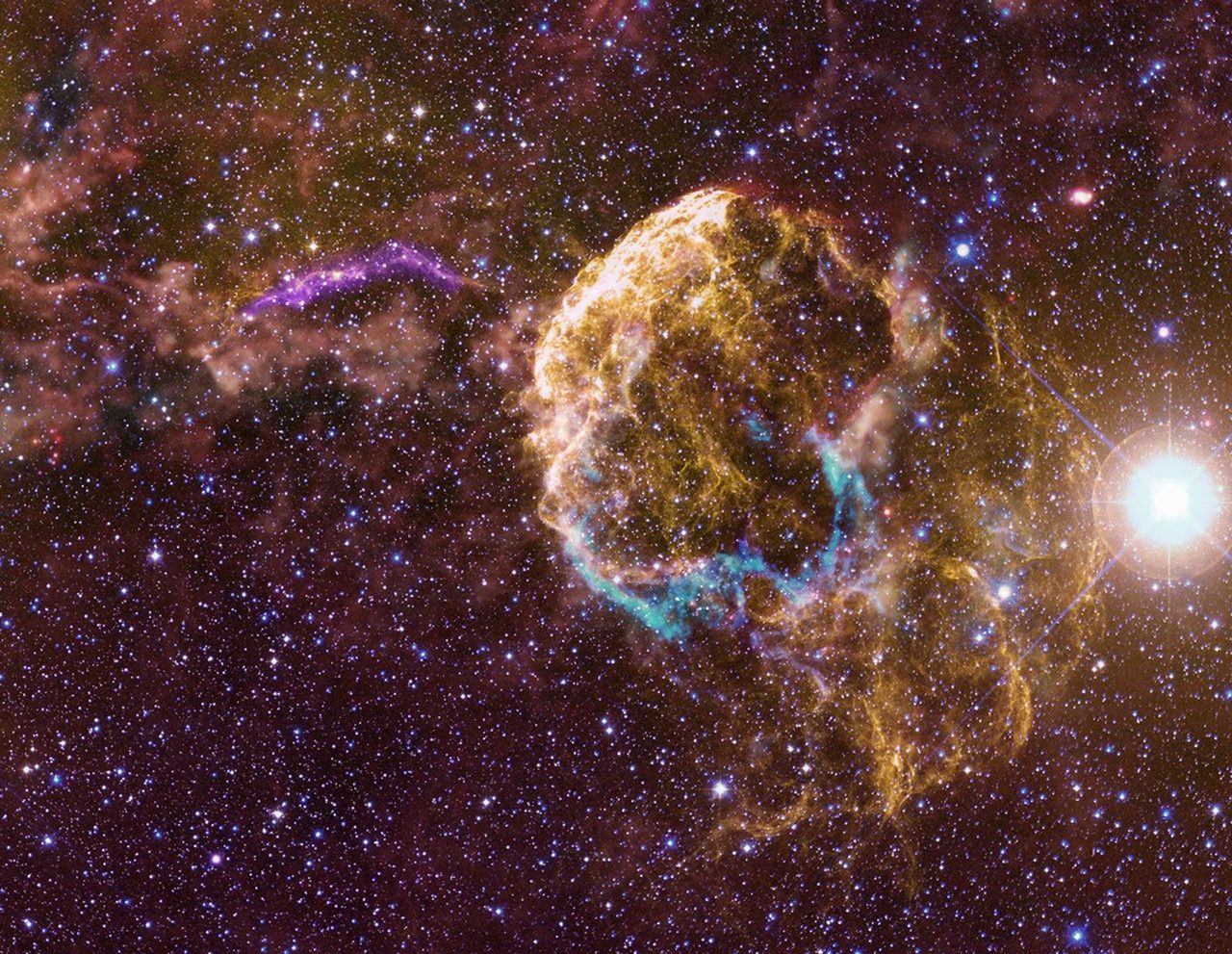
Discover the intertwined story of two supernova remnants, captured in a stunning multi-wavelength image, revealing the cosmic dance of a binary star system.
The image of the day presents a fascinating view of two supernova remnants, located approximately 6,000 light-years away. At the centre of this cosmic tableau is the Jellyfish Nebula, depicted in yellow, which is the younger of the two remnants. This nebula, if visible to the naked eye, would appear larger than the full moon. The purple filaments belong to an older remnant, G189.6+3.3, overlapping with the Jellyfish Nebula. Recent studies using data from NASA's Fermi Gamma-ray Space Telescope have pieced together the history of these remnants, suggesting they originated from a binary star system where both stars eventually went supernova.
The Legacy of Binary Star Explosions
The story of these supernova remnants is a testament to the dynamic and often violent nature of the cosmos. In a binary star system, the gravitational interaction between stars can lead to complex evolutionary paths. Here, the first star's explosion as a supernova likely disrupted the system, eventually leading to the companion star's own supernova event. Such interactions are crucial for understanding stellar evolution and the distribution of elements across the galaxy. The Jellyfish Nebula and its sibling remnant highlight the intricate processes that shape our universe.
Observing the Cosmic Dance
While these supernova remnants are beyond the reach of amateur telescopes, their study is enhanced by tools like the Satellite Eye, which provides live satellite imagery. For those interested in tracking the movement of satellites that might observe such phenomena, the Pass Predictor offers insights into visible passes. These remnants remind us of the interconnectedness of cosmic events and the tools that help us explore them.
Frequently Asked Questions
How many active satellites are currently orbiting Earth?
What is space debris, and why is it a concern?
📎 Cite this article
Orbital Radar Newsroom. (2026). Unveiling Cosmic Siblings: The Tale of Twin Supernovae. Orbital Radar. https://orbitalradar.com/blog/cosmic-gallery-2026-07-02"Unveiling Cosmic Siblings: The Tale of Twin Supernovae." Orbital Radar, 3 July 2026, https://orbitalradar.com/blog/cosmic-gallery-2026-07-02.@misc{orbitalradar_cosmic_gallery_2026_07_02,
title = {Unveiling Cosmic Siblings: The Tale of Twin Supernovae},
author = {{Orbital Radar}},
year = {2026},
howpublished = {\url{https://orbitalradar.com/blog/cosmic-gallery-2026-07-02}}
}