Tracing the Stars: A Glimpse from Paranal
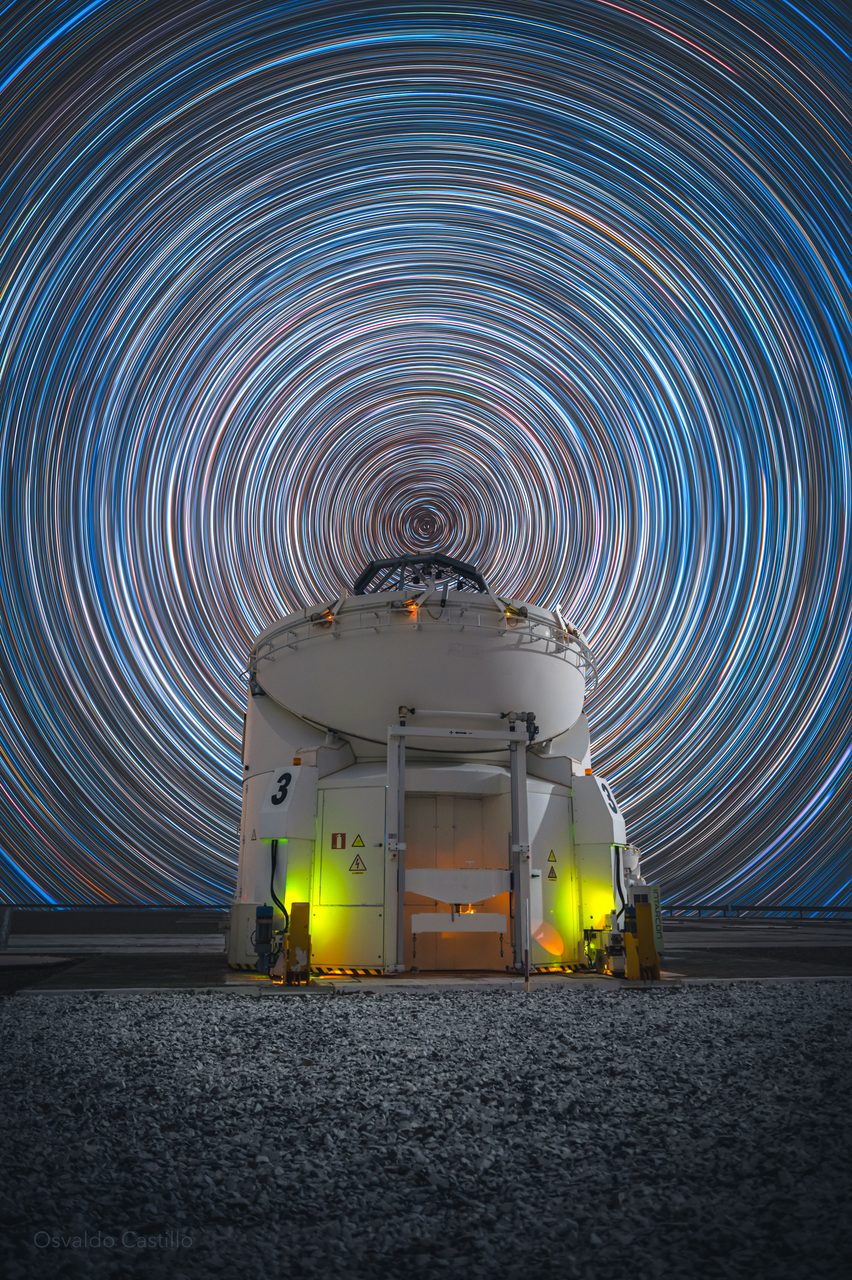
Star trails captured above Paranal Observatory reveal Earth's rotation, with arcs centred at the south celestial pole.
The image captures the ethereal beauty of star trails above the Paranal Observatory in Chile. These trails are a testament to Earth's constant rotation, moving at over 1,500 kilometres per hour at this latitude. Despite this rapid pace, the motion is invisible to the naked eye. However, through a series of 300 stacked 25-second exposures, the stars appear to trace graceful arcs around the south celestial pole, the point in the sky directly aligned with Earth's axis of rotation. This celestial dance is beautifully framed by the observatory's 1.8-metre auxiliary telescope, AT 3, which stands as a silent witness to the universe's vastness.
The Science Behind the Stars
Star trails are more than just a visual spectacle; they are a direct illustration of Earth's rotation. As our planet spins, stars appear to move across the sky, tracing circular paths around the celestial poles. This effect is a practical demonstration of basic orbital mechanics, the same principles that govern satellite orbits. Currently, there are 18,686 active satellites in orbit, including 11,045 Starlink satellites, which can be tracked using the Starlink Tracker on Orbital Radar. Understanding these mechanics is crucial for maintaining the delicate balance of objects in space, where even small deviations can lead to significant consequences.
Observing the Night Sky
For those inspired to observe star trails themselves, a clear night sky and a steady camera are all that's needed. A tripod and a camera capable of long exposures will allow you to capture the motion of the stars. For optimal results, find a location with minimal light pollution and aim towards the celestial poles. To anticipate when the skies will be clear, the Pass Predictor on Orbital Radar can provide valuable forecasts.
Frequently Asked Questions
What causes star trails in photographs?
Where is the Paranal Observatory located?
📎 Cite this article
Orbital Radar Newsroom. (2026). Tracing the Stars: A Glimpse from Paranal. Orbital Radar. https://orbitalradar.com/blog/cosmic-gallery-2026-08-28"Tracing the Stars: A Glimpse from Paranal." Orbital Radar, 29 August 2026, https://orbitalradar.com/blog/cosmic-gallery-2026-08-28.@misc{orbitalradar_cosmic_gallery_2026_08_28,
title = {Tracing the Stars: A Glimpse from Paranal},
author = {{Orbital Radar}},
year = {2026},
howpublished = {\url{https://orbitalradar.com/blog/cosmic-gallery-2026-08-28}}
}