M74: A Cosmic Masterpiece of Spiral Arms and Star Clusters
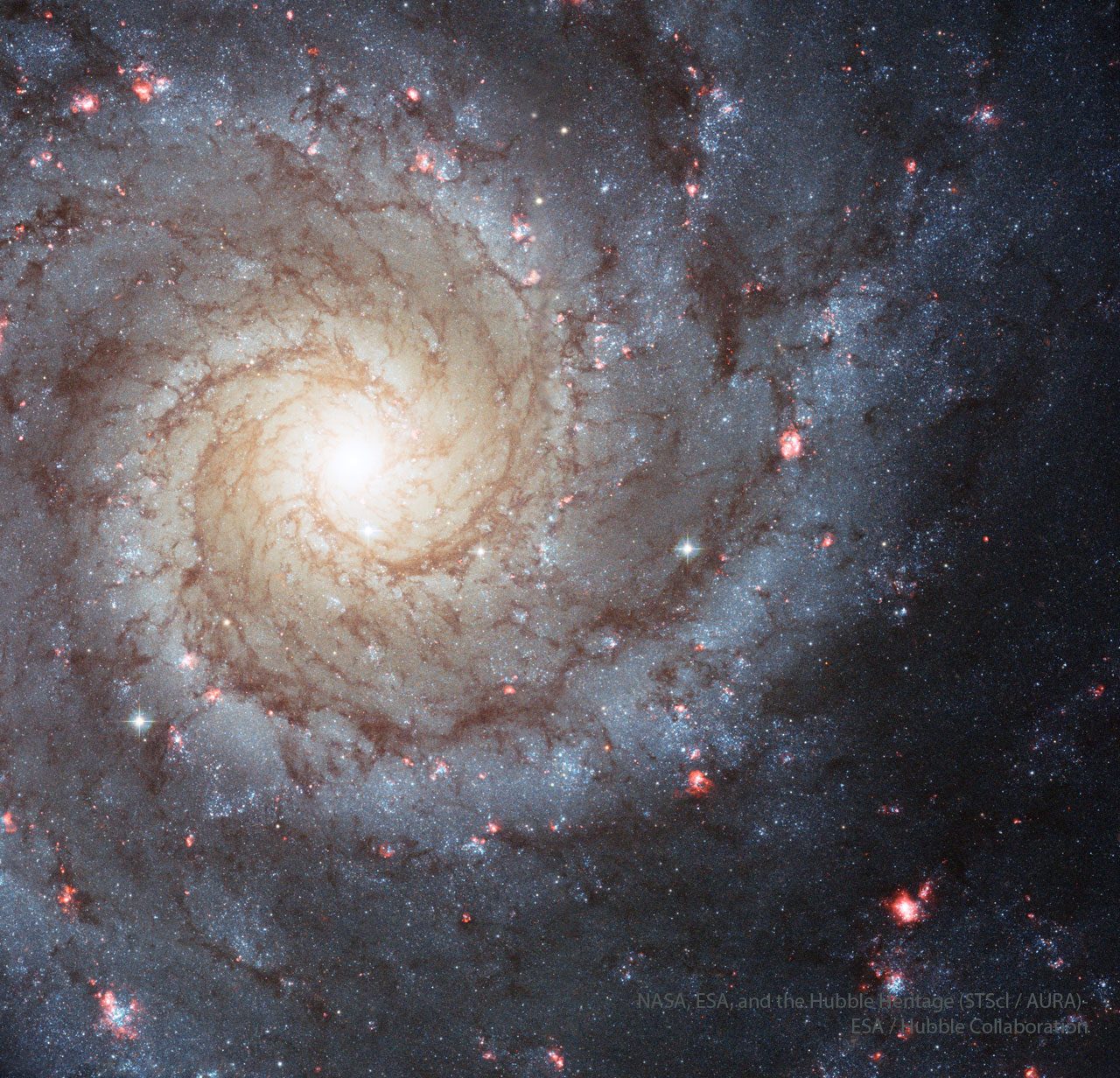
M74, a grand design spiral galaxy, offers a stunning face-on view with its bright blue star clusters and cosmic dust lanes, 32 million light-years away.
M74, also known as the Phantom Galaxy, is a prime example of a grand design spiral galaxy, located approximately 32 million light-years away in the constellation Pisces. This stunning celestial object is home to around 100 billion stars, and its face-on orientation provides a perfect view of its intricate spiral arms. These arms are adorned with bright blue star clusters and dark cosmic dust lanes, creating a breathtaking image captured by the Hubble Space Telescope. The reddish glow seen in the composite image highlights the galaxy's large star-forming regions, where hydrogen atoms emit light as they are excited by young, hot stars.
The Science of Spiral Galaxies
Spiral galaxies like M74 are characterised by their well-defined spiral arms, which are regions of active star formation. These structures are maintained by density waves that sweep through the galaxy, compressing gas and dust to form new stars. Understanding the dynamics of spiral galaxies helps astronomers learn about the processes that govern star formation and galactic evolution. M74's classification as an Sc galaxy indicates its loosely wound arms and small central bulge, typical of galaxies with ongoing star formation.
Observing M74 and Related Phenomena
While M74 is not visible to the naked eye, amateur astronomers with small telescopes can observe this galaxy under dark skies. For those interested in tracking other celestial objects, the Orbital Radar pass predictor offers a tool to plan observations of satellites and other space phenomena. With the ongoing expansion of satellite constellations like Starlink, understanding the night sky's changing landscape becomes increasingly important.
Frequently Asked Questions
What type of galaxy is M74?
How far away is M74?
📎 Cite this article
Orbital Radar Newsroom. (2026). M74: A Cosmic Masterpiece of Spiral Arms and Star Clusters. Orbital Radar. https://orbitalradar.com/blog/cosmic-gallery-2026-08-30"M74: A Cosmic Masterpiece of Spiral Arms and Star Clusters." Orbital Radar, 31 August 2026, https://orbitalradar.com/blog/cosmic-gallery-2026-08-30.@misc{orbitalradar_cosmic_gallery_2026_08_30,
title = {M74: A Cosmic Masterpiece of Spiral Arms and Star Clusters},
author = {{Orbital Radar}},
year = {2026},
howpublished = {\url{https://orbitalradar.com/blog/cosmic-gallery-2026-08-30}}
}