Blue Origin Prepares New Glenn for Year-End Return

Blue Origin advances its New Glenn rocket for a year-end flight as Webb and Hubble capture new cosmic images.
| Active satellites | 15,787 |
| Starlink active | 10,063 |
| Catalogued objects | 31,507 |
| Active close approaches | 21 |
| People in space | 10 |
Blue Origin is advancing the reconstruction of Launch Complex 36 (LC-36) at Cape Canaveral, aiming for a year-end return to flight for its New Glenn rocket. The New Glenn, a heavy-lift launch vehicle, has been in development for several years and represents a significant milestone for Blue Origin's commercial space ambitions. The company has been working on the LC-36 rebuild to support the rocket's launch operations. As of now, no specific launch date has been announced, but the company is targeting the end of 2026 for its next mission.
Webb and Hubble Capture Cosmic Wonders
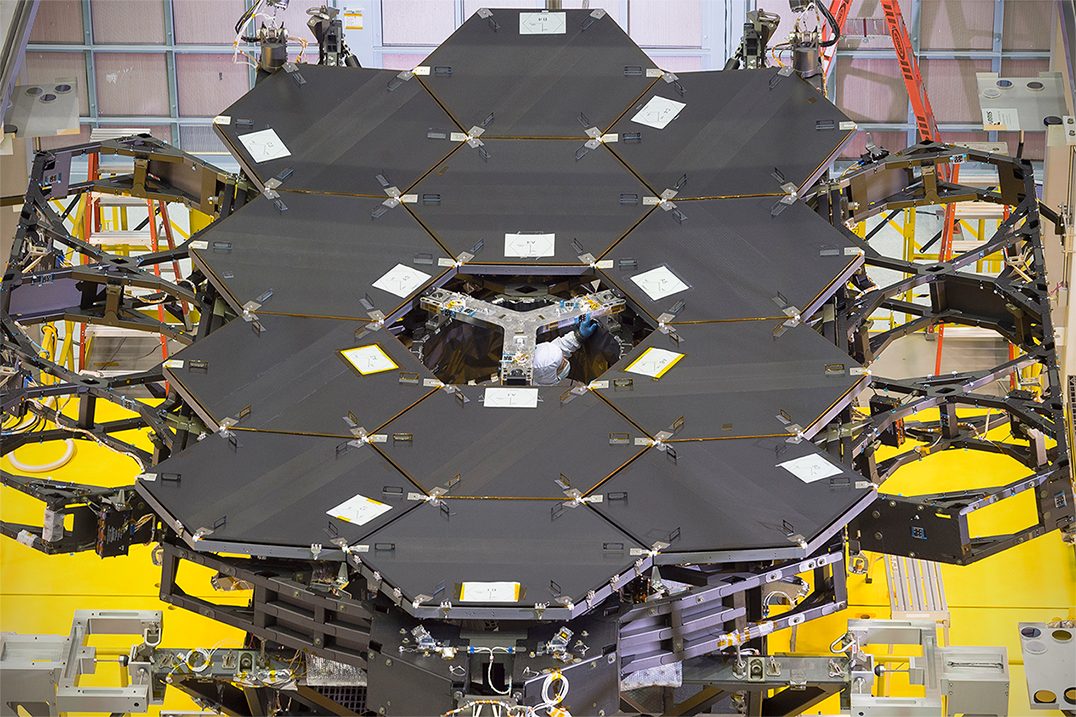
The James Webb Space Telescope and the Hubble Space Telescope have jointly observed a series of cosmic phenomena, including stellar nurseries, galaxies, and gravitational lensing. These observations provide new insights into the formation and evolution of galaxies and the role of dark matter in the universe. The images, which were released recently, highlight the capabilities of both telescopes in capturing detailed views of distant cosmic events. For those interested in tracking the position of these telescopes, the Orbital Radar pass predictor offers visibility schedules.
Orbital Close Approaches
Recent data indicates several close approaches between satellites and debris in orbit. Notably, the TerraSAR-X and TanDEM-X satellites experienced a minimum separation of approximately 1.42 km. These close approaches underscore the increasing congestion in low Earth orbit and the importance of space situational awareness. As of today, 21 active close approaches are being tracked by Orbital Radar's live catalogue. The total number of catalogued objects, including debris, stands at 31,507.
What to Watch
While no launches are scheduled for the immediate future, Blue Origin's anticipated New Glenn flight towards the end of the year is a key event to watch. Additionally, the preliminary lunar science report for Artemis II has been released, offering insights into upcoming lunar exploration missions. For a comprehensive overview of upcoming launches, the Orbital Radar launch schedule provides detailed information.
Frequently Asked Questions
When is Blue Origin's New Glenn expected to launch?
How many satellites are currently active in orbit?
📎 Cite this article · data available
Orbital Radar Newsroom. (2026). Blue Origin Prepares New Glenn for Year-End Return. Orbital Radar. https://orbitalradar.com/blog/orbital-briefing-2026-10-12"Blue Origin Prepares New Glenn for Year-End Return." Orbital Radar, 12 October 2026, https://orbitalradar.com/blog/orbital-briefing-2026-10-12.@misc{orbitalradar_orbital_briefing_2026_10_12,
title = {Blue Origin Prepares New Glenn for Year-End Return},
author = {{Orbital Radar}},
year = {2026},
howpublished = {\url{https://orbitalradar.com/blog/orbital-briefing-2026-10-12}}
}