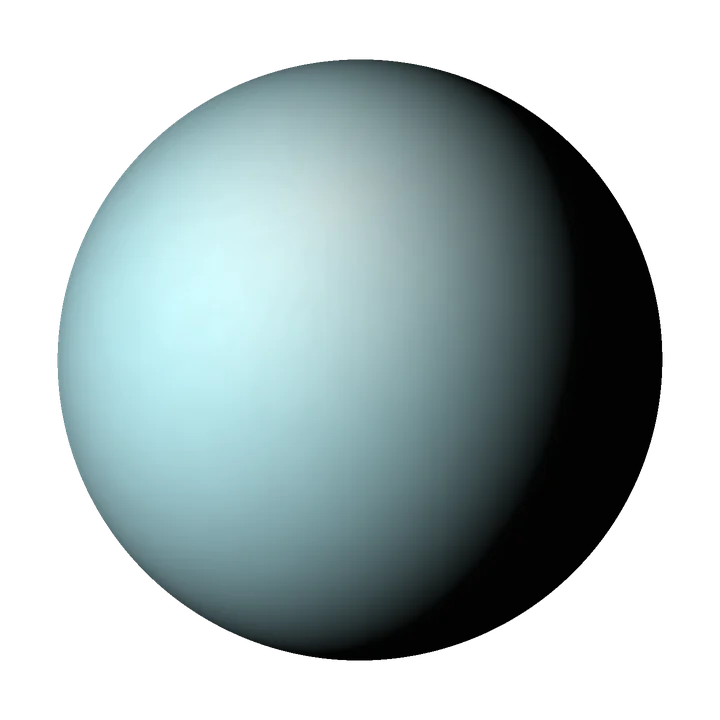
Uranus Live
Uranus is 2.76 billion km from Earth right now, so its light takes 2 hours 33 minutes to reach us. It is in Taurus, opposite the Sun and up all night.
LiveWorked out for
Uranus's next opposition
Uranus will be opposite the Sun, up all night and at its closest and brightest for the year: 2.75 billion km from Earth. What is an opposition?
Next conjunction: 27 May 2027. Uranus will pass behind the Sun and be lost in its glare for a few weeks around then.
Uranus tonight
Choose a place to see tonight's times
 UranusOpposite the Sun: up all nightChoose a place for the times where you are
"Visible" means at least 7° above the horizon while the sky is dark. Uranus looks like a faint star; a star chart helps.
Where Uranus is now
Seen from above the Solar System at 09:50 UTC on 28 November 2026. The dashed line is the 2.76 billion km between Earth and Uranus.
Uranus is 2.91 billion km from the Sun. Earth overtakes it on the inside once every 12 months and 4 days, and that is when it comes to opposition. Distances on the drawing are squeezed so the orbits fit.
Spacecraft at Uranus
Uranus at a glance
- Diameter
- 50,724 km
- Day
- 17 h 14 min
- Year
- 84 Earth years
- Moons
- 29
- Average distance from the Sun
- 2.87 billion km
- Tilt
- Spins on its side, tilted 98°
Uranus is an ice giant that spins on its side. At its brightest it is just visible to the naked eye from a dark site; binoculars show it as a small blue-green dot.
Frequently Asked Questions
Explore more






Cite this page
Pick a style, then copy it or download it for your reference manager.Orbital Radar. (2026, November 28). Uranus Live: Distance and Visibility Tonight. Retrieved November 28, 2026, from https://orbitalradar.com/planets/uranus
“Uranus Live: Distance and Visibility Tonight.” Orbital Radar, 28 Nov. 2026, orbitalradar.com/planets/uranus. Accessed 28 Nov. 2026.
Orbital Radar (2026) Uranus Live: Distance and Visibility Tonight. Available at: https://orbitalradar.com/planets/uranus (Accessed: 28 November 2026).
Orbital Radar. “Uranus Live: Distance and Visibility Tonight.” Last modified November 28, 2026. https://orbitalradar.com/planets/uranus.
@misc{orbitalradar_planets_uranus,
  author       = {{Orbital Radar}},
  title        = {Uranus Live: Distance and Visibility Tonight},
  year         = {2026},
  month        = nov,
  howpublished = {\url{https://orbitalradar.com/planets/uranus}},
  url          = {https://orbitalradar.com/planets/uranus},
  urldate      = {2026-11-28},
  note         = {Accessed 2026-11-28}
}
TY - ELEC AU - Orbital Radar, TI - Uranus Live: Distance and Visibility Tonight PY - 2026 DA - 2026/11/28 PB - Orbital Radar UR - https://orbitalradar.com/planets/uranus Y2 - 2026/11/28 LA - en ER -
Live figures change, so keep the date you accessed the page. How to cite Orbital Radar