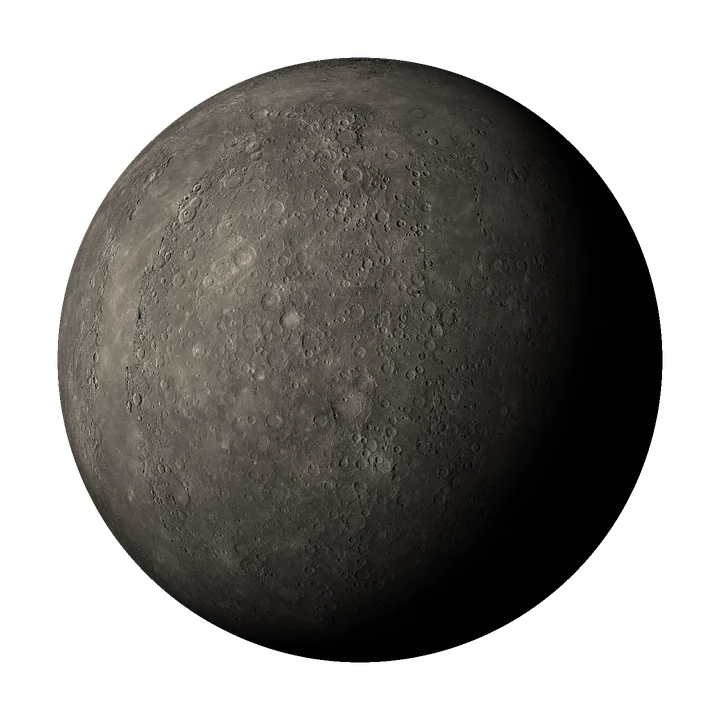
Mercury Live
Mercury is 175.0 million km from Earth right now, so its light takes 9 minutes 44 seconds to reach us. It is in Libra, in the morning sky before sunrise.
LiveWorked out for
Mercury's next best view
Mercury will be 18° from the Sun in the evening sky, its best view for weeks: look low in the west after sunset. What is greatest elongation?
Next superior conjunction: 1 January 2027. Mercury will pass behind the Sun, at its farthest from us.
Mercury tonight
Choose a place to see tonight's times
 MercuryMorning sky, before sunriseChoose a place for the times where you are
"Visible" means at least 7° above the horizon while the sky is dark. Mercury looks like a bright star that does not twinkle.
Where Mercury is now
Seen from above the Solar System at 09:50 UTC on 28 November 2026. The dashed line is the 175.0 million km between Earth and Mercury.
Mercury is 57.0 million km from the Sun. It is closer to the Sun than Earth, so it always appears near the Sun in our sky: it swings from the evening sky to the morning sky and back. Distances on the drawing are squeezed so the orbits fit.
Spacecraft at Mercury
Mercury at a glance
- Diameter
- 4,879 km
- Day
- 176 Earth days (sunrise to sunrise)
- Year
- 88 Earth days
- Moons
- None
- Average distance from the Sun
- 57.9 million km
- Temperature
- From −180 °C at night to 430 °C by day
Mercury is the smallest planet and the closest to the Sun. It never strays far from the Sun in our sky, so look low after sunset or before sunrise when it is at its greatest elongation.
Frequently Asked Questions
Explore more




Cite this page
Pick a style, then copy it or download it for your reference manager.Orbital Radar. (2026, November 28). Mercury Live: Distance and Visibility Tonight. Retrieved November 28, 2026, from https://orbitalradar.com/planets/mercury
“Mercury Live: Distance and Visibility Tonight.” Orbital Radar, 28 Nov. 2026, orbitalradar.com/planets/mercury. Accessed 28 Nov. 2026.
Orbital Radar (2026) Mercury Live: Distance and Visibility Tonight. Available at: https://orbitalradar.com/planets/mercury (Accessed: 28 November 2026).
Orbital Radar. “Mercury Live: Distance and Visibility Tonight.” Last modified November 28, 2026. https://orbitalradar.com/planets/mercury.
@misc{orbitalradar_planets_mercury,
  author       = {{Orbital Radar}},
  title        = {Mercury Live: Distance and Visibility Tonight},
  year         = {2026},
  month        = nov,
  howpublished = {\url{https://orbitalradar.com/planets/mercury}},
  url          = {https://orbitalradar.com/planets/mercury},
  urldate      = {2026-11-28},
  note         = {Accessed 2026-11-28}
}
TY - ELEC AU - Orbital Radar, TI - Mercury Live: Distance and Visibility Tonight PY - 2026 DA - 2026/11/28 PB - Orbital Radar UR - https://orbitalradar.com/planets/mercury Y2 - 2026/11/28 LA - en ER -
Live figures change, so keep the date you accessed the page. How to cite Orbital Radar