Fire Rainbow Over West Virginia: A Rare Atmospheric Phenomenon
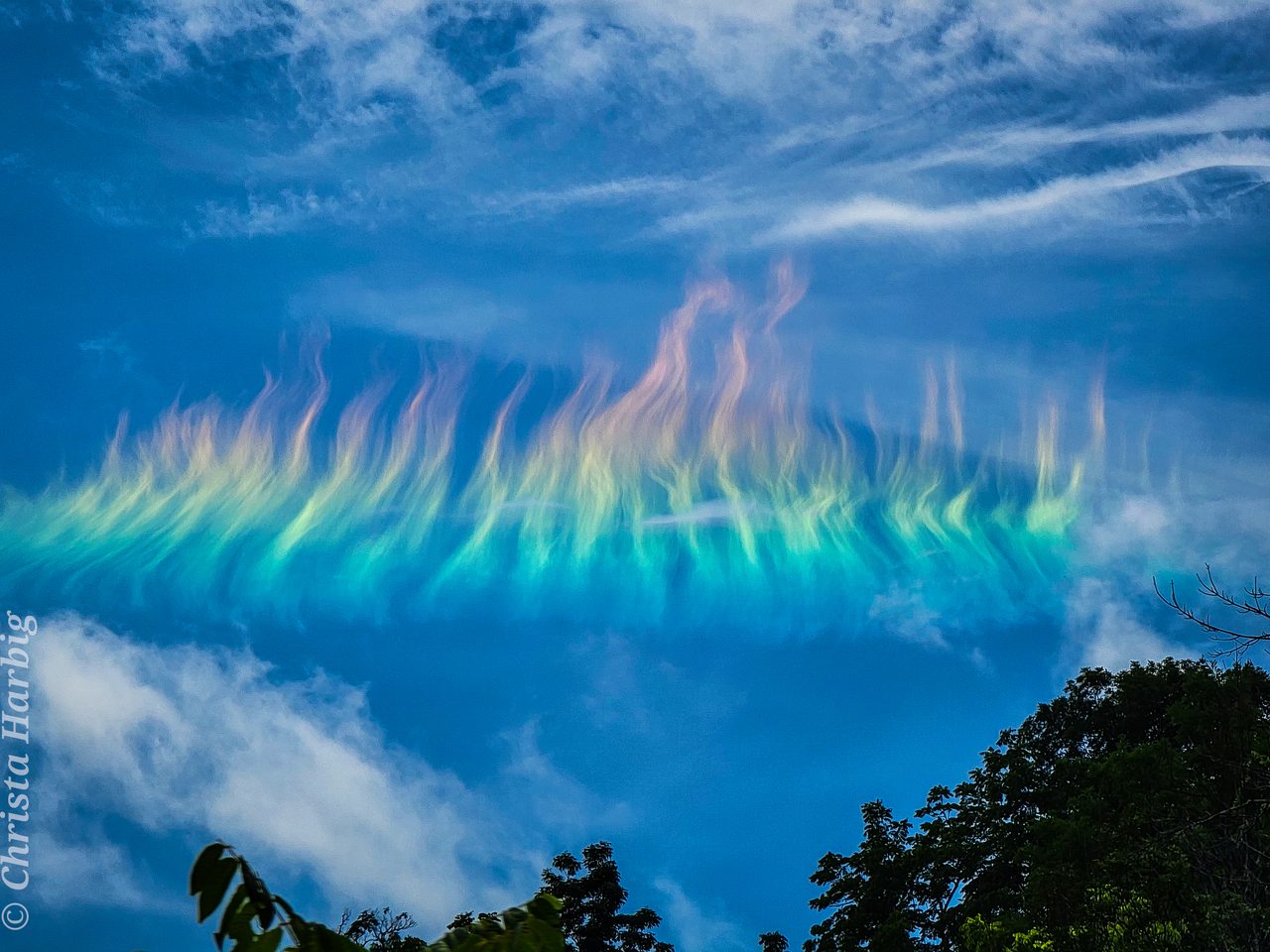
A fire rainbow, or circumhorizon arc, dazzled the skies over West Virginia. Learn how ice crystals in cirrus clouds create this rare spectacle.
The image captures a rare atmospheric spectacle known as a fire rainbow, or more scientifically, a circumhorizon arc. This optical phenomenon occurs when sunlight refracts through hexagonal ice crystals in cirrus clouds, creating a spectrum of colours parallel to the horizon. For such an arc to appear, the Sun must be positioned at least 58 degrees above the horizon, a condition met in the skies over West Virginia in 2021 when this photograph was taken. The alignment of the ice crystals is crucial, as they must be horizontally aligned to refract light uniformly, giving rise to the arc's distinctive flame-like appearance.
The Science Behind the Spectacle
Circumhorizon arcs are a testament to the intricate interplay between sunlight and atmospheric conditions. These arcs are relatively rare due to the specific alignment required of both the Sun and the cirrus clouds. The phenomenon is a reminder of the complex dynamics at play in our atmosphere, similar to how orbital mechanics govern the movement of satellites and debris in space. Currently, there are 18,515 active satellites in orbit, with a significant portion belonging to the Starlink constellation. Understanding these dynamics is crucial for maintaining the safety and functionality of our increasingly crowded skies.
Observing Tips and Further Exploration
Witnessing a fire rainbow is a matter of timing and location. Observers should look for high-altitude cirrus clouds on days when the Sun is high in the sky. While these arcs are a rare treat, similar atmospheric phenomena can be explored through tools like the Satellite Eye, which offers real-time satellite imagery. For those interested in tracking the movement of satellites, the Pass Predictor provides valuable insights into when and where these objects will be visible.
Frequently Asked Questions
What causes a fire rainbow?
How rare are fire rainbows?
📎 Cite this article
Orbital Radar Newsroom. (2026). Fire Rainbow Over West Virginia: A Rare Atmospheric Phenomenon. Orbital Radar. https://orbitalradar.com/blog/cosmic-gallery-2026-05-15"Fire Rainbow Over West Virginia: A Rare Atmospheric Phenomenon." Orbital Radar, 15 May 2026, https://orbitalradar.com/blog/cosmic-gallery-2026-05-15.@misc{orbitalradar_cosmic_gallery_2026_05_15,
title = {Fire Rainbow Over West Virginia: A Rare Atmospheric Phenomenon},
author = {{Orbital Radar}},
year = {2026},
howpublished = {\url{https://orbitalradar.com/blog/cosmic-gallery-2026-05-15}}
}