Analemma and Ancient Stones: A Year in the Sky
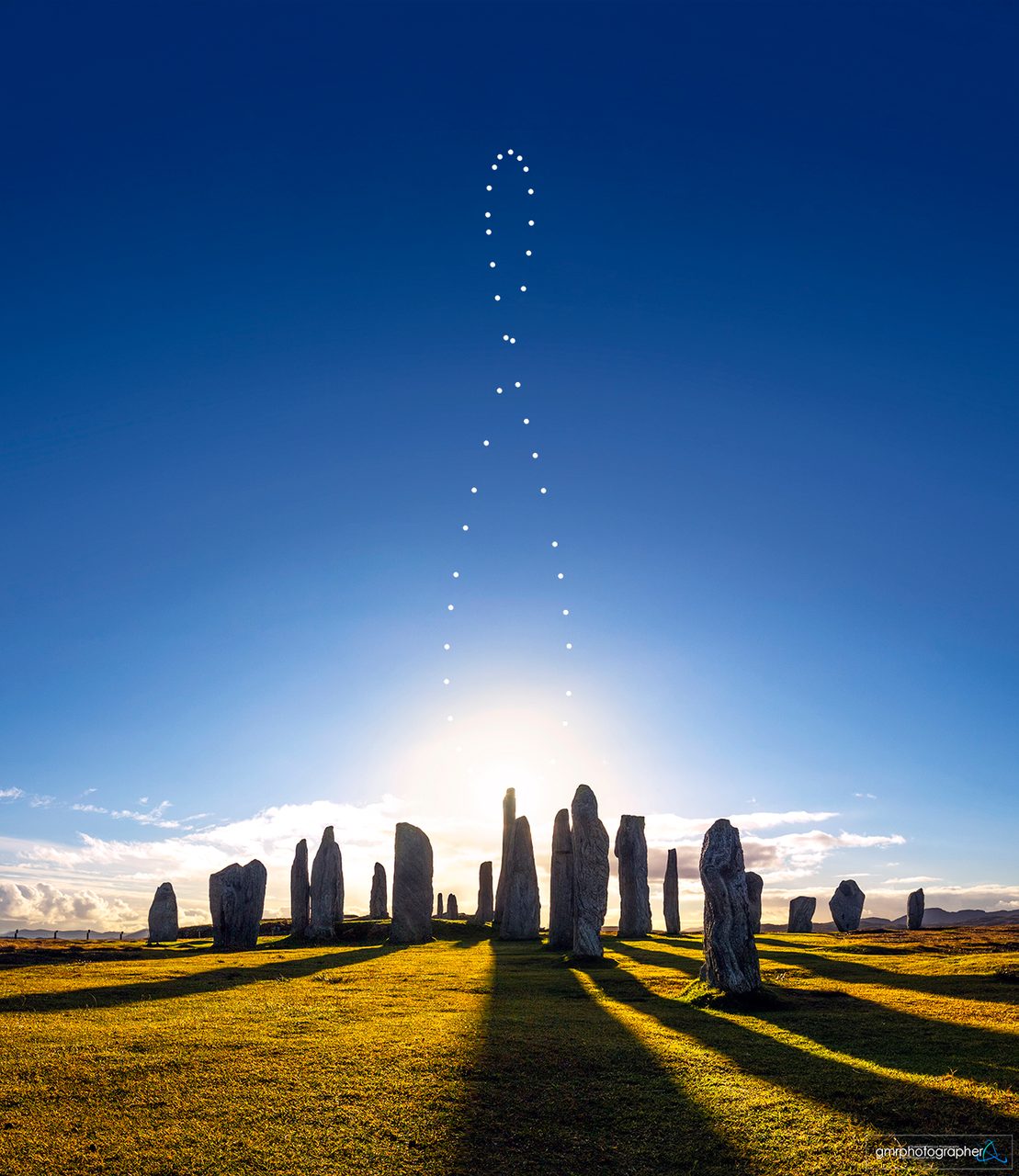
The analemma over the Callanish Stones reveals the Sun's shifting position throughout the year, highlighting Earth's axial tilt and orbital dynamics.
| Active satellites | 15,730 |
| Catalogued objects | 31,448 |
| Starlink active | 9,845 |
Today's image captures an analemma above the Callanish Stones, a megalithic site in Scotland. An analemma is a composite photograph showing the Sun's position at the same time over a year. This celestial figure-8 results from Earth's axial tilt and elliptical orbit, with solstices and equinoxes marking key points. The Callanish Stones, dating back to 2700 BC, add historical intrigue, though their astronomical purpose remains speculative.
The Science Behind the Analemma
The analemma's figure-8 shape is a product of two factors: Earth's axial tilt and its elliptical orbit around the Sun. As Earth orbits, the Sun's apparent position shifts, creating this unique pattern. The solstices appear at the analemma's extremities, while equinoxes are near the middle. This phenomenon provides insight into Earth's orbital mechanics, a subject explored in our Space Academy.
Observing and Understanding
To observe an analemma, one must photograph the Sun from the same location at the same time over a year. This requires patience and precision. For those interested in tracking celestial movements, tools like the Sun Globe can offer real-time solar positions and phases, enhancing understanding of solar dynamics.
Frequently Asked Questions
What causes the analemma's shape?
Do the Callanish Stones have astronomical significance?
📎 Cite this article · data available
Orbital Radar Newsroom. (2026). Analemma and Ancient Stones: A Year in the Sky. Orbital Radar. https://orbitalradar.com/blog/cosmic-gallery-2026-09-21"Analemma and Ancient Stones: A Year in the Sky." Orbital Radar, 21 September 2026, https://orbitalradar.com/blog/cosmic-gallery-2026-09-21.@misc{orbitalradar_cosmic_gallery_2026_09_21,
title = {Analemma and Ancient Stones: A Year in the Sky},
author = {{Orbital Radar}},
year = {2026},
howpublished = {\url{https://orbitalradar.com/blog/cosmic-gallery-2026-09-21}}
}