Saturn's Six Moons: A Celestial Family Portrait
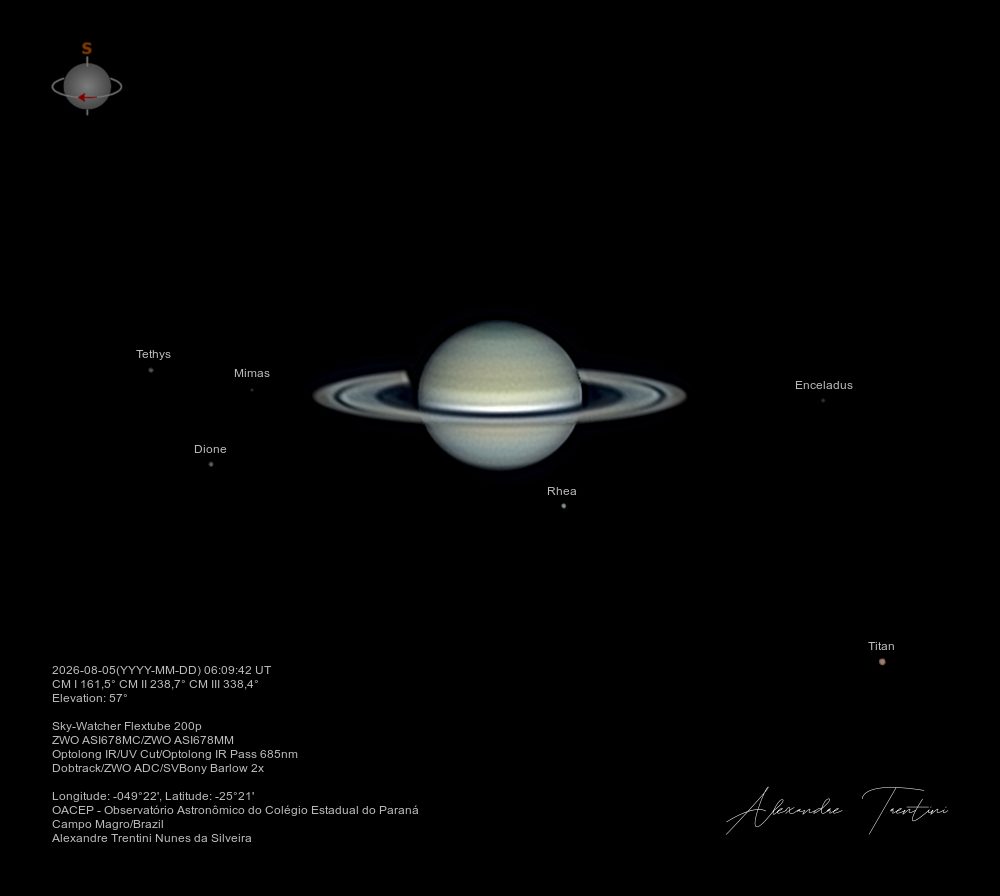
A telescopic image captures Saturn's six largest moons, showcasing the diversity of its 293 satellites. Learn about these celestial bodies and their significance.
Captured in a striking telescopic image, six of Saturn's largest moons are on display, offering a glimpse into the complexity of the ringed planet's satellite system. As of June 2026, Saturn boasts 293 confirmed moons, surpassing Jupiter's count of 115. This image, taken on August 5, highlights Titan, Saturn's largest moon, which is even bigger than Mercury. Alongside Titan, the icy moons Mimas, Tethys, Enceladus, Dione, and Rhea are visible, each contributing to our understanding of planetary formation and dynamics.
Saturn's Expanding Lunar Family
Saturn's moons vary widely in size and composition, with many being small, irregular satellites in tilted orbits. The discovery of these moons has been significantly aided by missions such as Voyager and Cassini, which have provided detailed data on their characteristics and interactions. The gravitational influence of these moons plays a crucial role in shaping Saturn's rings and contributes to the planet's complex gravitational field. For those interested in the broader context of Saturn's moons, the Space Agencies directory offers insights into the missions that have expanded our knowledge of this distant world.
Observing Saturn's Moons
For amateur astronomers, observing Saturn and its moons can be a rewarding experience. With a moderate telescope, viewers can spot Titan and some of the larger moons. To plan your observation, the Orbital Radar pass predictor can help determine the best viewing times based on your location. This tool provides real-time data on the position and visibility of celestial objects, making it easier to catch a glimpse of Saturn's fascinating lunar companions.
Frequently Asked Questions
How many moons does Saturn have?
Which is Saturn's largest moon?
📎 Cite this article
Orbital Radar Newsroom. (2026). Saturn's Six Moons: A Celestial Family Portrait. Orbital Radar. https://orbitalradar.com/blog/cosmic-gallery-2026-05-18"Saturn's Six Moons: A Celestial Family Portrait." Orbital Radar, 18 May 2026, https://orbitalradar.com/blog/cosmic-gallery-2026-05-18.@misc{orbitalradar_cosmic_gallery_2026_05_18,
title = {Saturn's Six Moons: A Celestial Family Portrait},
author = {{Orbital Radar}},
year = {2026},
howpublished = {\url{https://orbitalradar.com/blog/cosmic-gallery-2026-05-18}}
}