How Long Does It Take to Get to Mars?
Getting to Mars usually takes seven to nine months. The journey depends on where both planets will be at arrival, not simply how far apart they are at launch.
| Active satellites | 15,894 |
| Starlink active | 10,038 |
| Catalogued objects | 31,852 |
| Active close approaches | 14 |
| People in space | 10 |
Getting to Mars typically takes seven to nine months with conventional spacecraft. The exact launch-to-arrival time depends on the mission and its trajectory (the path a spacecraft follows through space).
Favourable launch opportunities recur roughly every 26 months, when Earth and Mars are suitably aligned. A spacecraft does not head straight towards Mars’s current position: it follows a path around the Sun designed to meet the planet where it will be on arrival.
Mars travel is distinct from the orbital activity closer to home. As of 25 October 2026, 15,894 active satellites were in orbit, according to Orbital Radar tracking data. Orbital Radar tracking data recorded 10 people in space on 25 October 2026; that figure is not a count of travellers to Mars.
This guide covers launch to arrival at Mars, not the duration of an entire expedition. Landing, surface operations and returning to Earth introduce separate constraints. Orbital Radar’s Mars globe provides a planetary reference as you explore how those journeys work.
Why does getting to Mars usually take seven to nine months?
Seven to nine months is a useful planning range for conventional missions to Mars because a fuel-efficient journey follows a long, curved path around the Sun. It is not a fixed timetable or a physical minimum: the duration depends on the departure conditions and the trajectory chosen for the mission.
An initial departure burn (a period of engine firing) puts the spacecraft onto its interplanetary path. Most of the journey is then spent coasting around the Sun, with smaller course corrections along the way. Coasting does not mean stopping: the spacecraft continues moving under gravity without continuously firing its engines.
The standard starting point for understanding this journey is the Hohmann transfer in Orbital Radar’s glossary: an idealised, fuel-efficient route between circular orbits. Its elliptical path connects the smaller orbit with the larger one. Actual Mars missions use trajectories tailored to their objectives rather than following this simplified model exactly.
Orbital Radar tracking data recorded 15,894 active Earth-orbiting satellites on 25 October 2026. Orbital Radar’s live catalogue recorded 10,038 operational Starlink satellites on 25 October 2026. Those Earth-orbiting populations are distinct from spacecraft making an interplanetary crossing.
For Mars, the key distinction is between journey time and engine-running time. A months-long flight mostly reflects the solar orbit selected for the crossing, not months of continuous powered flight.
Why do Mars launch windows come roughly every 26 months?
Mars launch opportunities recur roughly every 26 months because Earth travels faster on its inner orbit, repeatedly gaining on Mars until favourable departure geometry returns. Earth circles the Sun in about one year, while Mars takes about 687 days, so their relative positions follow a repeating cycle.
A launch window is a period when departure can meet a mission’s trajectory, energy and arrival requirements. The planets need not be at their closest: the useful arrangement depends on where Mars will be when the spacecraft arrives, rather than where it is at launch.
The roughly 26-month cycle is not the length of an individual mission’s launch period. That shorter period typically spans weeks, with its boundaries set by rocket capability, spacecraft fuel and acceptable arrival conditions. Orbital Radar’s launch schedule provides a way to follow announced mission departures.
Missing that period can mean waiting for the next opportunity, not simply moving departure to the following month. As the geometry changes, the planned journey may require more energy than the spacecraft and rocket can supply.
These interplanetary constraints differ from those governing routine Earth-orbit launches. Orbital Radar tracking data recorded 15,894 active satellites in Earth orbit on 25 October 2026. Orbital Radar tracking data recorded 10 people in space on 25 October 2026. Neither level of activity removes the need for suitable Earth–Mars geometry.
Why can't a spacecraft just point at Mars and go?
A spacecraft cannot simply point at Mars because both planets keep moving throughout the flight. It must aim for where Mars will be at arrival, not where the planet appears at launch. The departing spacecraft also carries Earth's orbital motion: it is already travelling around the Sun before its engines change that path.
An interplanetary trajectory is therefore an orbit around the Sun designed to intersect Mars's future position. A Hohmann transfer (an elliptical orbit connecting different orbital distances) illustrates this principle. Mission planners choose the departure direction and speed so that spacecraft and planet reach the meeting point together.
Unlike fictional journeys with continuous acceleration, conventional chemical-propulsion missions use engine burns separated by long coasting phases. The departure burn establishes the interplanetary path; smaller correction burns refine it. Coasting does not mean stopping: gravity keeps bending the spacecraft's moving trajectory.
Orbital Radar tracking data lists 15,894 active Earth satellites as of 25 October 2026. Orbital Radar's live catalogue contains 31,852 objects, including debris, on that date. These Earth-orbiting populations are distinct from spacecraft following interplanetary paths around the Sun.
Arrival geometry matters just as much as departure. A trajectory that reaches Mars's vicinity may produce only a flyby if its direction or speed is unsuitable. Entering orbit requires losing enough speed relative to Mars to become gravitationally bound; landing requires a controlled approach and further deceleration. Simply crossing the planet's orbital path achieves neither.
Does launching when Mars is closest make the trip shorter?
No. Launching when Mars is closest to Earth does not necessarily shorten the journey. Closest approach means the smallest separation between the planets during that encounter; opposition means Mars appears opposite the Sun in Earth's sky. These events occur near each other, but their dates need not coincide.
A suitable departure opportunity is different: it depends on where Mars will be when the spacecraft arrives. In a fuel-efficient Hohmann transfer (an elliptical path between orbital distances), the spacecraft leaves Earth while Mars is ahead, then meets it farther around the Sun. Waiting for minimum separation can mean missing that favourable geometry.
Dividing today's separation by a quoted spacecraft speed therefore gives a misleading answer. The spacecraft follows a curved trajectory, not the straight line between today's planetary positions. Its speed changes under solar gravity, and its arrival speed must suit the intended encounter, whether a flyby, orbit insertion or landing.
Orbital Radar tracking data lists 15,894 active Earth satellites as of 25 October 2026. Orbital Radar's live catalogue contains 31,852 objects, including debris, as of 25 October 2026. Those Earth-orbit counts do not describe interplanetary routes: for Mars, trajectory length, changing speed and arrival conditions must be considered together. Orbital Radar's Mars globe provides planetary context.
Could a more powerful rocket get to Mars faster?
Yes: a more powerful rocket can put a spacecraft on a higher-energy departure trajectory, shortening some journeys to Mars. But that usually means accepting less payload, using more propellant, or reaching Mars at a higher speed that the mission must accommodate.
The launch vehicle supplies the capability to lift the mission from Earth and send it towards Mars, sometimes through an upper-stage engine burn. The spacecraft’s own propulsion system handles course corrections and any planned braking manoeuvres. These are distinct roles: a launcher’s lifting capacity alone does not determine transit time.
Extra propellant is not a free solution. Propellant adds mass, which itself needs accelerating, while larger tanks and supporting hardware add further weight. Within a launcher’s limits, carrying more fuel can mean carrying fewer instruments or supplies; faster arrival can also increase the braking requirement.
Chemical propulsion, which releases energy through chemical reactions, is established technology for Mars departures and spacecraft manoeuvres. Proposed nuclear thermal propulsion would heat propellant using a reactor; electric propulsion accelerates charged particles efficiently but generally produces low thrust. Neither label justifies a fixed, shorter journey-time promise without a specific spacecraft and trajectory.
Orbital Radar’s launch vehicle guide provides context on launcher roles, distinct from the spacecraft they deliver. Orbital Radar tracking data lists 2,205 rocket bodies as of 25 October 2026. Orbital Radar tracking data lists 18,907 payloads as of 25 October 2026. That catalogue distinction helps illustrate why launch hardware and mission spacecraft should not be treated as interchangeable.
Does reaching Mars mean entering orbit or landing?
Reaching Mars can mean flying past it, entering orbit or landing on its surface: these are different endpoints for a journey time. A flyby carries a spacecraft past the planet without remaining there; an orbiter must be captured by Mars’s gravity, while a lander must also reach the ground safely.
Orbital insertion means slowing relative to Mars sufficiently to become gravitationally bound rather than continuing past it. This usually requires a carefully timed propulsion manoeuvre: an engine burn that changes the spacecraft’s speed and trajectory. Reaching Mars’s vicinity is therefore not the same as successfully entering orbit.
Landing requires atmospheric entry and a controlled surface descent. The atmosphere helps remove speed, but it also produces intense heating; the spacecraft must then shed enough remaining speed to touch down safely. Arrival speed influences that challenge because a faster approach means more energy must be dissipated. A lander need not enter orbit first: it can arrive directly from its interplanetary trajectory.
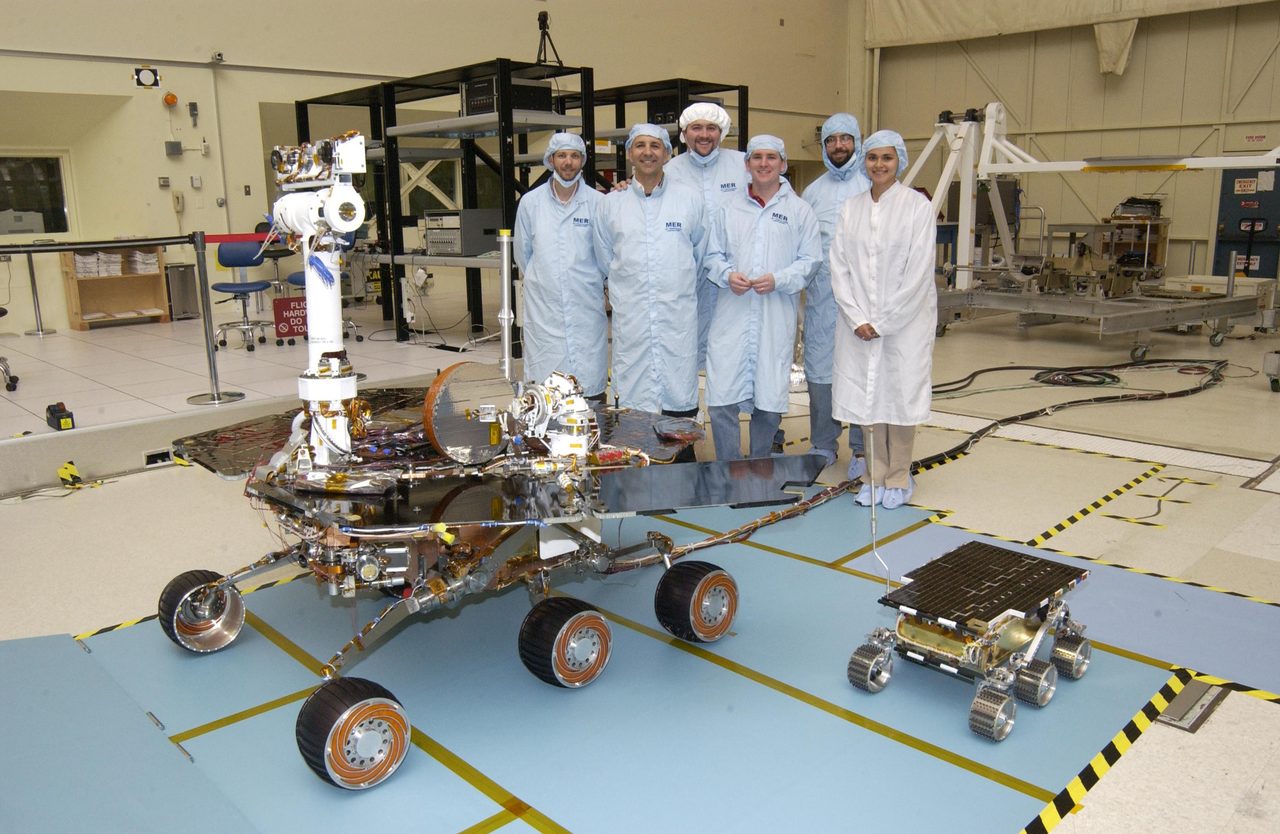
Perseverance and Curiosity are landed missions, with heat shields, parachutes and rocket-powered descent systems used to reach the surface. Orbital Radar’s Mars rovers page provides mission context for both. When comparing travel times, distinguish the interplanetary cruise from landing operations and initial surface commissioning—the checks and preparations before routine work begins. Touchdown does not mean a rover is immediately ready to drive and conduct science.
Would astronauts take longer than robotic spacecraft?
Not necessarily: astronauts and robotic spacecraft obey the same orbital mechanics, but their acceptable risks and mission priorities differ. A crewed mission might prioritise a shorter crossing to protect its passengers, whereas a robotic mission can accept a longer journey to conserve propellant or meet its scientific objectives.
Orbital Radar tracking data recorded 10 people in space on 25 October 2026. That figure describes the current population in space, not astronauts travelling to Mars; no crewed Mars journey is under way.
For astronauts, transit time affects radiation exposure and the demands placed on life support. Longer journeys require more food, sufficient water and dependable recycling systems, while equipment must operate without rapid resupply or rescue. Isolation and the physical effects of prolonged weightlessness also make time in transit consequential.
A faster crossing could reduce those burdens, but achieving it introduces competing demands. Depending on the design, greater speed can require more propellant, more capable propulsion and additional capacity to slow down at Mars. Radiation shielding, supplies and backup equipment add mass, which itself makes the spacecraft harder to accelerate.
The resulting timetable therefore depends on the propulsion system, trajectory, protection measures and acceptable risks chosen for a particular mission. Seven to nine months is not an agreed timetable for a future crewed mission whose architecture remains unfixed. Robotic journeys, explored through Orbital Radar’s Mars rovers page, provide useful comparisons, but they are not schedules that a human mission must copy.
How long would a Mars mission take including the return?
A fuel-efficient crewed Mars mission could take roughly two to three years, including the outward cruise, a substantial surface stay and the journey home. The return is another interplanetary transfer (a flight between planetary orbits), not an immediate reversal of the outbound route.
Earth and Mars continue moving around the Sun while the crew travels and works on the surface. After arrival, astronauts may need to wait many months before the planets reach positions that allow a return with manageable fuel requirements.
The mission therefore needs three separate allowances: outbound transit, surface operations and inbound transit. Surface time would support exploration, equipment maintenance and preparations for departure; it is not simply spare time added to a one-way cruise.
Shorter-stay concepts change that balance rather than eliminate it. Depending on the trajectory, they can require more propulsion energy, a longer return flight or different arrival and departure conditions, with consequences for spacecraft mass, supplies and crew exposure.
Orbital Radar's Mars Sample Return overview illustrates the additional stages: collecting material is distinct from launching it off Mars, transferring it to an Earth-bound spacecraft and delivering it safely. Those stages do not imply a fixed programme schedule.
Orbital Radar tracking data records 10 people in space as of 25 October 2026. Orbital Radar tracking data also records 15894 active satellites in Earth orbit as of 25 October 2026. That activity should not be confused with experience of sustaining crews through a Mars round trip.
How can I explore Mars and follow missions on Orbital Radar?
Use Orbital Radar’s live Mars globe to explore the planet, then follow launch listings and individual mission timelines to understand when spacecraft depart and arrive. The visual globe is an exploration tool, not a calculated departure window or a spacecraft arrival forecast: viewing Mars live does not tell you how long a particular journey will take.
Orbital Radar tracking data listed 15,894 active satellites in orbit on 25 October 2026. That active-satellite total is not a count of spacecraft travelling to Mars, and it should not be used to infer how many Mars missions are under way.
The launch schedule at /launch-schedule lists upcoming missions, while /satellite-launch-log provides historical launch records. A launch date marks departure from Earth, not arrival at Mars; an arrival date must come from the relevant mission timeline. Orbital Radar’s /mars-rovers page adds surface-exploration context, complementing the globe’s planetary view and the launch records’ chronology.
Orbital Radar tracking data’s total of 15,894 active satellites on 25 October 2026 is an orbital inventory, not a Mars cruise-duration forecast. Keep the practical distinction clear: explore Mars live with the globe, follow a listed departure through the launch schedule, and obtain a mission-specific cruise duration from its planned or recorded departure and arrival dates. Those are different questions, answered by different kinds of information.
Key takeaways
- A conventional journey to Mars typically takes seven to nine months, depending on the trajectory and mission requirements.
- Favourable launch opportunities recur roughly every 26 months because Earth and Mars must have suitable orbital alignment.
- Spacecraft intercept Mars's future position, and faster journeys can demand more departure energy and more difficult arrival manoeuvres.
- A return expedition must account for surface operations and a separate return opportunity, not just double the outbound travel time.
Frequently Asked Questions
How long did Perseverance take to reach Mars?
How long does a radio message take to travel from Mars to Earth?
Can a spacecraft reach Mars without carrying astronauts?
Do spacecraft engines run throughout the journey to Mars?
Could a Mars mission refuel in space before leaving Earth?
📎 Cite this article · data available
Orbital Radar Newsroom. (2026). How Long Does It Take to Get to Mars?. Orbital Radar. https://orbitalradar.com/blog/how-long-to-get-to-mars"How Long Does It Take to Get to Mars?." Orbital Radar, 25 October 2026, https://orbitalradar.com/blog/how-long-to-get-to-mars.@misc{orbitalradar_how_long_to_get_to_mars,
title = {How Long Does It Take to Get to Mars?},
author = {{Orbital Radar}},
year = {2026},
howpublished = {\url{https://orbitalradar.com/blog/how-long-to-get-to-mars}}
}