RCW 86: Tracing the Echoes of an Ancient Supernova
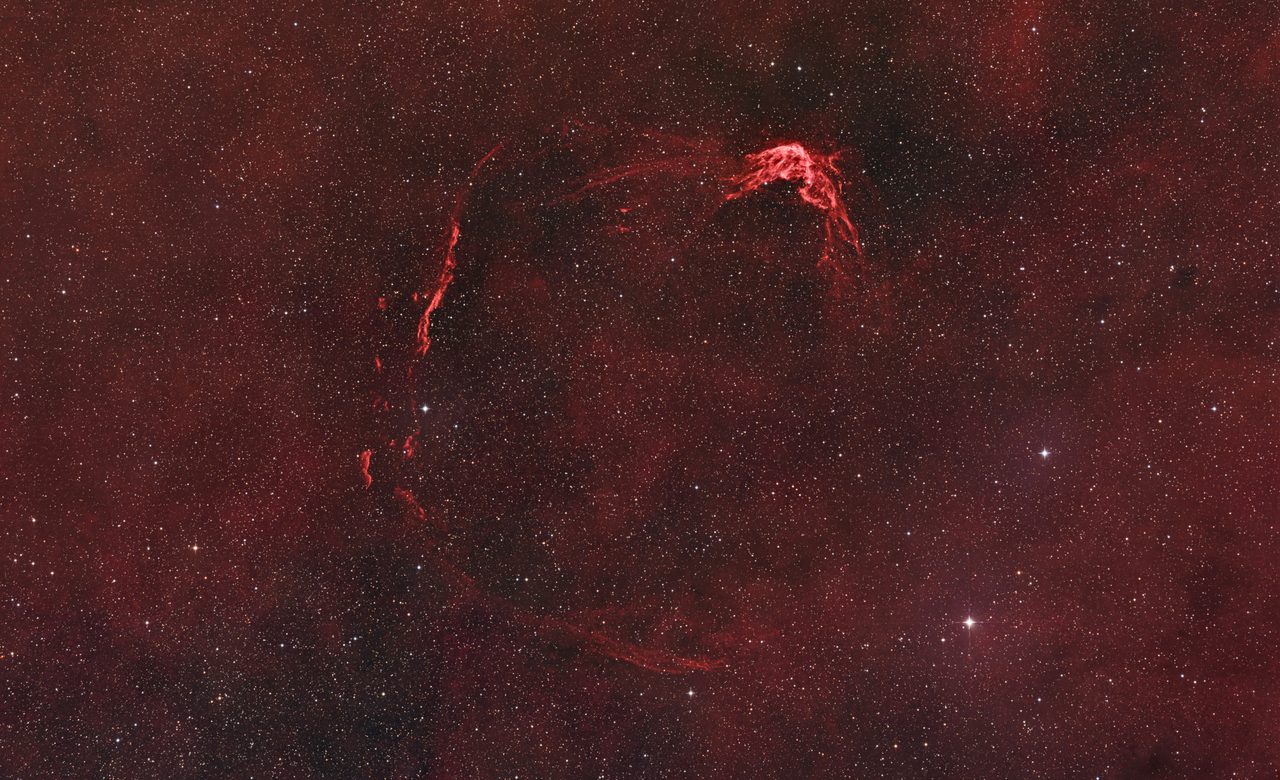
Discover RCW 86, the remnant of the earliest recorded supernova from 185 AD, offering clues to its Type Ia origin.
The image of RCW 86 presents a fascinating glimpse into the remnants of the earliest recorded supernova, first observed by Chinese astronomers in 185 AD. This supernova, identified in the Nanmen asterism, is now located in the southern constellation Centaurus. The nebula's faint, wispy outlines are the aftermath of a stellar explosion, catalogued as RCW 86. This remnant is the result of interstellar gas ionised by the supernova's expanding shock wave, stretching across 100 light-years and situated 8,000 light-years from Earth.
Space-based observations have detected an abundance of iron within RCW 86, with no neutron star or pulsar present, indicating a Type Ia supernova origin. Unlike core-collapse supernovae, which involve the explosion of massive stars, Type Ia supernovae occur when a white dwarf star in a binary system accretes enough material from its companion to trigger a thermonuclear detonation. This process leaves behind a nebula that is visible today through telescopic imaging, though it remains too faint for naked-eye observation.
Connecting the Dots in Space Science
RCW 86 offers astronomers a unique opportunity to study the dynamics of Type Ia supernovae, which play a crucial role in understanding cosmic distances and the expansion of the universe. These supernovae serve as standard candles in astronomy, helping scientists measure vast cosmic distances due to their consistent luminosity.
The study of supernova remnants like RCW 86 also contributes to our understanding of the interstellar medium (ISM), the matter that exists between stars. The shock waves from such explosions can trigger the formation of new stars by compressing the ISM, thus playing a pivotal role in the galactic life cycle. For those interested in tracking the movement of celestial objects, the Orbital Radar pass predictor provides insights into visible satellite passes and other astronomical phenomena.
Frequently Asked Questions
What is RCW 86?
Why is RCW 86 significant?
📎 Cite this article
Orbital Radar Newsroom. (2026). RCW 86: Tracing the Echoes of an Ancient Supernova. Orbital Radar. https://orbitalradar.com/blog/cosmic-gallery-2026-05-10"RCW 86: Tracing the Echoes of an Ancient Supernova." Orbital Radar, 10 May 2026, https://orbitalradar.com/blog/cosmic-gallery-2026-05-10.@misc{orbitalradar_cosmic_gallery_2026_05_10,
title = {RCW 86: Tracing the Echoes of an Ancient Supernova},
author = {{Orbital Radar}},
year = {2026},
howpublished = {\url{https://orbitalradar.com/blog/cosmic-gallery-2026-05-10}}
}