Exploring the Dark Doodad: A Cosmic Silhouette in Musca
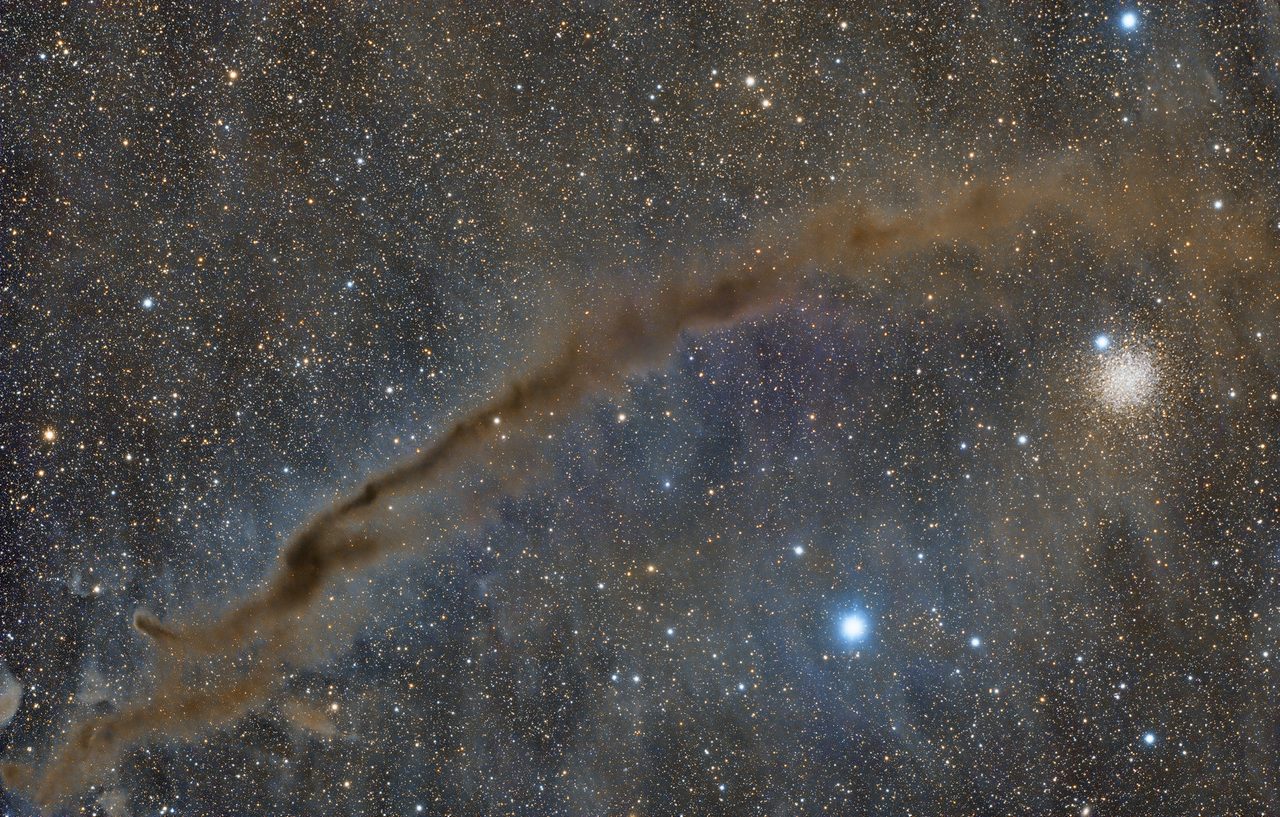
The Dark Doodad Nebula, a dusty interstellar cloud in Musca, offers a stunning view against the starry backdrop of NGC 4372, revealing the beauty of cosmic structures.
The Dark Doodad Nebula, a striking interstellar cloud, drifts through the constellation Musca, The Fly. This celestial feature is a favourite among amateur astronomers, stretching for about 3 degrees across the sky. Its silhouette is set against a backdrop of rich starfields, with the globular cluster NGC 4372 providing a contrasting point of interest. While the nebula itself is about 700 light-years away, NGC 4372 is a distant 20,000 light-years from Earth, highlighting the vast scales and distances in our galaxy.
The Science Behind the Shadows
The Dark Doodad Nebula is part of the Musca molecular cloud, a region where star formation may occur in the future. Its dark appearance is due to the dense dust blocking light from stars behind it, a phenomenon that allows astronomers to study the composition and structure of such clouds. The nebula's name, coined by Dennis di Cicco in 1986, adds a playful touch to its scientific significance. Observing such features helps scientists understand the life cycle of stars and the dynamics of our galaxy. For those interested in tracking the movements of satellites across the sky, the Orbital Radar pass predictor offers detailed information on visible passes.
Observing the Dark Doodad
To view the Dark Doodad Nebula, a pair of binoculars or a small telescope is recommended. The nebula is best seen from the Southern Hemisphere, where it appears near the Southern Cross. Observers should look for its elongated shape and the nearby yellowish hue of NGC 4372. The interplay of light and shadow in this region offers a captivating glimpse into the processes shaping our universe.
Frequently Asked Questions
What is the Dark Doodad Nebula?
How far is NGC 4372 from Earth?
📎 Cite this article
Orbital Radar Newsroom. (2026). Exploring the Dark Doodad: A Cosmic Silhouette in Musca. Orbital Radar. https://orbitalradar.com/blog/cosmic-gallery-2026-05-13"Exploring the Dark Doodad: A Cosmic Silhouette in Musca." Orbital Radar, 14 May 2026, https://orbitalradar.com/blog/cosmic-gallery-2026-05-13.@misc{orbitalradar_cosmic_gallery_2026_05_13,
title = {Exploring the Dark Doodad: A Cosmic Silhouette in Musca},
author = {{Orbital Radar}},
year = {2026},
howpublished = {\url{https://orbitalradar.com/blog/cosmic-gallery-2026-05-13}}
}