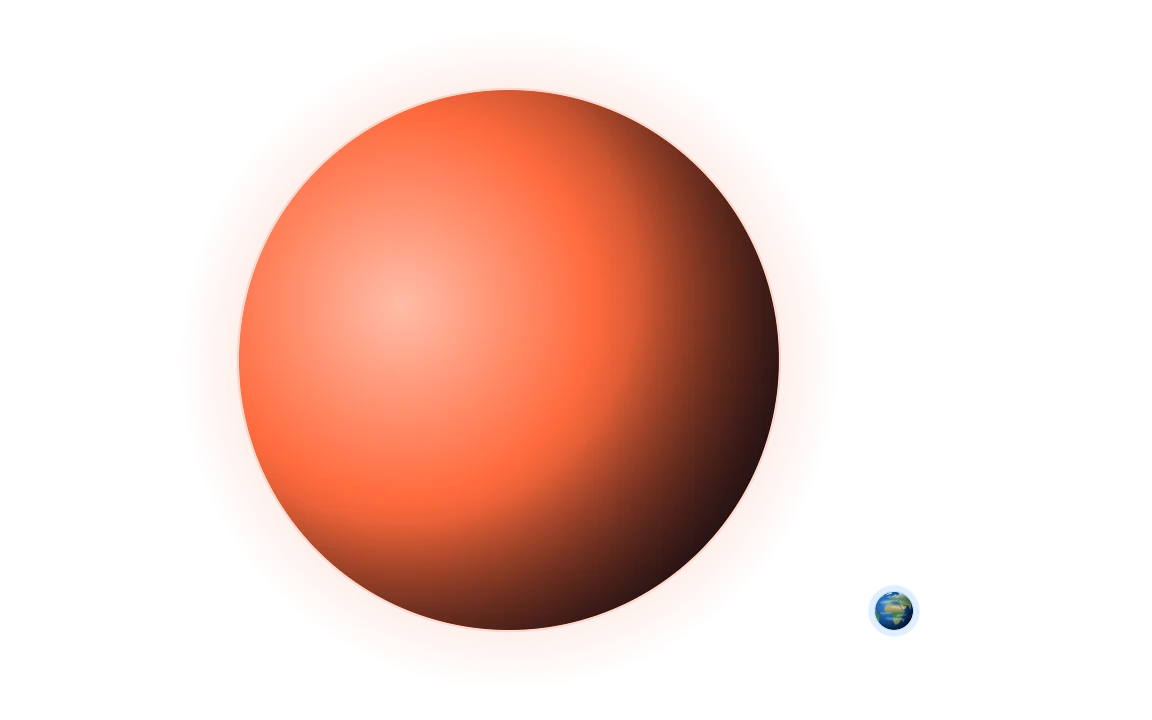
51 Pegasi b
51 Pegasi b is a giant planet 50.4 light-years away in Pegasus. It goes round 51 Pegasi every 4.2 days.
Find 51 Pegasi tonight
Choose a place to see tonight's times
 51 PegasiIn Pegasus, highest at midnight in SeptemberChoose a place for the times where you are
"Visible" means at least 7° above the horizon while the sky is dark. The planet itself cannot be seen: it is lost in its star’s glare.
The 51 Pegasi System
51 Pegasi b orbits 51 Pegasi, a yellow star like the Sun 1.2 times the Sun’s width. It is the only planet known in the system.
It is 0.052 AU from its star (an AU is the distance from Earth to the Sun). That is closer in than the habitable zone, the green band.
Light from 51 Pegasi takes 50.4 years to reach us. At the speed of Voyager 1, the trip would take about 889,000 years; even the fastest spacecraft ever launched would need about 78,900 years.
Distances are to scale; the planets are drawn much larger, at the same scale as each other.
How It Was Found and Studied
Found in 1995 by the ELODIE spectrograph on the 1.93-metre telescope at Haute-Provence Observatory in France, which measured the star’s wobble as the planet pulled on it.
- Year
- 1995
- Method
- Star wobble
The ELODIE spectrograph caught the star wobbling back and forth every 4.2 days, revealing the first planet found around a Sun-like star.
- Year
- 1995
The CRIRES spectrograph detected water vapour in the planet’s atmosphere by picking out the planet’s own faint infrared light.
- Year
- 2017
The upgraded CRIRES+ spectrograph confirmed the water vapour and gave a new estimate of the planet’s true mass, higher than earlier estimates and not yet checked by other measurements.
- Year
- 2026
Facts and Figures
- Star
- 51 Pegasi (G5V)
- Constellation
- Pegasus
- Distance
- 50.4 light-years
- Orbit
- 4.2 days, 0.052 AU
- Size
- ~14 × Earth
- Temperature
- 1048 °C (estimated)
- Discovered
- 1995, star wobble
51 Pegasi b is a giant gas planet, and it is famous as the first planet ever found orbiting a star like the Sun. Its discovery was announced in October 1995. It circles its star in just over four days, much closer than Mercury is to the Sun. Its two discoverers were awarded half of the 2019 Nobel Prize in Physics for the find.
Frequently Asked Questions
Explore more


Cite this page
Pick a style, then copy it or download it for your reference manager.Orbital Radar. (2026, November 19). 51 Pegasi b: Facts, Distance and Where to See Its Star. Retrieved November 28, 2026, from https://orbitalradar.com/exoplanets/51-pegasi-b
“51 Pegasi b: Facts, Distance and Where to See Its Star.” Orbital Radar, 19 Nov. 2026, orbitalradar.com/exoplanets/51-pegasi-b. Accessed 28 Nov. 2026.
Orbital Radar (2026) 51 Pegasi b: Facts, Distance and Where to See Its Star. Available at: https://orbitalradar.com/exoplanets/51-pegasi-b (Accessed: 28 November 2026).
Orbital Radar. “51 Pegasi b: Facts, Distance and Where to See Its Star.” Last modified November 19, 2026. https://orbitalradar.com/exoplanets/51-pegasi-b.
@misc{orbitalradar_exoplanets_51_pegasi_b,
  author       = {{Orbital Radar}},
  title        = {51 Pegasi b: Facts, Distance and Where to See Its Star},
  year         = {2026},
  month        = nov,
  howpublished = {\url{https://orbitalradar.com/exoplanets/51-pegasi-b}},
  url          = {https://orbitalradar.com/exoplanets/51-pegasi-b},
  urldate      = {2026-11-28},
  note         = {Accessed 2026-11-28}
}
TY - ELEC AU - Orbital Radar, TI - 51 Pegasi b: Facts, Distance and Where to See Its Star PY - 2026 DA - 2026/11/19 PB - Orbital Radar UR - https://orbitalradar.com/exoplanets/51-pegasi-b Y2 - 2026/11/28 LA - en ER -
Live figures change, so keep the date you accessed the page. How to cite Orbital Radar