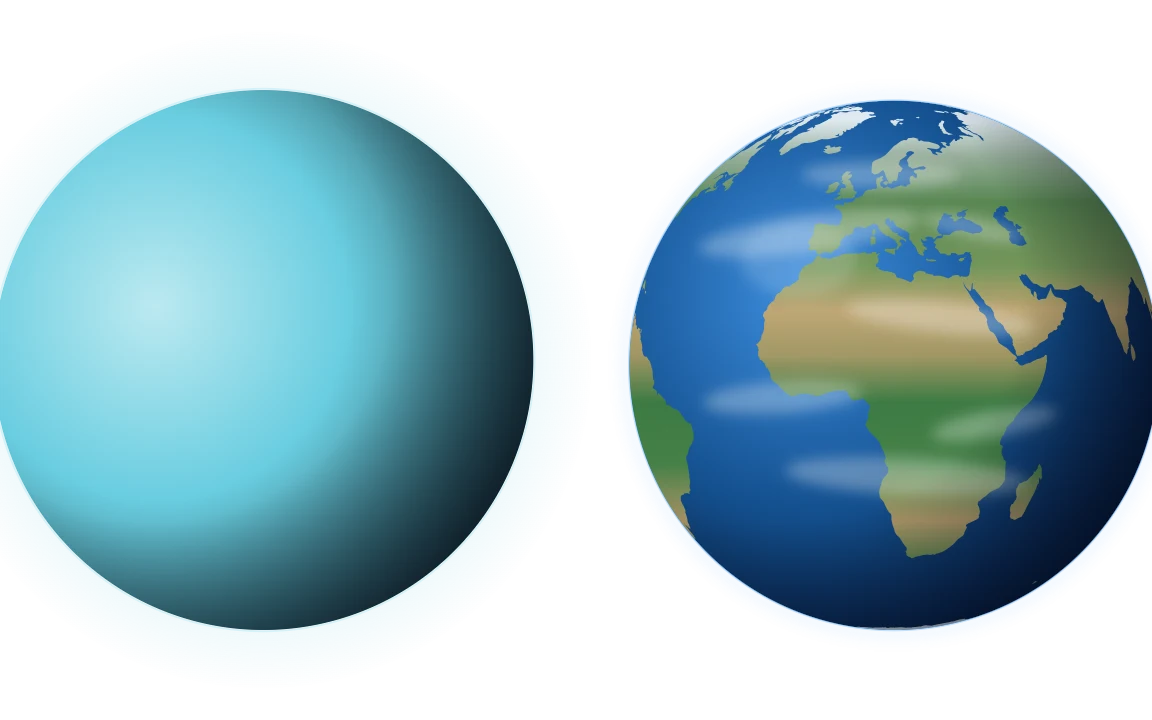
Proxima Centauri b
Proxima Centauri b is an Earth-sized planet 4.2 light-years away in Centaurus. It goes round Proxima Centauri every 11 days, inside the zone where liquid water could exist.
Find Proxima Centauri tonight
Choose a place to see tonight's times
 Proxima CentauriIn Centaurus, highest at midnight in AprilChoose a place for the times where you are
"Visible" means at least 7° above the horizon while the sky is dark. The planet itself cannot be seen: it is lost in its star’s glare.
The Proxima Centauri System
Proxima Centauri b orbits Proxima Centauri, a small red star 14% of the Sun’s width. One other planet is known in the system: Proxima Centauri d.
It is 0.048 AU from its star (an AU is the distance from Earth to the Sun). That puts it inside the habitable zone, the green band.
Light from Proxima Centauri takes 4.2 years to reach us. At the speed of Voyager 1, the trip would take about 75,000 years; even the fastest spacecraft ever launched would need about 6,600 years.
Distances are to scale; the planets are drawn much larger, at the same scale as each other.
How It Was Found and Studied
Found in 2016 by the HARPS instrument on a 3.6-metre telescope at La Silla in Chile, which measured the slight wobble the planet’s pull causes in its star.
- Year
- 2016
- Method
- Star wobble
The HARPS instrument at La Silla detected the star’s tiny wobble, revealing a planet that orbits every 11.2 days.
- Year
- 2016
The more precise ESPRESSO instrument on the Very Large Telescope confirmed the planet independently.
- Year
- 2020
The NIRPS instrument, which works in infrared light, detected the planet again and helped confirm its smaller sibling, Proxima d.
- Year
- 2025
Facts and Figures
- Star
- Proxima Centauri (M5.5 V)
- Constellation
- Centaurus
- Distance
- 4.2 light-years
- Orbit
- 11 days, 0.048 AU
- Size
- ~1.0 × Earth
- Mass
- >1.1 × Earth
- Temperature
- −24 °C (estimated)
- Discovered
- 2016, star wobble
Proxima Centauri b, usually shortened to Proxima b, is a planet at least as massive as Earth orbiting the closest star to the Sun, and it is the nearest known planet that might be habitable. It lies in its star’s habitable zone, the range of distances where a planet’s surface could be warm enough for liquid water. It has never been seen to pass in front of its star, so its size and whether it has an atmosphere are unknown.
Frequently Asked Questions
Explore more


Cite this page
Pick a style, then copy it or download it for your reference manager.Orbital Radar. (2026, November 19). Proxima Centauri b: Facts, Distance and Where to See Its Star. Retrieved November 28, 2026, from https://orbitalradar.com/exoplanets/proxima-centauri-b
“Proxima Centauri b: Facts, Distance and Where to See Its Star.” Orbital Radar, 19 Nov. 2026, orbitalradar.com/exoplanets/proxima-centauri-b. Accessed 28 Nov. 2026.
Orbital Radar (2026) Proxima Centauri b: Facts, Distance and Where to See Its Star. Available at: https://orbitalradar.com/exoplanets/proxima-centauri-b (Accessed: 28 November 2026).
Orbital Radar. “Proxima Centauri b: Facts, Distance and Where to See Its Star.” Last modified November 19, 2026. https://orbitalradar.com/exoplanets/proxima-centauri-b.
@misc{orbitalradar_exoplanets_proxima_centauri_b,
  author       = {{Orbital Radar}},
  title        = {Proxima Centauri b: Facts, Distance and Where to See Its Star},
  year         = {2026},
  month        = nov,
  howpublished = {\url{https://orbitalradar.com/exoplanets/proxima-centauri-b}},
  url          = {https://orbitalradar.com/exoplanets/proxima-centauri-b},
  urldate      = {2026-11-28},
  note         = {Accessed 2026-11-28}
}
TY - ELEC AU - Orbital Radar, TI - Proxima Centauri b: Facts, Distance and Where to See Its Star PY - 2026 DA - 2026/11/19 PB - Orbital Radar UR - https://orbitalradar.com/exoplanets/proxima-centauri-b Y2 - 2026/11/28 LA - en ER -
Live figures change, so keep the date you accessed the page. How to cite Orbital Radar