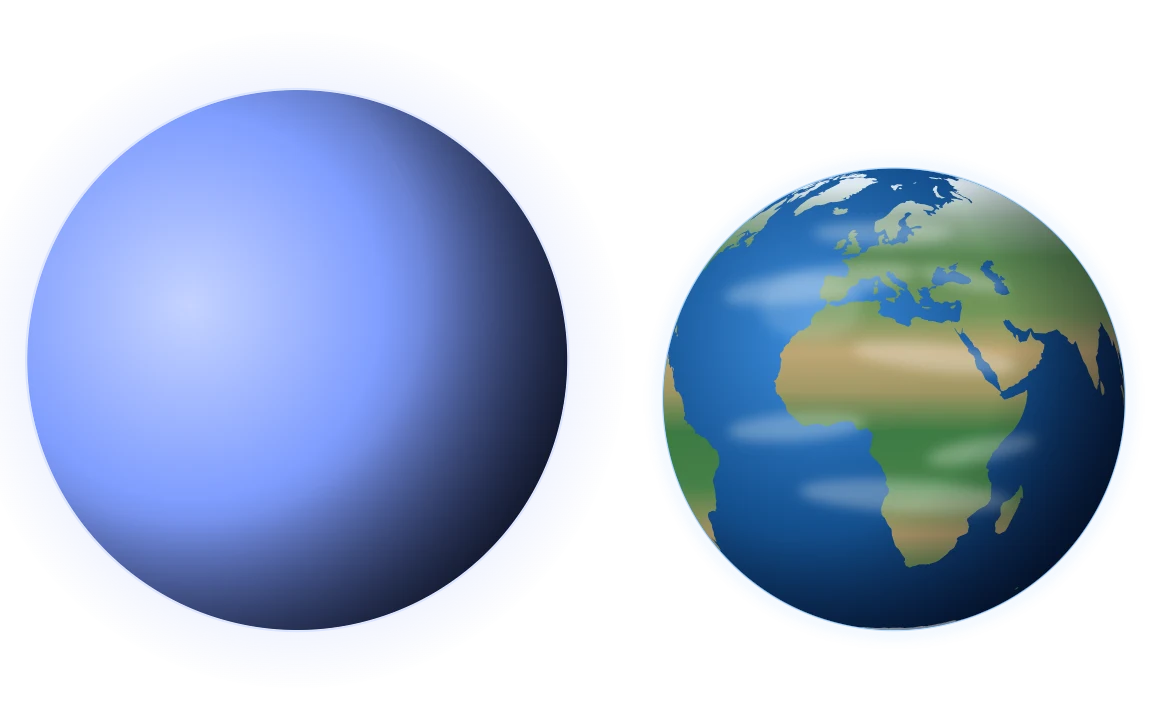
Kepler-186 f
Kepler-186 f is an Earth-sized planet 579 light-years away in Cygnus. It goes round Kepler-186 every 130 days, inside the zone where liquid water could exist.
When It Next Crosses Its Star
Kepler-186 f crosses the face of Kepler-186 every 130 days, as seen from Earth, dimming it by about 0.04% for about 5.6 hours.
Worked out from its orbit, so the real time may differ by up to 1.3 hours. Telescopes catch these crossings to measure the planet and any atmosphere it has.
Find Kepler-186 tonight
Choose a place to see tonight's times
 Kepler-186In Cygnus, highest at midnight in JulyChoose a place for the times where you are
"Visible" means at least 7° above the horizon while the sky is dark. The planet itself cannot be seen: it is lost in its star’s glare.
The Kepler-186 System
Kepler-186 f orbits Kepler-186, a small red star 52% of the Sun’s width. Four other planets are known in the system: Kepler-186 b, Kepler-186 c, Kepler-186 d, Kepler-186 e.
It is 0.43 AU from its star (an AU is the distance from Earth to the Sun). That puts it inside the habitable zone, the green band.
Light from Kepler-186 takes 579 years to reach us. At the speed of Voyager 1, the trip would take about 10,215,000 years; even the fastest spacecraft ever launched would need about 905,800 years.
Distances are to scale; the planets are drawn much larger, at the same scale as each other.
How It Was Found and Studied
Found in 2014 by the Kepler space telescope, which recorded the slight dips in its star’s light each time the planet passed in front of it.
- Year
- 2014
- Method
- Transit
Its regular dips in starlight revealed the outermost of five planets around Kepler-186, the first Earth-sized planet found in another star’s habitable zone.
- Year
- 2014
Facts and Figures
- Star
- Kepler-186 (M1)
- Constellation
- Cygnus
- Distance
- 579 light-years
- Orbit
- 130 days, 0.43 AU
- Size
- 1.2 × Earth
- Mass
- ~1.7 × Earth
- Temperature
- −67 °C (estimated)
- Discovered
- 2014, transit
- Status
- Disputed: not every check agrees it is a real planet
Kepler-186 f is an Earth-sized planet circling a red dwarf, a star smaller and cooler than the Sun, and it is famous as the first Earth-sized planet found in another star’s habitable zone, the range of distances where liquid water could exist on a planet’s surface. It is the outermost of five known planets in its system. It lies near the cooler, outer edge of this zone, so it gets much less energy from its star than Earth gets from the Sun. Its mass has never been measured, so nobody knows for sure whether it is rocky.
Frequently Asked Questions
Explore more


Cite this page
Pick a style, then copy it or download it for your reference manager.Orbital Radar. (2026, November 19). Kepler-186 f: Facts, Distance and Where to See Its Star. Retrieved November 28, 2026, from https://orbitalradar.com/exoplanets/kepler-186-f
“Kepler-186 f: Facts, Distance and Where to See Its Star.” Orbital Radar, 19 Nov. 2026, orbitalradar.com/exoplanets/kepler-186-f. Accessed 28 Nov. 2026.
Orbital Radar (2026) Kepler-186 f: Facts, Distance and Where to See Its Star. Available at: https://orbitalradar.com/exoplanets/kepler-186-f (Accessed: 28 November 2026).
Orbital Radar. “Kepler-186 f: Facts, Distance and Where to See Its Star.” Last modified November 19, 2026. https://orbitalradar.com/exoplanets/kepler-186-f.
@misc{orbitalradar_exoplanets_kepler_186_f,
  author       = {{Orbital Radar}},
  title        = {Kepler-186 f: Facts, Distance and Where to See Its Star},
  year         = {2026},
  month        = nov,
  howpublished = {\url{https://orbitalradar.com/exoplanets/kepler-186-f}},
  url          = {https://orbitalradar.com/exoplanets/kepler-186-f},
  urldate      = {2026-11-28},
  note         = {Accessed 2026-11-28}
}
TY - ELEC AU - Orbital Radar, TI - Kepler-186 f: Facts, Distance and Where to See Its Star PY - 2026 DA - 2026/11/19 PB - Orbital Radar UR - https://orbitalradar.com/exoplanets/kepler-186-f Y2 - 2026/11/28 LA - en ER -
Live figures change, so keep the date you accessed the page. How to cite Orbital Radar