Genesis Capsule's Fiery Return: A Solar Wind Odyssey
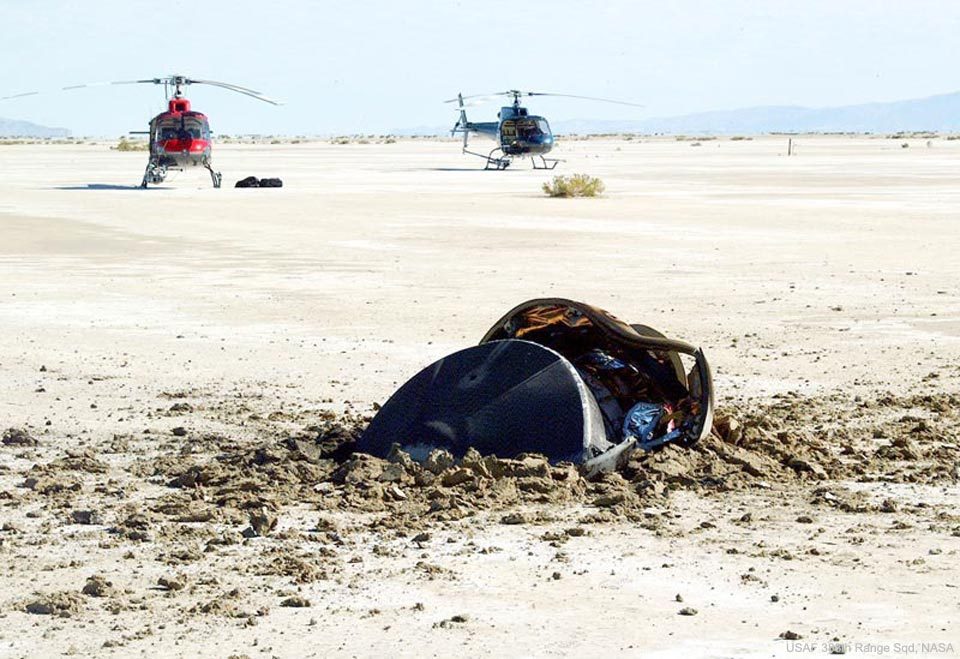
In 2004, NASA's Genesis capsule crash-landed in Utah, bringing back solar wind samples that unveiled secrets of the Sun's composition and the Solar System's formation.
The image captures a moment from 2004 when NASA's Genesis sample return capsule made an unexpected crash landing in Utah's desert. This 'flying saucer' was not an alien visitor but a crucial part of the Genesis mission, launched in 2001 to collect solar wind particles. Despite a parachute failure that led to a high-speed impact, the mission succeeded in returning valuable samples. These particles, typically deflected by Earth's magnetic field, provided insights into the Sun's composition and the elemental distribution across the Solar System.
Unveiling Solar Secrets
The Genesis mission's findings have been instrumental in enhancing our understanding of the Solar System's formation. By analysing the solar wind samples, scientists discovered variations in elemental abundances, offering clues about the processes that shaped our planetary neighbourhood billions of years ago. This mission exemplifies the challenges and triumphs of space exploration, where even a crash landing can yield significant scientific rewards. For those interested in current missions, the Launch Schedule on Orbital Radar provides updates on upcoming explorations.
Tracking Space Exploration
While the Genesis capsule's return was dramatic, it underscores the importance of tracking and predicting satellite re-entries. Orbital Radar's Re-entry Tracker offers insights into upcoming re-entries, helping us understand how space missions conclude. This tool is invaluable for enthusiasts and researchers monitoring the dynamic environment of Earth's orbit.
Frequently Asked Questions
What was the Genesis mission's goal?
Why did the Genesis capsule crash-land?
📎 Cite this article
Orbital Radar Newsroom. (2026). Genesis Capsule's Fiery Return: A Solar Wind Odyssey. Orbital Radar. https://orbitalradar.com/blog/cosmic-gallery-2026-07-19"Genesis Capsule's Fiery Return: A Solar Wind Odyssey." Orbital Radar, 20 July 2026, https://orbitalradar.com/blog/cosmic-gallery-2026-07-19.@misc{orbitalradar_cosmic_gallery_2026_07_19,
title = {Genesis Capsule's Fiery Return: A Solar Wind Odyssey},
author = {{Orbital Radar}},
year = {2026},
howpublished = {\url{https://orbitalradar.com/blog/cosmic-gallery-2026-07-19}}
}