Unveiling the Sombrero Galaxy's Hidden Past
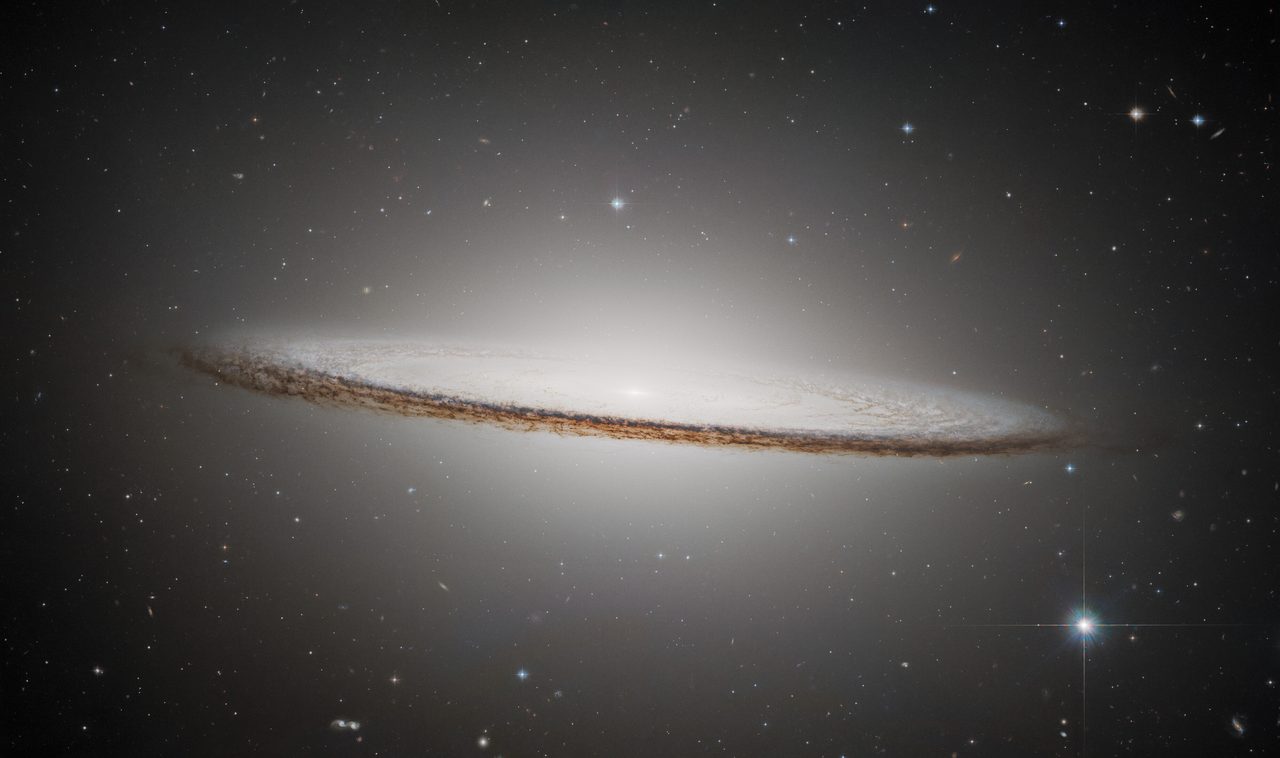
NASA's deep image of the Sombrero Galaxy reveals a hidden halo and structures, suggesting a history of cosmic collisions and mergers.
| Active satellites | 15,750 |
| Catalogued objects | 31,474 |
| Starlink active | 10,056 |
The Sombrero Galaxy, or M104, is a striking celestial object located approximately 30 million light years away. Named for its hat-like appearance in shorter exposures, this galaxy is renowned for its prominent dark dust lane encircling its bright core. However, deep imaging has uncovered a more complex structure: a luminous halo extending beyond the central disk, containing unresolved stars and intriguing formations, such as a diagonal ring. These features suggest a tumultuous past involving collisions and mergers with smaller galaxies.
The Sombrero Galaxy's halo and tidal streams are crucial for understanding the dynamics of galaxy formation and evolution. Such structures are typically remnants of past interactions, providing evidence of the galaxy's violent history. This imagery contributes to our broader understanding of galactic mergers, a process that significantly influences the morphology and growth of galaxies over cosmic time scales.
For those interested in observing celestial wonders like the Sombrero Galaxy, tools such as the Orbital Radar pass predictor can assist in planning stargazing sessions. While this galaxy is best viewed through a telescope, understanding its position and visibility can enhance the observing experience.
Frequently Asked Questions
What is the Sombrero Galaxy?
How was the Sombrero Galaxy's halo discovered?
Cite this article
Pick a style, then copy it or download it for your reference manager.Orbital Radar. (2026, October 5). Unveiling the Sombrero Galaxy's Hidden Past. Retrieved November 19, 2026, from https://orbitalradar.com/blog/cosmic-gallery-2026-10-05
“Unveiling the Sombrero Galaxy's Hidden Past.” Orbital Radar, 5 Oct. 2026, orbitalradar.com/blog/cosmic-gallery-2026-10-05. Accessed 19 Nov. 2026.
Orbital Radar (2026) Unveiling the Sombrero Galaxy's Hidden Past. Available at: https://orbitalradar.com/blog/cosmic-gallery-2026-10-05 (Accessed: 19 November 2026).
Orbital Radar. “Unveiling the Sombrero Galaxy's Hidden Past.” Last modified October 5, 2026. https://orbitalradar.com/blog/cosmic-gallery-2026-10-05.
@misc{orbitalradar_blog_cosmic_gallery_2026_10_05,
  author       = {{Orbital Radar}},
  title        = {Unveiling the Sombrero Galaxy's Hidden Past},
  year         = {2026},
  month        = oct,
  howpublished = {\url{https://orbitalradar.com/blog/cosmic-gallery-2026-10-05}},
  url          = {https://orbitalradar.com/blog/cosmic-gallery-2026-10-05},
  urldate      = {2026-11-19},
  note         = {Accessed 2026-11-19}
}
TY - ELEC AU - Orbital Radar, TI - Unveiling the Sombrero Galaxy's Hidden Past PY - 2026 DA - 2026/10/05 PB - Orbital Radar UR - https://orbitalradar.com/blog/cosmic-gallery-2026-10-05 Y2 - 2026/11/19 LA - en ER -
Live figures change, so keep the date you accessed the page. How to cite Orbital Radar