How Do We Communicate With Voyager Across Deep Space?
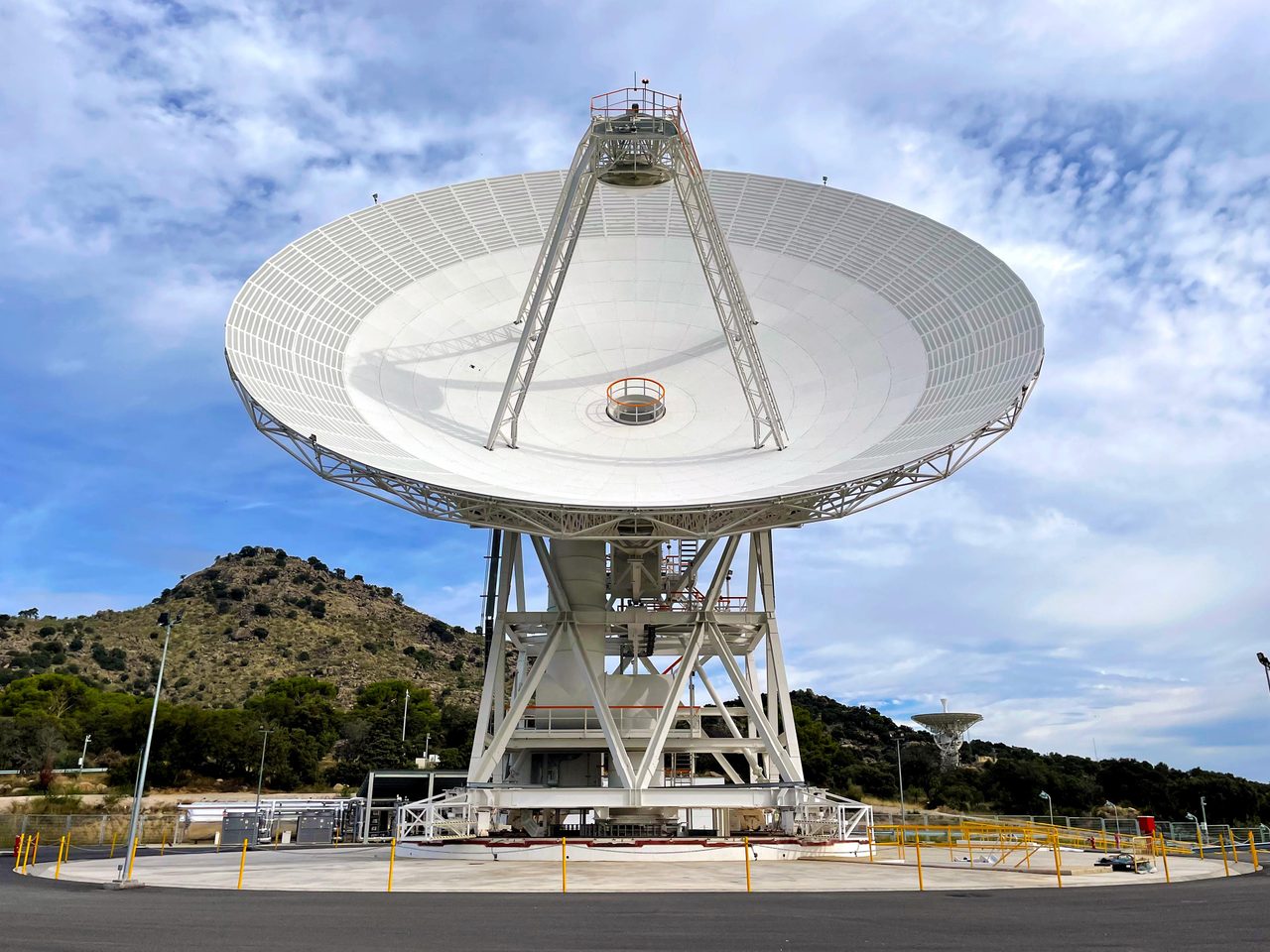
Voyager communicates through faint radio signals collected by NASA’s Deep Space Network. Here is how giant dishes recover its messages across billions of kilometres.
| Active satellites | 16,693 |
| Starlink active | 9,813 |
| Catalogued objects | 32,132 |
| Active close approaches | 19 |
| People in space | 10 |
We communicate with Voyager using radio signals exchanged between the spacecraft’s antenna and NASA’s Deep Space Network (DSN), a worldwide system of large ground antennas. Engineers send commands towards Voyager, while sensitive receivers on Earth collect its faint replies and decode them into spacecraft readings and scientific data.
The DSN has three sites, in California, Spain and Australia, spaced roughly 120° apart around Earth. As Earth turns, this arrangement allows contact to pass between sites, keeping distant spacecraft within view. The same network serves missions from lunar orbiters to the Voyagers.
But this is not a live conversation: radio signals travel at the speed of light, and no larger antenna can remove the delay imposed by distance. Following the journey from the Moon to Voyager means separating three challenges: detecting a signal, carrying useful data and waiting for a response. Orbital Radar’s Space Academy provides background on the physics behind those links; here, the distinction between signal strength and travel time is essential.
What is the Deep Space Network, and why are its antennas spread around Earth?
NASA’s Deep Space Network (DSN) is the ground-based radio infrastructure that lets Earth communicate with Voyager and other spacecraft across the Solar System and beyond. It is an array of large, steerable antennas on Earth, not a chain of relay satellites passing messages through space.
The DSN’s three communications complexes are in California, Spain and Australia. They are approximately 120 degrees apart in longitude, spreading their coverage around the planet rather than concentrating it on one continent. This geographical separation matters because Earth rotates: a spacecraft visible above one complex’s horizon will eventually set below it, putting Earth itself in the way of the radio link.
As a spacecraft sets at one site, another complex can take over when it has the spacecraft in view. These handovers allow communications to continue beyond the viewing window of any single location. They do not guarantee uninterrupted antenna time for every mission: the network serves multiple spacecraft, so observations and command sessions must be scheduled around competing demands and antenna availability.
The dishes have two distinct jobs. When receiving, they collect radio signals carrying scientific measurements and engineering information about a spacecraft’s condition; when transmitting, they direct radio commands towards the spacecraft to tell it what to do. Orbital Radar’s Deep Space Network definition explains this shared communications infrastructure, which supports missions from lunar orbiters to the Voyagers.
How can Earth detect Voyager’s extremely faint radio signal?
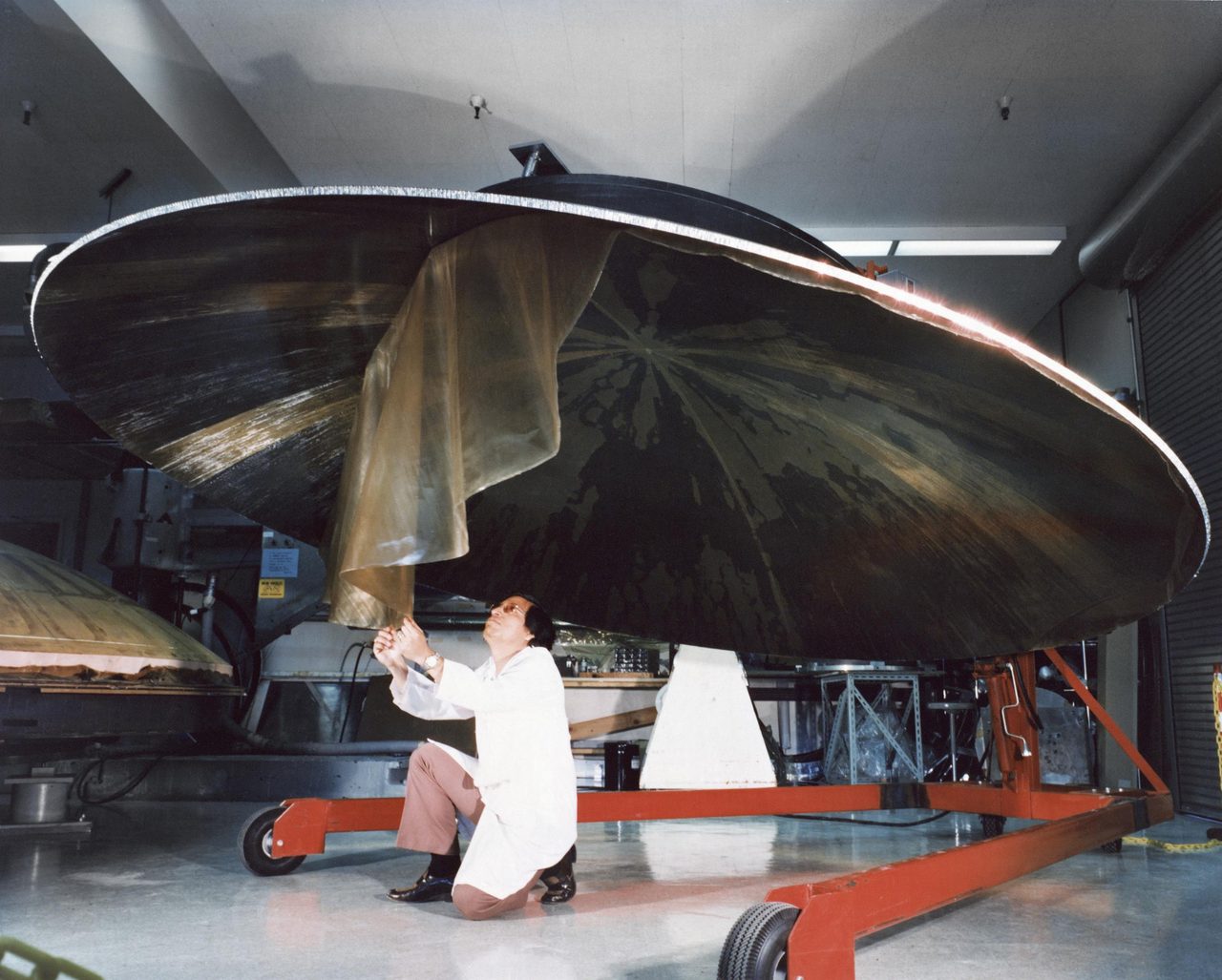
Earth detects Voyager’s faint radio signal by collecting it with large dishes, using low-noise receivers and tracking its frequency precisely. Voyager’s transmitter feeds a high-gain antenna (a dish that concentrates radio energy in a narrow direction), which must point towards Earth for reliable communication.
That directed beam still spreads as it travels. The power reaching a fixed collecting area follows an inverse-square relationship: doubling the distance reduces the intercepted power to a quarter, even if the transmitter’s output remains unchanged. Voyager’s dish concentrates the transmission; it does not prevent this spreading loss.
On Earth, NASA’s Deep Space Network uses giant radio antennas to collect a small portion of that beam and focus it towards a receiver. A larger collecting area captures more signal, while low-noise receiving equipment limits the unwanted electrical noise added during reception. Orbital Radar’s Space Academy provides background on radio communication.
Engineers predict and track the signal’s frequency, including shifts caused by relative motion between Earth and Voyager. This lets receivers concentrate on a narrow frequency range rather than admit unnecessary background noise. When needed, antenna arraying (combining signals received by several antennas) improves reception, although the arrangement varies between contacts.
Detecting the carrier—the underlying radio wave—is not the same as decoding the information impressed upon it. A carrier can remain identifiable when spacecraft data cannot be recovered reliably. Received power is therefore not a universal fixed figure: distance, pointing, equipment and the receiving configuration all affect an individual contact.
How long does a message take to reach Voyager?
A radio message takes hours to reach Voyager, and its reply takes hours more to return to Earth. This is light-time: the travel time of an electromagnetic signal. Radio waves travel at the speed of light in a vacuum, just as visible light does; a stronger transmitter cannot make them arrive sooner.
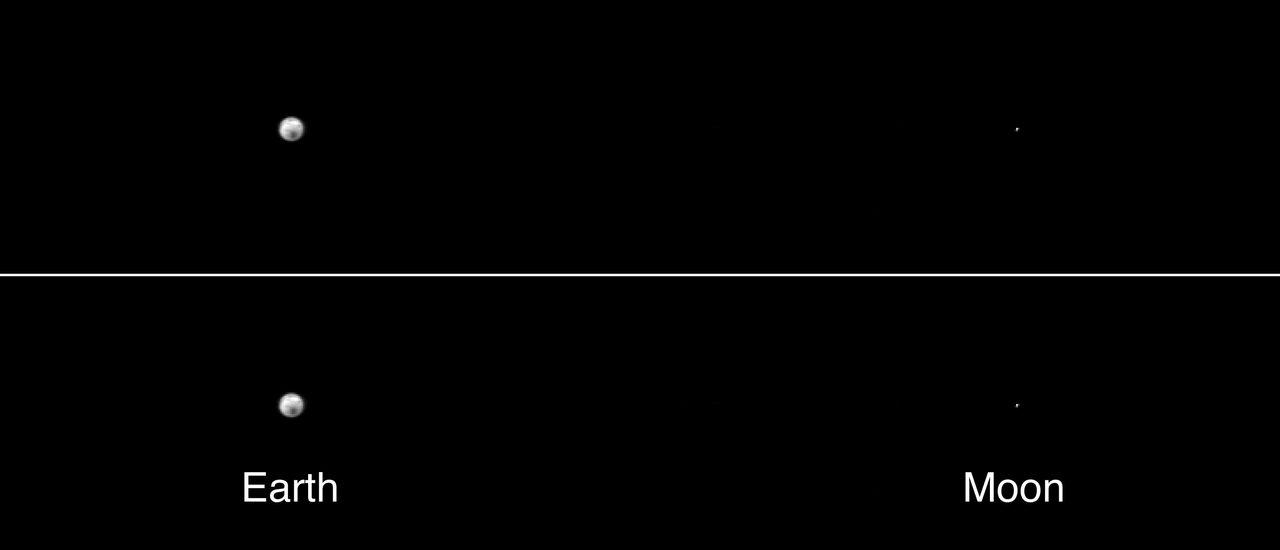
The Moon provides a useful comparison. At its average distance of about 384,400 kilometres from Earth, a radio signal takes about 1.3 seconds to travel one way. Orbital Radar’s Moon Globe provides context for our nearest celestial neighbour; Voyager operates far beyond that lunar scale.
One-way delay is not round-trip delay. A command must first reach the spacecraft before it can transmit an acknowledgement, which then makes the long journey back. Even with an immediate response, confirmation therefore requires both signal journeys, not just the outward trip.
Voyager’s delay is not permanently fixed: the spacecraft continues travelling outwards while Earth moves around the Sun, changing their separation. Orbital Radar’s Voyager 1 mission page offers further mission context.
Engineers therefore plan operations in advance and upload scheduled command sequences rather than steer with a joystick. Onboard fault protection lets the spacecraft respond to certain problems without waiting for instructions. NASA’s Deep Space Network carries those instructions and replies, but its giant antennas cannot remove the delay imposed by distance.
Why are Voyager’s data rates so much lower than links near the Moon?
Voyager’s data rates are much lower because its radio signal spreads over a far greater distance, leaving very little power for Earth’s antennas to collect. Data rate means the amount of digital information transmitted per second; it is separate from the time a signal takes to arrive. Sending fewer bits per second does not make radio waves travel faster.
Engineers assess a link budget: an accounting of transmitted power, antenna performance, propagation losses and receiver noise. In plain language, they calculate whether enough signal survives the journey to distinguish the message from background noise.
Transmitting more slowly can give the receiver more time to collect energy for each bit, making it easier to recover reliably. Error-correcting coding adds information that helps repair errors, but also consumes transmission capacity. Spacecraft equipment, ground receivers and supported operating modes constrain the rates available.
NASA’s Deep Space Network uses three sites in California, Spain and Australia as of 17 November 2026, according to Orbital Radar tracking data. Those Deep Space Network sites are approximately 120° apart around Earth as of 17 November 2026, according to Orbital Radar tracking data.
Lunar spacecraft face much smaller distance-related losses, potentially supporting far greater throughput. There is no single standard lunar data rate: power, antennas, equipment and ground support differ between missions. Orbital Radar’s Space Academy provides context for these communications principles.
Voyager’s limited capacity therefore goes towards essential engineering information about spacecraft health and selected science measurements, rather than an unrestricted video stream. Engineers must choose what to send within the connection’s available capacity.
How do engineers turn a faint radio signal into readable spacecraft data?
Engineers turn Voyager’s faint radio signal into data by tracking its carrier, recovering the information encoded on it and decoding digital symbols. A Deep Space Network (DSN) antenna collects the radio energy; sensitive receivers amplify it and isolate the narrow frequency band containing the signal.
NASA’s Deep Space Network operates from three sites in California, Spain and Australia as of 17 November 2026. NASA’s Deep Space Network sites are approximately 120° apart around Earth as of 17 November 2026.
Receiver electronics track the carrier (the underlying radio wave), allowing for shifts in its received frequency. They then recover modulation (changes in the wave that carry information) and use timing estimates to identify digital symbols representing bits.
Error-correcting codes add deliberate redundancy: extra information that lets a decoder detect and correct some errors caused by noise. They cannot rescue every damaged transmission. Known synchronisation patterns and expected timing help ground systems locate message boundaries and assemble the recovered bits into usable records.
These records contain telemetry (measurements sent by a spacecraft). Engineering telemetry describes spacecraft health, including power and temperatures; scientific telemetry carries observations from instruments. A detected carrier can still confirm a transmission and support tracking even when its telemetry cannot be decoded.
Mission teams interpret the recovered records, compare them with expected behaviour and decide whether a later command is necessary. Orbital Radar’s Space Academy provides background on the communications concepts behind that chain.
What happens if Voyager loses contact with Earth?
If Voyager unexpectedly falls silent, engineers investigate the missing signal; silence alone does not establish that the spacecraft has failed. A scheduled gap between antenna bookings is different from an absent transmission during an expected contact.
NASA’s Deep Space Network (DSN) receives Voyager’s signals through sites in California, Spain and Australia. Their global coverage does not mean Voyager is monitored continuously: antennas are shared between missions. Orbital Radar’s Deep Space Network guide explains this ground infrastructure.
An unexpected loss of reception could mean Voyager’s antenna is no longer pointing accurately towards Earth, electrical power is insufficient, or a transmitter or onboard computer has developed a fault. Engineers must also rule out problems with the receiving antenna, its electronics or ground systems.
Voyager’s radioisotope thermoelectric generators convert heat from radioactive decay into electricity. Available electrical power declines over time, forcing engineers to choose which instruments, heaters and other equipment can remain switched on while preserving essential spacecraft functions and communications.
Recovery starts with the last telemetry (measurements reporting spacecraft health) and checks of the ground equipment. Teams search for a radio carrier (the underlying transmission), even if readable data are absent, then prepare cautious commands and wait through the signal’s round trip before assessing the response.
Onboard fault protection can autonomously respond to certain problems, for example by switching equipment or reducing activity. Such responses can preserve the spacecraft without immediate help from Earth, but cannot repair every hardware failure or guarantee that contact will return.
Can the Sun or Earth’s weather interrupt deep-space communications?
Yes—the Sun and Earth’s atmosphere can disrupt deep-space radio links, but neither makes every contact unreliable. Solar conjunction is a viewing geometry in which a spacecraft appears close to the Sun as seen from Earth, so its radio signal travels near the Sun.
Solar plasma (electrically charged gas) can disturb a radio wave’s phase and amplitude, making data harder to recover. Conjunction geometry is predictable; solar activity and the plasma’s changing structure are more variable. Operators may restrict commanding when reception is unreliable, rather than risk a spacecraft receiving corrupted instructions.
The effect depends on the spacecraft’s actual position in the sky: conjunction restrictions for another mission do not automatically apply to Voyager. Orbital Radar’s guide to space weather explains the wider relationship between solar activity and technological systems; a solar storm does not necessarily interrupt Voyager communications.
At Earth, atmospheric gases, water vapour, clouds and rain can absorb radio energy or add noise, with their importance depending on frequency and observing conditions. NASA’s Deep Space Network operates from California, Spain and Australia, where local weather conditions can differ.
Receivers must also follow Doppler shift (a change in received frequency caused by relative motion). Earth’s rotation and orbital motion, together with Voyager’s motion, shift the arriving signal’s frequency. Ground systems therefore predict and track that moving frequency rather than listen at one unchanging setting; this is a routine tracking requirement, not itself a weather effect.
Why can satellite internet feel instant while Voyager cannot?
Satellite internet can feel instant because its signals travel much shorter distances than Voyager’s, through infrastructure designed for frequent connections. Voyager’s radio messages must cross interstellar distances: faster electronics cannot remove the time that journey takes.
Orbital Radar tracking data listed 16,693 active satellites in Earth orbit on 17 November 2026. That population is not a count of broadband spacecraft or users of NASA’s Deep Space Network (DSN), the giant radio antennas that communicate with distant spacecraft. Earth-orbiting communications networks and deep-space links serve different distances and purposes.
Broadband networks near Earth combine comparatively short signal paths with frequently available satellites and ground connections. Voyager has limited electrical power and transmitting capacity, and relies on scheduled support from the DSN’s shared antennas in California, Spain and Australia. Continuous geometric visibility does not mean an antenna is continuously assigned to Voyager.
The crucial distinction is between latency (the waiting time for information to arrive) and throughput (the amount of data delivered over time), concepts explored in Orbital Radar’s Space Academy. Better electronics can process information faster or support higher throughput, but cannot make a radio wave cross a fixed distance sooner. Relay spacecraft can solve visibility problems and change how a network routes messages; they cannot make information travel faster than light, and an indirect route can add waiting time.
How can I follow Voyager and deep-space missions on Orbital Radar?
Start at Orbital Radar’s deep-space hub, then open the Voyager 1 mission page to explore the mission information displayed there. Treat this as mission context, not a live radio reception: viewing the page does not mean Voyager’s signal is being received, and it does not send a command to the spacecraft.
For any displayed distance or light-time, read the label and its reference point. Distance from Earth describes a different separation from distance from the Sun; the two are not interchangeable. Light-time means the time a radio signal takes to travel the stated path, so check whether the display describes a one-way journey or a round trip.
Orbital Radar’s live catalogue contained 32,132 Earth-orbiting objects, including debris, on 17 November 2026. That Earth-orbit catalogue total is not a count of interplanetary probes and cannot establish whether Voyager is currently transmitting or a Deep Space Network (DSN) antenna is receiving it.
NASA’s DSN communicates with distant spacecraft through antenna sites in California, Spain and Australia, but a mission page is not confirmation of an active radio link. Visit Orbital Radar’s data provenance page at /data-sources to understand the origins of displayed information, and the Moon Globe at /moon for lunar context alongside your exploration of deeper space.
Key takeaways
- Voyager exchanges radio commands and telemetry with Earth through NASA’s Deep Space Network, whose widely separated ground stations support communications as Earth rotates.
- Large antennas and sensitive receivers recover faint signals, while careful encoding and lower data rates help make the information readable.
- Radio signals cannot outrun light, so distance imposes a delay that better receivers or faster computers cannot eliminate.
- Orbital Radar’s deep-space pages provide mission context, but a displayed spacecraft position is not proof of an active communications link.
Frequently Asked Questions
Can amateur radio operators receive Voyager’s signal?
Does Voyager use the internet to send messages to Earth?
Could laser communications replace Voyager’s radio link?
How do scientists know a radio signal really comes from Voyager?
Can Voyager still send new photographs back to Earth?
Cite this article
Pick a style, then copy it or download it for your reference manager.Orbital Radar. (2026, November 17). How Do We Communicate With Voyager Across Deep Space? Retrieved November 17, 2026, from https://orbitalradar.com/blog/how-we-talk-to-distant-spacecraft
“How Do We Communicate With Voyager Across Deep Space?” Orbital Radar, 17 Nov. 2026, orbitalradar.com/blog/how-we-talk-to-distant-spacecraft. Accessed 17 Nov. 2026.
Orbital Radar (2026) How Do We Communicate With Voyager Across Deep Space? Available at: https://orbitalradar.com/blog/how-we-talk-to-distant-spacecraft (Accessed: 17 November 2026).
Orbital Radar. “How Do We Communicate With Voyager Across Deep Space?” Last modified November 17, 2026. https://orbitalradar.com/blog/how-we-talk-to-distant-spacecraft.
@misc{orbitalradar_blog_how_we_talk_to_distant_spacecraft,
  author       = {{Orbital Radar}},
  title        = {How Do We Communicate With Voyager Across Deep Space?},
  year         = {2026},
  month        = nov,
  howpublished = {\url{https://orbitalradar.com/blog/how-we-talk-to-distant-spacecraft}},
  url          = {https://orbitalradar.com/blog/how-we-talk-to-distant-spacecraft},
  urldate      = {2026-11-17},
  note         = {Accessed 2026-11-17}
}
TY - ELEC AU - Orbital Radar, TI - How Do We Communicate With Voyager Across Deep Space? PY - 2026 DA - 2026/11/17 PB - Orbital Radar UR - https://orbitalradar.com/blog/how-we-talk-to-distant-spacecraft Y2 - 2026/11/17 LA - en ER -
Live figures change, so keep the date you accessed the page. How to cite Orbital Radar