SatNet reaches orbit: Orbital Briefing, 25 October 2026

China's SatNet LEO Group 28 has reached orbit aboard Long March 8A. Elsewhere, satellite close approaches warrant attention while geomagnetic conditions remain quiet.
| Active satellites | 15,890 |
| Starlink active | 10,050 |
| Catalogued objects | 31,864 |
| Active close approaches | 16 |
| People in space | 10 |
China's SatNet constellation expanded on Sunday with the successful launch of SatNet LEO Group 28 into low Earth orbit, the region used by many communications and Earth-observation satellites. Long March 8A launched SatNet LEO Group 28 at 02:03 UTC on 25 October 2026, according to Orbital Radar tracking data.
The mission continues China's deployment activity following the successful Long March 4B and Long March 6A Yaogan launches on 23 October. Those missions carried different payloads, but together they illustrate the breadth of the country's current launch programme. Mission histories and constellation activity can be explored through Orbital Radar's China in Space hub and Long March launch record.
Close approaches in a crowded orbital environment
Orbital Radar tracking data lists 16 active satellite close approaches on 25 October 2026. Among the named pairs, LEMUR-2-TARTIFLETTE and LEMUR-2-HOTSPUR-TOM have a reported minimum separation of approximately 0.66 km, while TANAGER-2 and MIKROGLOB-3 are listed at approximately 1.51 km. FLOCK 4H-14 and FLOCK 4H-19 have a reported minimum separation of approximately 1.34 km.
A close approach, also called a conjunction, is not itself a collision warning: assessing risk requires information about timing, relative motion and uncertainty in each object's position. Orbital Radar's live catalogue lists 15,890 active satellites on 25 October 2026. The space situational awareness toolkit provides context for monitoring this increasingly busy environment without treating separation alone as a measure of danger.
Quiet space weather, active solar research
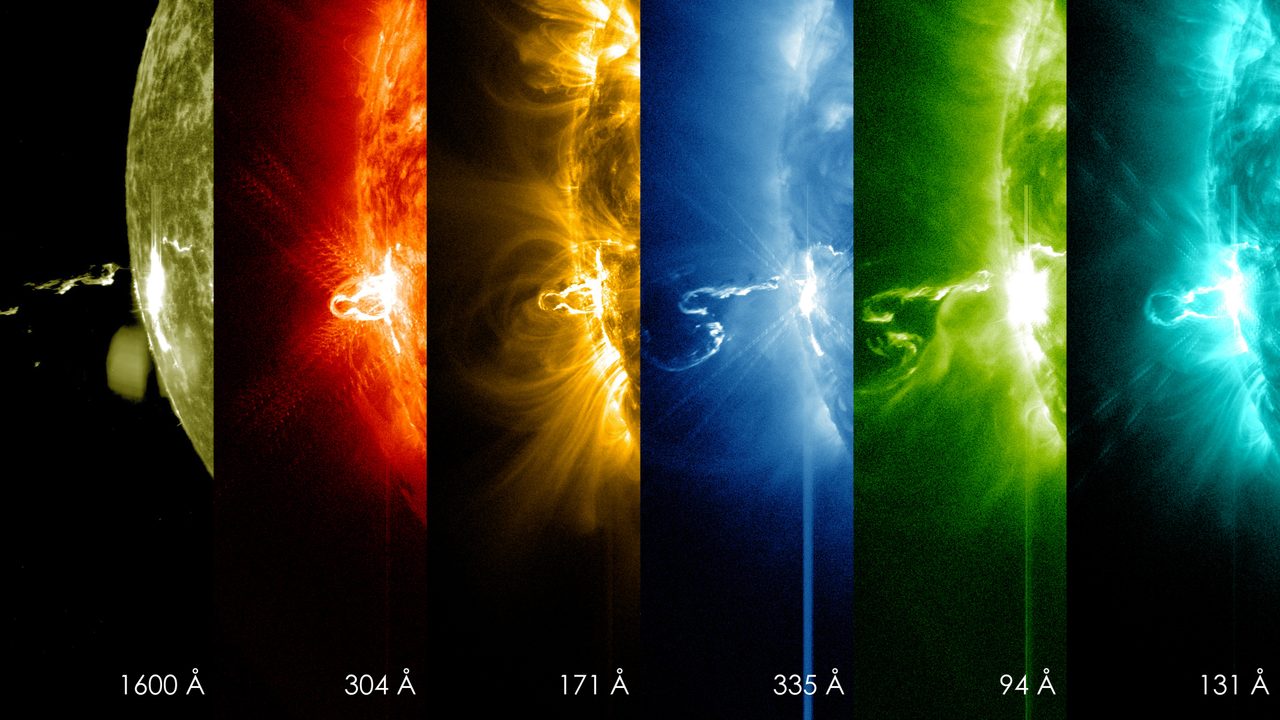
Geomagnetic conditions are quiet, with Kp at 0 and Dst at −8. Kp describes the level of disturbance in Earth's magnetic field, while Dst measures changes associated with the ring current around Earth. Current risk indicators are green for low Earth orbit, geostationary orbit and the International Space Station.
Meanwhile, research coverage is examining how flare ribbons reveal otherwise hidden aspects of solar explosions. These bright features trace where energy released during a flare reaches the Sun's lower atmosphere; understanding them helps researchers reconstruct events that can affect the space environment. Quiet conditions now do not establish what the Sun will do next, and the Orbital Radar Sun globe offers a natural starting point for following our star.
What to Watch
SpaceX's next listed Starlink mission is Group 15-16, scheduled for 27 October at 04:45 UTC aboard Falcon 9 Block 5. Group 15-18 follows on 30 October at 04:02 UTC. Both are marked go for launch, though schedules remain subject to change; updated timings are available on the Orbital Radar launch schedule.
India's GSLV Mk II mission carrying IRNSS-1L, also designated NVS-03, is listed for 30 October at 17:00 UTC, with confirmation pending. Beyond launches, NASA's Artemis programme remains worth following as reporting focuses on Space Launch System stacking, lunar surface suits and possible paths towards astronaut landings in 2028. Those are programme developments and planning targets, rather than evidence that a landing timetable is assured.
Frequently Asked Questions
What did China launch on 25 October 2026?
When is the next scheduled Starlink launch?
📎 Cite this article · data available
Orbital Radar Newsroom. (2026). SatNet reaches orbit: Orbital Briefing, 25 October 2026. Orbital Radar. https://orbitalradar.com/blog/orbital-briefing-2026-10-25"SatNet reaches orbit: Orbital Briefing, 25 October 2026." Orbital Radar, 25 October 2026, https://orbitalradar.com/blog/orbital-briefing-2026-10-25.@misc{orbitalradar_orbital_briefing_2026_10_25,
title = {SatNet reaches orbit: Orbital Briefing, 25 October 2026},
author = {{Orbital Radar}},
year = {2026},
howpublished = {\url{https://orbitalradar.com/blog/orbital-briefing-2026-10-25}}
}