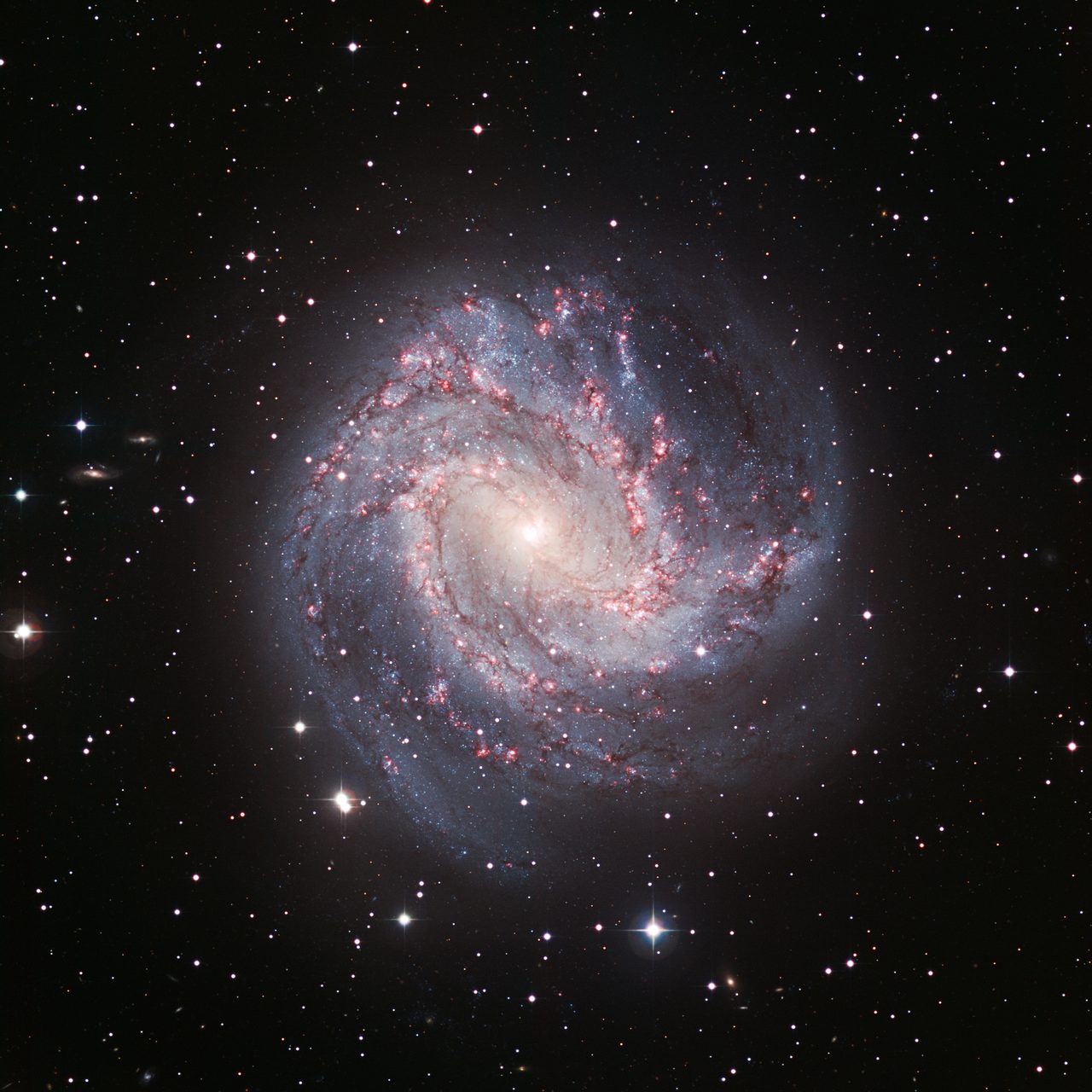
A swirling galaxy: M83 reveals its cold star-making gas
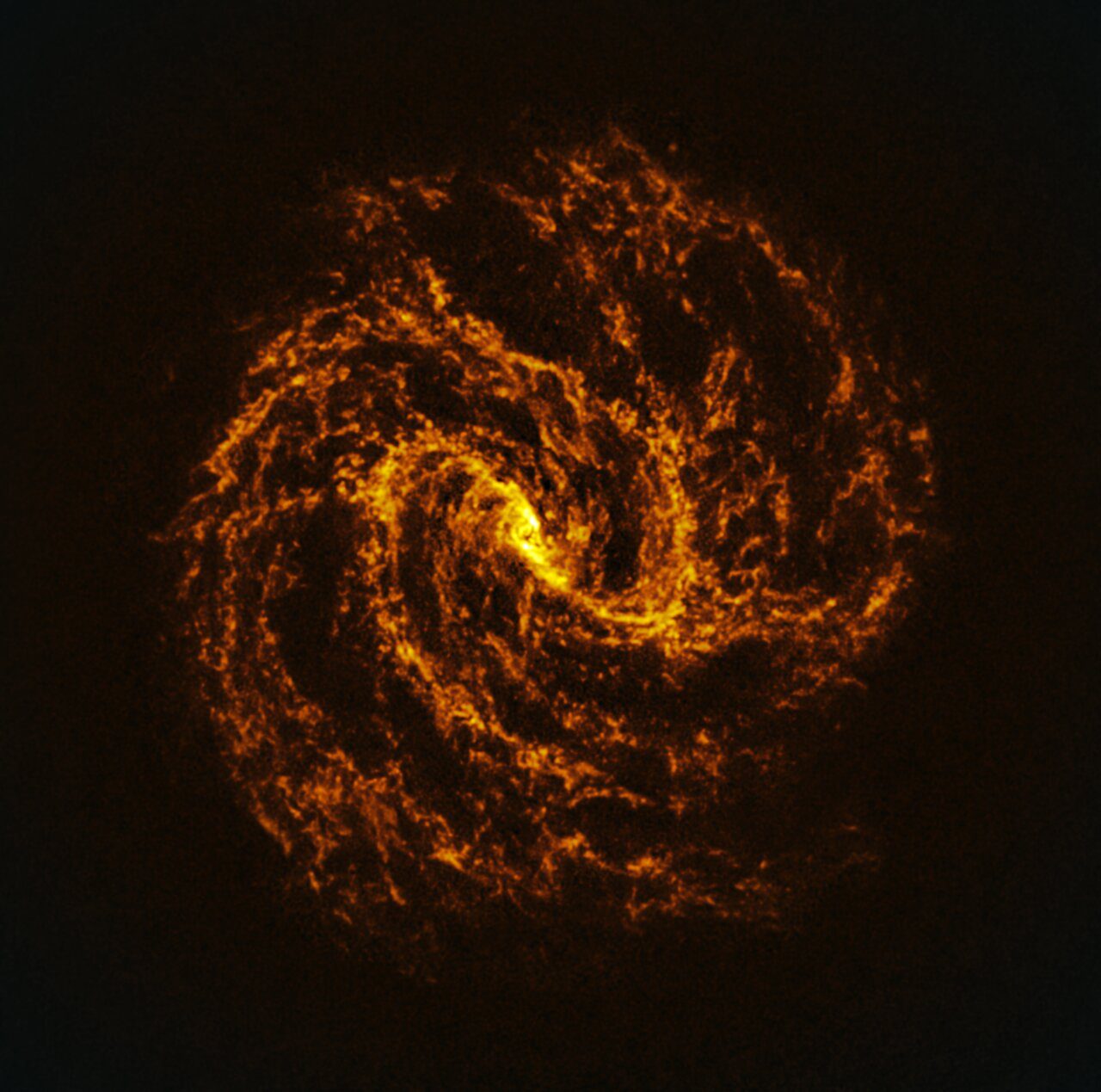
ALMA’s view of the Southern Pinwheel reveals cold molecular gas rather than visible starlight — tracing the material from which new stars form.
| Active satellites | 15,890 |
| Catalogued objects | 31,868 |
| Starlink active | 10,050 |
The swirl in this image traces the raw material for future stars in M83, the Southern Pinwheel galaxy, approximately 15 million light-years away. Rather than showing visible starlight, the image maps emission from cold gas molecules using the Atacama Large Millimeter/submillimeter Array (ALMA), an observatory in which ESO is a partner.
M83 is among the brightest galaxies in the night sky, but this view reveals a different aspect of its structure. Its nearly face-on orientation lets astronomers compare molecular gas across the central regions, spiral arms and spaces between them.
What controls a galaxy’s star formation?
Virtually all stars begin with the collapse of molecular gas clouds. Once stars form, they heat their surroundings, making it harder for gas to condense into another generation of stars.
That heating works alongside galactic dynamics — the motions that continually stir gas — to regulate a galaxy’s growth. ALMA lets researchers map variations in gas density and temperature, investigating whether different environments turn gas into stars in different ways.
M83 closely resembles the Milky Way, giving these comparisons particular relevance to our own galactic home. The central question is whether star formation follows a universal recipe or depends on local conditions.
A distant galaxy, a moving foreground
Closer to home, 15,890 satellites were active in Earth orbit as of 24 October 2026, according to Orbital Radar tracking data. Starlink accounted for 10,050 active satellites as of 24 October 2026, according to Orbital Radar tracking data.
These nearby objects belong to a very different observing landscape from M83’s molecular clouds. For a separate look at what crosses your local sky, Orbital Radar’s Pass Predictor helps identify visible satellite passes.
Frequently Asked Questions
What does the ALMA image of M83 show?
How far away is the Southern Pinwheel galaxy?
📎 Cite this article · data available
Orbital Radar Newsroom. (2026). A swirling galaxy: M83 reveals its cold star-making gas. Orbital Radar. https://orbitalradar.com/blog/cosmic-gallery-2026-10-24"A swirling galaxy: M83 reveals its cold star-making gas." Orbital Radar, 24 October 2026, https://orbitalradar.com/blog/cosmic-gallery-2026-10-24.@misc{orbitalradar_cosmic_gallery_2026_10_24,
title = {A swirling galaxy: M83 reveals its cold star-making gas},
author = {{Orbital Radar}},
year = {2026},
howpublished = {\url{https://orbitalradar.com/blog/cosmic-gallery-2026-10-24}}
}