Lunar Gateway Orbit: Why NASA Chose a Halo Around the Moon
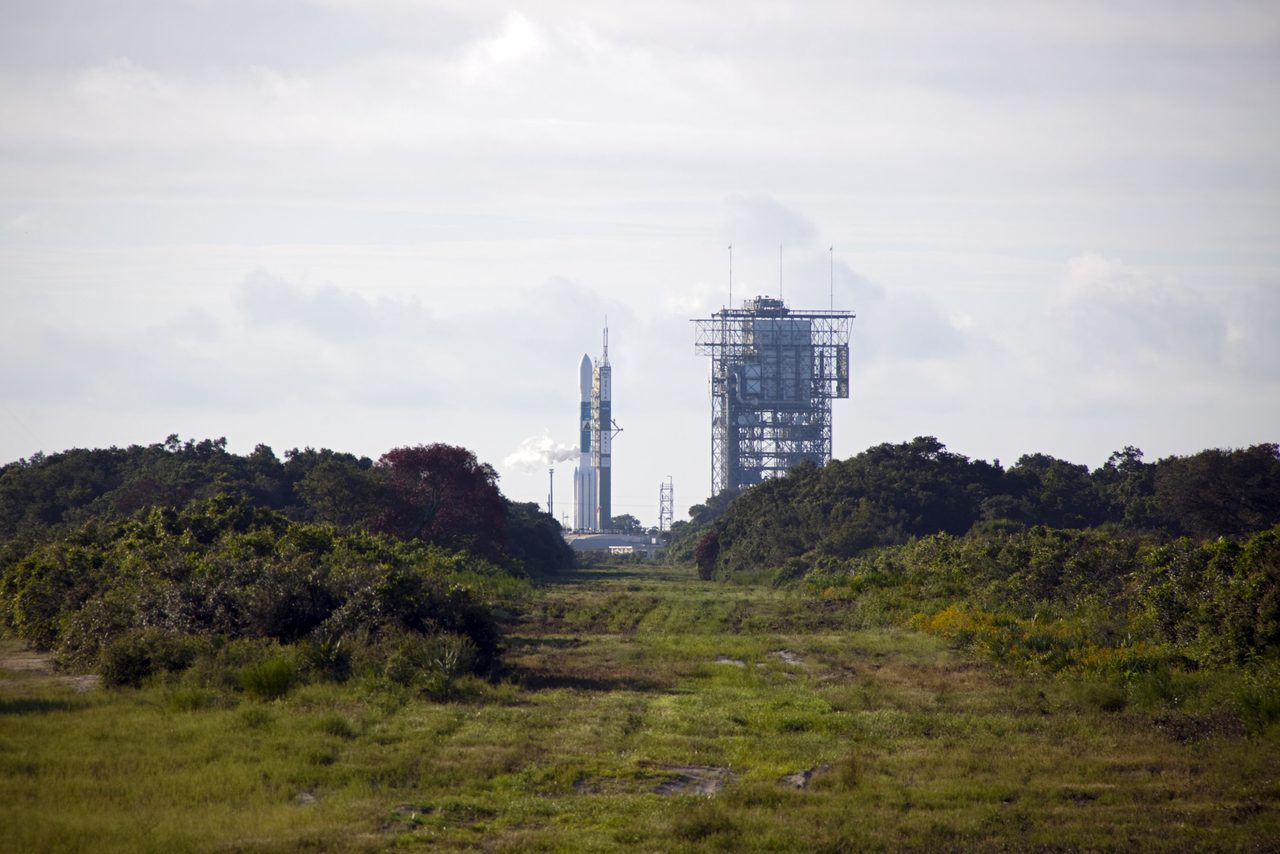
Gateway is designed for a looping orbit rather than a close circle around the Moon. Its route explains how lunar gravity, communications and landing access shape mission design.
| Active satellites | 16,684 |
| Starlink active | 9,897 |
| Catalogued objects | 32,104 |
| Active close approaches | 22 |
| People in space | 10 |
NASA’s planned lunar Gateway will use a near-rectilinear halo orbit (NRHO), a long, looping path that swings close to the Moon before carrying the station far away again. NASA chose this orbit to balance lunar surface access, communications with Earth and the propellant needed to maintain the station’s path.
The distinction is gravitational: close lunar orbits are strongly affected by the Moon’s uneven gravity, while distant halo orbits depend on the combined gravitational dynamics of Earth and the Moon. Gateway is planned infrastructure, not an operating lunar station.
Orbital Radar tracking data lists 16,684 active satellites in orbit as of 8 November 2026. Orbital Radar’s live catalogue contains 32,104 objects, including debris, as of 8 November 2026; lunar operations present a different orbital problem.
This article connects low lunar orbit, mass concentrations, Lagrange points and halo orbits, distinguishing spacecraft that have flown from planned architecture. Orbital Radar’s Moon Globe provides a companion view of the Moon and its orbiters.
What makes an orbit around the Moon unstable?
The Moon’s uneven gravity can gradually reshape a spacecraft’s orbit, while Earth’s pull adds further disturbances. An orbit calculated for a perfectly smooth, isolated Moon therefore does not fully describe the path a real spacecraft follows.
Mass concentrations, or mascons (regions associated with unusually strong gravitational attraction), are a major reason. Many lie beneath large impact basins, where dense material contributes to local gravity variations. Repeated passes through this uneven field can change an orbit’s shape and orientation.
In some low lunar orbits, those changes can push the lowest point down towards the terrain, eventually risking an impact unless controllers make corrective manoeuvres. That is not the inevitable fate of every low lunar orbit: the outcome depends on its altitude, tilt and orientation.
Perturbations (forces that alter an idealised orbit) also include Earth’s gravity and, especially for more distant lunar paths, the Sun’s influence. Mathematical instability means that small departures from a reference path can grow; it does not mean an orbit is operationally unusable. Planned corrections can keep a spacecraft serving its mission reliably.
Orbital Radar tracking data lists 16,684 active satellites as of 8 November 2026. Orbital Radar’s live catalogue contains 32,104 objects, including debris, as of 8 November 2026. Those overall totals are not lunar population counts; the Orbital Radar Moon Globe provides a focused view of the Moon and its orbiters.
How does low lunar orbit work, and which spacecraft use it?

Low lunar orbit is a close path around the Moon, useful for detailed observations and relatively direct access to the surface. The term describes proximity rather than a universally agreed altitude boundary: a spacecraft’s height and route depend on its instruments, targets and mission.
NASA’s Lunar Reconnaissance Orbiter, launched in 2009, is a principal example of close lunar mapping. Its cameras and other instruments survey terrain, measure surface conditions and help assess potential landing sites. Flying close allows instruments to distinguish finer features than comparable equipment could from much farther away; Orbital Radar’s Lunar Reconnaissance Orbiter profile explores the mission.
A polar orbit carries a spacecraft over or near both lunar poles. While it repeatedly follows a roughly north–south route, the Moon rotates beneath its orbital plane, bringing different strips of terrain into view on successive passes. Over time, that geometry supports broad mapping coverage, although the detail and frequency of observations depend on the instrument and orbit.
Apollo command and service modules also used close lunar orbits, remaining above the Moon while the lunar module descended and later returned for rendezvous (a planned meeting in space). Their task was to support a short expedition and the crew’s journey home, not to operate as a station for years. Low lunar orbit therefore has a proven role in both surveying the Moon and supporting surface visits, but those missions impose different requirements from a long-lived outpost.
Can a spacecraft stay in lunar orbit without constant corrections?
Yes: a carefully chosen lunar orbit can limit unwanted changes without constant corrections, although it still needs navigation and may need occasional manoeuvres. A frozen orbit is an orbital configuration chosen to limit long-term changes in selected orbital elements (the quantities describing its size, shape and orientation); “frozen” does not mean the spacecraft remains motionless.
Designers select the inclination (tilt of the orbital plane), eccentricity (how elongated the orbit is) and orientation so that effects of the Moon’s uneven gravity partly balance rather than continually reinforce unwanted drift. The result can keep the orbit’s shape and the location of its closest approach comparatively steady, rather than making every aspect unchanging.
This passive behaviour is distinct from station-keeping: small corrective manoeuvres used to maintain a desired trajectory. Fuel requirements depend on the particular path, allowable deviations and mission lifetime; an orbit suitable for a short mission may need more intervention over a longer stay.
Neither “all lunar orbits are unstable” nor “a stable orbit needs no navigation” is a useful rule. Controllers still measure the trajectory and assess deviations. Orbital Radar’s Moon Globe provides context for the orbiters whose paths must be designed around these constraints.
What are Lagrange points, and how do halo orbits use them?
Lagrange points are locations where the gravitational and orbital effects of a two-body system allow a small object to maintain a fixed position relative to both bodies in an idealised rotating frame (a viewpoint that turns with their orbital motion). For Earth and the Moon, this means a spacecraft could theoretically keep the same relative geometry without either body's gravity disappearing.
Earth–Moon L1 lies between Earth and the Moon; L2 lies beyond the Moon, on the side away from Earth. Neither is a physical object or an invisible anchor. Both are mathematical locations defined by the combined dynamics of the system, and a spacecraft near either point will not simply remain there indefinitely without intervention.
Halo orbits are three-dimensional trajectories associated with these regions. They loop out of the plane of the Moon's orbit rather than tracing small circles around a Lagrange point. Their shape emerges from the combined gravitational influence of Earth and the Moon and the spacecraft's motion.
These dynamics support useful repeating paths, but real spacecraft still need navigation and corrective manoeuvres: actual conditions depart from the idealised model. Orbital Radar's Moon Globe provides context for the Moon's position and its orbiters.
Orbital Radar tracking data lists 16,684 active satellites as of 8 November 2026. Orbital Radar's live catalogue contains 32,104 objects, including debris, as of 8 November 2026. These are overall orbital counts, not counts of spacecraft using lunar halo orbits.
What does Gateway’s near-rectilinear halo orbit look like?
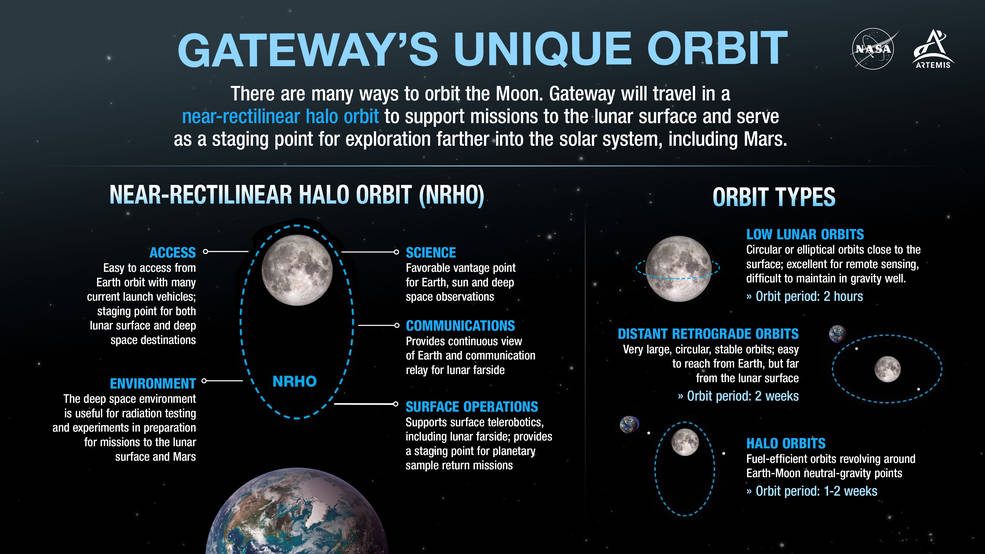
Gateway’s planned near-rectilinear halo orbit is a stretched, three-dimensional loop, with a close passage over the Moon’s northern region and a much longer excursion towards its southern side. It belongs to the southern Earth–Moon L2 halo family, rather than following a fixed ellipse centred on the Moon.
Near-rectilinear describes the nearly straight-looking close-pass portion of the trajectory. It does not mean the whole orbit is straight: the spacecraft continues around a curved path shaped by the combined gravitational influence of Earth and the Moon.
For a schematic, place the Moon near the upper end of an elongated loop, with the larger sweep extending southwards. Label the nearest point perilune and the farthest point apolune: these terms describe distance from the Moon’s centre. Such a sketch explains the geometry without implying precise operational altitudes, and a flat drawing necessarily hides some of the orbit’s three-dimensional structure.
The viewing frame matters. An Earth–Moon rotating-frame diagram turns with the Moon’s motion around Earth, keeping both bodies in fixed positions. An inertial-frame animation uses axes that do not rotate with that system, so the same spacecraft motion traces a different-looking path. Neither view makes the trajectory a conventional lunar ellipse.
Orbital Radar’s live catalogue contained 32,104 tracked objects on 8 November 2026. Orbital Radar tracking data recorded 16,684 active satellites on 8 November 2026. Those inventory totals do not describe Gateway’s planned trajectory; the Orbital Radar Moon Globe provides lunar context for interpreting orbital diagrams.
Why choose a halo orbit for Gateway instead of low lunar orbit?
NASA chose Gateway’s near-rectilinear halo orbit because it balances modest station-keeping demands, access from Earth, communications and support for south-polar landings. It is a compromise for an exploration staging post, rather than the shortest route between lunar orbit and the surface.
Station-keeping means manoeuvres that keep a spacecraft close to its intended trajectory. Gateway’s selected path limits that continuing fuel demand compared with many low lunar orbits, where the Moon’s uneven gravity field can drive substantial orbital changes; it also avoids requiring visiting spacecraft from Earth to descend into, and later climb out of, the Moon’s deeper gravity well.
The selected trajectory keeps Earth favourably placed for communications and is designed to limit time spent in shadow, supporting solar power and thermal management. Those benefits depend on the particular orbit and its timing: a halo orbit does not automatically guarantee uninterrupted sunlight or communications, and equipment, pointing and operational constraints still matter.
Its orientation supports transfers towards the lunar south polar region, but Gateway does not hover above a landing site. A lander must still depart the station, manoeuvre onto a descent trajectory, brake for touchdown and, for a return mission, launch and rendezvous again; those steps retain substantial propulsion requirements.
Within the planned Artemis exploration architecture, Gateway would provide a rendezvous point and base for visiting crews, spacecraft and supplies; those intended roles should not be confused with completed flights. The geographic relationship between the station’s destination and polar landing regions can be explored using Orbital Radar’s Moon Globe.
Which spacecraft use halo orbits and other distant lunar paths?
CAPSTONE has flown the orbit family selected for Gateway, while Orion and China’s Queqiao relay demonstrate other distant lunar paths with different purposes. These missions are not interchangeable examples: a near-rectilinear halo orbit (NRHO), a distant retrograde orbit and a wider halo around Earth–Moon L2 have distinct geometries.
- CAPSTONE — NRHO — historical flight demonstration. CAPSTONE arrived in its near-rectilinear halo orbit in November 2022, providing a flown demonstration relevant to Gateway’s planned route. The small spacecraft tested navigation and operations in this environment; that historical achievement does not establish its present operating status.
- Gateway — NRHO — planned operations. NASA’s lunar station is intended to use an elongated halo orbit associated with Earth–Moon L2, the gravitational balance region beyond the Moon. Its purpose is to support visiting crews, research and lunar exploration, rather than simply demonstrate the trajectory.
- Orion — distant retrograde orbit — historical Artemis I flight. During Artemis I in 2022, Orion used a distant retrograde orbit, not Gateway’s planned NRHO. Retrograde means motion opposite the relevant orbital direction: here, Orion’s path around the Moon ran opposite the Moon’s motion around Earth when described in the Earth–Moon rotating frame.
- Queqiao — Earth–Moon L2 halo orbit — historical relay deployment. China’s original Queqiao relay entered its halo orbit in 2018 to support communications with the lunar far side. Its wider loop around L2 allowed it to maintain views towards Earth and the far side; it was not Gateway’s near-rectilinear trajectory.
The comparison is therefore about both orbit family and mission purpose. Orbital Radar’s Moon Globe provides a lunar reference alongside these mission descriptions.
Why is lunar traffic different from satellites orbiting Earth?
Lunar traffic differs from Earth’s satellite environment because orbit selection depends on the Moon’s uneven gravity, the combined pull of Earth and the Moon, and the communications links each mission needs. Dense Earth-orbit traffic is not a useful template for understanding those choices.
Orbital Radar tracking data lists 16,684 active satellites as of 8 November 2026. That figure provides broad satellite-catalogue context: it is not a count of spacecraft orbiting the Moon.
Around Earth, many satellites follow paths designed for repeated coverage, navigation or communications. Near the Moon, concentrations of mass beneath the surface can disturb low orbits, while more distant trajectories respond strongly to Earth–Moon dynamics. Mission planners must also consider when a spacecraft can see Earth, reach lunar destinations and maintain communications without the Moon blocking the signal.
A familiar Earth-satellite map therefore cannot, by itself, establish a lunar spacecraft’s trajectory or operational status. A plotted position does not demonstrate that a spacecraft is communicating or carrying out its mission; that requires mission-specific tracking and operational information. Orbital Radar’s Moon globe provides a lunar-centred view rather than treating lunar traffic as another layer of Earth-orbit satellites.
How can you explore the Moon and its orbiters on Orbital Radar?
Open Orbital Radar’s Moon Globe to explore the Moon’s current position, phase and available orbiter information. Use the globe as a spatial reference for the lunar regions discussed in this article, rather than as a map of Gateway’s planned flight path.
Identify the near side, which faces Earth, then explore the far side and the regions around the lunar poles. These landmarks help put the lunar gateway orbit discussion in context: a spacecraft’s path around the Moon is distinct from the terrain beneath it. The far side is not permanently dark; like the near side, it experiences sunlight and darkness.
Orbital Radar’s live catalogue contains 32,104 objects, including debris, as of 8 November 2026. That catalogue total is not a lunar-object count and should not be read as the number of spacecraft orbiting the Moon.
The Moon Globe provides a live visualisation, not a mission-specific navigation solution or a guarantee that a spacecraft is visible from your location. Use it to build geographical understanding and explore the orbiter information available, without assuming that it includes a Gateway trajectory overlay.
Key takeaways
- Gateway is designed to use a near-rectilinear halo orbit that balances communications, surface access and orbit-maintenance demands.
- The Moon’s uneven gravity can disrupt low lunar orbits, but carefully selected orbital configurations can limit unwanted changes.
- Low lunar orbits, halo orbits and distant retrograde orbits serve different purposes rather than forming a simple ranking of better and worse options.
- Lunar Reconnaissance Orbiter, CAPSTONE and Orion illustrate different flown orbit choices, while Gateway represents a planned long-term staging architecture.
Frequently Asked Questions
Will Gateway always be visible from Earth?
Does Gateway orbit the Moon or the Earth–Moon L2 point?
Why did Orion use a different orbit on Artemis I?
Could astronauts travel directly to the lunar surface without Gateway?
Is NASA’s Gateway the same thing as a satellite-internet gateway station?
Cite this article
Pick a style, then copy it or download it for your reference manager.Orbital Radar. (2026, November 8). Lunar Gateway Orbit: Why NASA Chose a Halo Around the Moon. Retrieved November 8, 2026, from https://orbitalradar.com/blog/orbits-around-the-moon
“Lunar Gateway Orbit: Why NASA Chose a Halo Around the Moon.” Orbital Radar, 8 Nov. 2026, orbitalradar.com/blog/orbits-around-the-moon. Accessed 8 Nov. 2026.
Orbital Radar (2026) Lunar Gateway Orbit: Why NASA Chose a Halo Around the Moon. Available at: https://orbitalradar.com/blog/orbits-around-the-moon (Accessed: 8 November 2026).
Orbital Radar. “Lunar Gateway Orbit: Why NASA Chose a Halo Around the Moon.” Last modified November 8, 2026. https://orbitalradar.com/blog/orbits-around-the-moon.
@misc{orbitalradar_blog_orbits_around_the_moon,
  author       = {{Orbital Radar}},
  title        = {Lunar Gateway Orbit: Why NASA Chose a Halo Around the Moon},
  year         = {2026},
  month        = nov,
  howpublished = {\url{https://orbitalradar.com/blog/orbits-around-the-moon}},
  url          = {https://orbitalradar.com/blog/orbits-around-the-moon},
  urldate      = {2026-11-08},
  note         = {Accessed 2026-11-08}
}
TY - ELEC AU - Orbital Radar, TI - Lunar Gateway Orbit: Why NASA Chose a Halo Around the Moon PY - 2026 DA - 2026/11/08 PB - Orbital Radar UR - https://orbitalradar.com/blog/orbits-around-the-moon Y2 - 2026/11/08 LA - en ER -
Live figures change, so keep the date you accessed the page. How to cite Orbital Radar