Types of Rocket Propulsion: Chemical, Electric and Nuclear
Chemical engines deliver thrust, electric thrusters conserve propellant, and nuclear concepts offer different trade-offs. Here is how mission designers choose between them.
| Active satellites | 15,918 |
| Starlink active | 9,980 |
| Catalogued objects | 31,878 |
| Active close approaches | 24 |
| People in space | 10 |
The main types of rocket propulsion are chemical, electric and nuclear, distinguished by how they supply energy to accelerate propellant. Chemical engines release energy through reactions, electric thrusters use electrical power, and nuclear concepts use reactors to heat propellant or generate electricity. More thrust means a stronger push; it does not necessarily mean using propellant more efficiently.
Orbital Radar tracking data lists 15,918 active satellites as of 28 October 2026. Chemical engines provide the high thrust needed for launch, while electric thrusters conserve propellant but typically deliver a much gentler push over longer periods. Orbital Radar’s launch vehicle profiles show the rockets responsible for that initial climb.
Orbital Radar tracking data lists 9,980 operational Starlink satellites as of 28 October 2026. Starlink is one operational example of electric propulsion, but nuclear propulsion remains a development field, not an operational alternative available to book for a mission. Understanding these choices starts with separating thrust from specific impulse (a measure of how effectively an engine uses propellant).
Why can’t one rocket engine do every job?
No rocket engine suits every job because high thrust, low propellant use and manageable power demands are competing priorities. Thrust is a force; acceleration is how quickly velocity changes, and depends on spacecraft mass too. The same thrust gives a heavier spacecraft less acceleration.
Rockets accelerate expelled propellant to produce a force in the opposite direction. They do not need air to push against, so they work in a vacuum.
Orbital Radar tracking data lists 15,918 active satellites as of 28 October 2026. Orbital Radar tracking data estimates the mass of objects in Earth orbit at 15,800 tonnes. Moving spacecraft within that population poses different demands from lifting a launch vehicle off Earth.
Thrust, propellant economy, energy consumption and journey time are distinct measures. An engine described as “efficient” might save propellant while requiring substantial electrical power and a long burn. Specific impulse measures propellant economy, not how quickly a spacecraft reaches its destination.
Engine choice therefore depends on gravity, available power, spacecraft mass, burn duration and the required change in velocity (delta-v). Leaving the ground demands enough thrust to overcome weight; a spacecraft already in orbit can sometimes accumulate its required velocity change through prolonged, gentle thrust.
Why do chemical rockets still dominate launches?
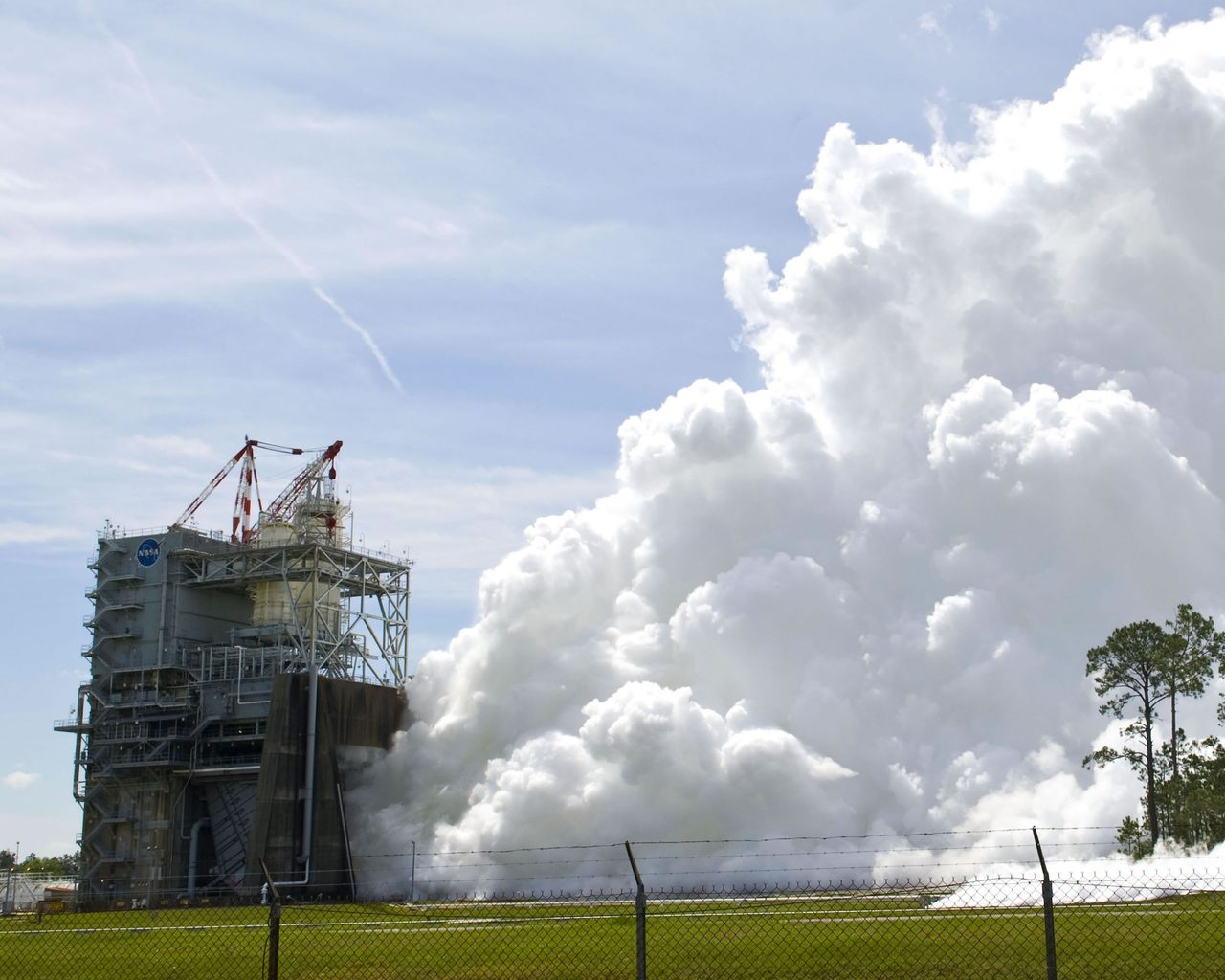
Chemical rockets dominate launches because they deliver the high thrust needed to overcome gravity and atmospheric drag. Chemical reactions release energy from propellants, producing hot, pressurised gas that expands through a nozzle; accelerating the exhaust backwards pushes the vehicle forwards.
Solid motors contain fuel and oxidiser (the substance enabling combustion) mixed in a solid grain. Liquid engines feed liquid propellants from separate tanks into a combustion chamber. Hybrids keep the components separate, usually pairing solid fuel with a liquid oxidiser.
Space Shuttle boosters used solid propellant; Falcon 9’s Merlin engines burn liquid kerosene and liquid oxygen. Hybrid motors have powered SpaceShipTwo. Solids offer readiness and simplicity, while liquid engines generally offer greater control; hybrids have their own engineering trade-offs. No combination is best for every mission. Orbital Radar’s launch vehicle profiles provide examples of these design choices.
At lift-off, upward thrust must exceed the vehicle’s weight. Electric propulsion accelerates propellant using electrical energy, but available power limits thrust: it cannot lift a conventional launch vehicle from Earth.
Chemical spacecraft thrusters serve different needs, including pointing and orbital manoeuvres. Some burn fuel with a separate oxidiser; monopropellant thrusters instead decompose a single propellant, often using a catalyst, to generate hot exhaust.
Orbital Radar tracking data lists 15,918 active satellites on 28 October 2026. Orbital Radar tracking data estimates orbital mass at 15,800 tonnes on 28 October 2026. Launching that hardware and manoeuvring it afterwards impose very different propulsion requirements.
What does specific impulse tell you about efficiency?
Specific impulse measures propellant economy: higher values mean an engine needs less propellant to sustain a given thrust for a given time. It is thrust divided by propellant weight flow under standard gravity — mass flow multiplied by standard gravitational acceleration — and is conventionally expressed in seconds.
Those seconds are not an engine’s burn duration. They express how much thrust an engine produces for the rate at which it consumes propellant. Orbital Radar’s specific impulse definition and units explain this convention; it measures propellant economy, not overall energy efficiency.
Delta-v is a spacecraft’s capacity to change velocity. The rocket equation links it to effective exhaust speed and mass ratio: the spacecraft’s mass before a burn divided by its mass afterwards. Faster exhaust increases the velocity change available from a given mass ratio; carrying more propellant also helps, but with diminishing returns.
High specific impulse does not guarantee high thrust. Accelerating a small propellant flow to high speed can conserve propellant while demanding substantial power. Power supplies, cooling equipment and other supporting systems can add mass, reducing the spacecraft-level benefit.
Orbital Radar tracking data lists 15,918 active satellites on 28 October 2026. Orbital Radar tracking data lists 9,980 active Starlink satellites on 28 October 2026. Across such fleets, specific impulse alone cannot reveal manoeuvre speed, power demand or the mass of the complete propulsion system.
How do electric thrusters move a spacecraft?
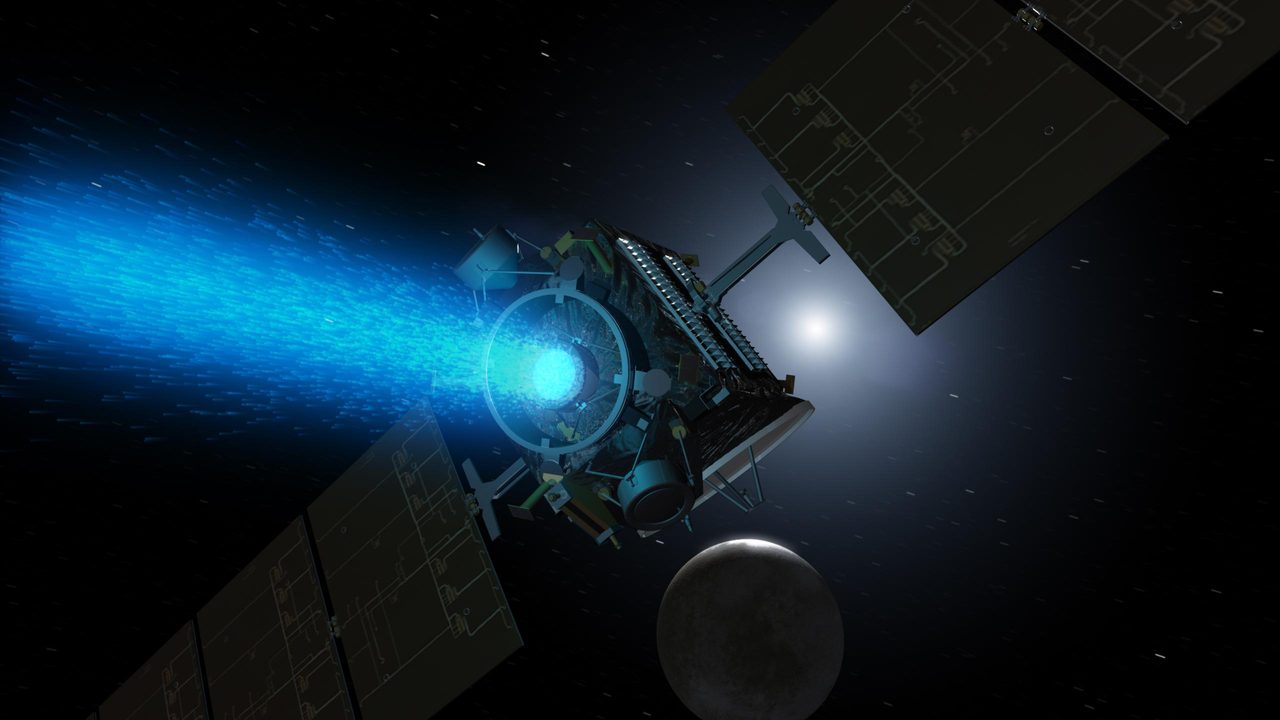
Electric thrusters move a spacecraft by using electrical energy to accelerate propellant backwards, producing a forward push. They still consume propellant: electricity supplies energy, but expelled material carries away the momentum needed to change the spacecraft’s motion.
A power supply, usually fed by solar arrays, provides electricity; a propellant feed system meters gas into the thruster. In gridded ion engines, gas atoms become ions (electrically charged particles), which electric fields accelerate through perforated grids. Hall-effect thrusters instead use a magnetic field to restrain electrons, helping ionise the gas while an electric field accelerates ions out of an open channel. These are two electric-propulsion designs, not the whole category.
For both designs, a neutraliser supplies electrons to balance the positive charge leaving in the ion beam. Without charge neutralisation, the spacecraft would accumulate an opposing charge that could hinder operation.
The key constraint is available electrical power. At a fixed power supply and comparable efficiency, accelerating exhaust to higher speeds means accelerating less propellant each second, reducing thrust. Higher exhaust speed improves propellant economy, but the resulting gentle push may need to operate for long periods.
Orbital Radar tracking data records 9,980 operational Starlink satellites as of 28 October 2026. Starlink is an operational example of electric propulsion, not evidence that every active satellite uses it. Orbital Radar’s electric propulsion glossary entry connects these mechanisms with orbit raising, station-keeping (maintaining a desired orbit) and deep-space flight, where sustained thrust can gradually build substantial changes in velocity.
Which propulsion systems suit different orbits and missions?
Chemical propulsion suits launch and urgent manoeuvres; electric propulsion suits gradual orbit changes when power and time permit. Launch needs enough thrust to overcome gravity, while orbit insertion needs a carefully timed velocity change to enter the intended orbit.
Orbit raising changes a spacecraft’s altitude; station-keeping corrects drift to maintain its assigned orbit or position. Disposal instead targets atmospheric re-entry or a graveyard orbit, requiring adequate remaining propellant and reliable control.
Orbital Radar tracking data lists 981 Starlink satellites raising orbit as of 28 October 2026. Orbital Radar tracking data lists 201 Starlink satellites deorbiting as of 28 October 2026.
A spacecraft may combine chemical propulsion for rapid insertion or collision avoidance with electric thrusters for slower orbit raising and station-keeping. Orbital Radar’s guide to types of orbits connects these tasks: low Earth orbit can require compensation for atmospheric drag, geostationary orbit needs position control, and interplanetary trajectories demand departure and arrival planning.
Solar electric propulsion depends on sunlight and spacecraft electrical capacity: eclipses interrupt solar generation, while batteries and other spacecraft systems constrain thruster operation. Farther from the Sun, weaker illumination reduces available solar power unless larger arrays compensate.
High exhaust speed reduces propellant needs but does not guarantee the quickest planetary journey. Low thrust can mean prolonged acceleration, so travel time also depends on spacecraft mass, available power, launch timing and trajectory.
How would a nuclear thermal rocket work?
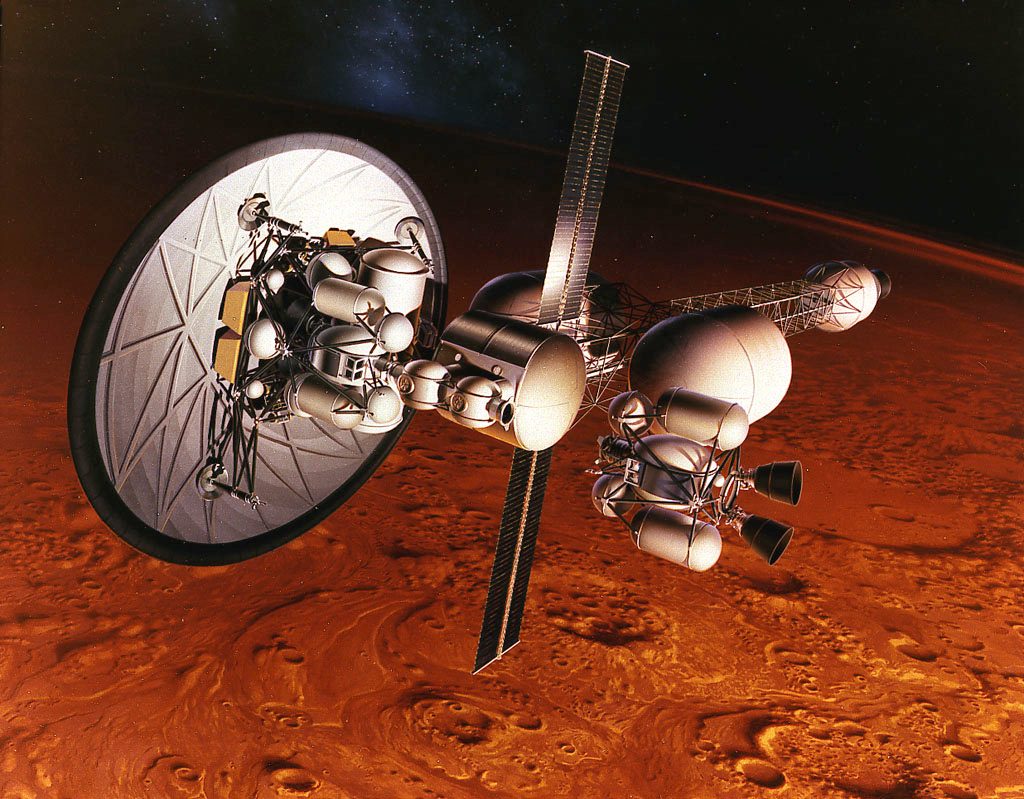
A nuclear thermal rocket uses a reactor to heat propellant, commonly hydrogen in studied designs, which then expands through a nozzle to produce thrust. The reactor supplies heat rather than chemical combustion: the spacecraft still needs a propellant tank, plumbing and a nozzle, and exhaust leaving the vehicle provides the push.
The intended benefit is substantial thrust with less propellant consumed for a given change in velocity than conventional chemical propulsion. Hot, lightweight hydrogen can leave the nozzle at high speed, improving specific impulse (thrust produced per unit of propellant weight consumed each second), explained in Orbital Radar’s glossary. These are design objectives, not demonstrated nuclear-powered flight performance.
The historical NERVA programme tested nuclear reactors and rocket-engine hardware on the ground. Those tests established important engineering capabilities, but did not produce an operational spaceflight system.
Fuel endurance means keeping reactor fuel intact through intense heating, flowing hydrogen and repeated operating cycles. Hydrogen storage requires bulky, insulated tanks and control of boil-off (liquid turning into gas). Shielding adds mass, while reactor control must manage startup, power changes, shutdown and residual heat.
Orbital Radar tracking data lists 15,918 active satellites as of 28 October 2026. Orbital Radar tracking data records 10 people in space on 28 October 2026. Neither figure demonstrates nuclear propulsion readiness; launch safety remains a separate engineering requirement, including preventing unintended reactor operation and assessing radioactive-material containment during launch accidents.
How is nuclear electric propulsion different?
Nuclear electric propulsion uses a reactor to supply electricity, rather than directly heating propellant for thrust. The reactor produces heat, a conversion system turns some into electricity, and electric thrusters use that electricity to accelerate propellant.
Unlike nuclear thermal propulsion, which expels reactor-heated gas, the electrical approach retains electric propulsion’s typically low thrust. A nuclear power source does not give an electric thruster a thermal rocket’s thrust characteristics. Orbital Radar’s electric propulsion glossary entry explains this distinction between power supply and thrust production.
Reactor power does not depend on sunlight, potentially supporting propulsion far from the Sun or through prolonged darkness. However, reactors, conversion equipment, shielding and radiators all add mass, reducing the advantage available to the payload.
Waste heat must leave the spacecraft mainly as thermal radiation: space provides no surrounding air to carry it away. Radiator size and temperature therefore matter alongside electrical output, thruster efficiency and total spacecraft mass. Reactor power alone cannot establish acceleration or journey time.
Voyager’s radioisotope thermoelectric generators produce electricity from radioactive decay, not a controlled fission chain reaction. They power spacecraft equipment; they are not nuclear rocket engines.
Orbital Radar tracking data lists 15,918 active satellites as of 28 October 2026. Orbital Radar’s live catalogue contains 31,878 objects, including debris, as of 28 October 2026. Neither figure is a count of nuclear-powered spacecraft.
What would nuclear propulsion tests actually prove?
Nuclear propulsion tests would establish how well particular components or complete systems perform under defined conditions—not whether nuclear spacecraft are ready for routine service. Fuel-material experiments can reveal resistance to heat, radiation and erosion; reactor tests can establish controlled heat production, but neither alone proves an engine works.
An integrated nuclear thermal firing must assess heat transfer, fuel integrity, propellant flow and controllability together. It must show that the reactor can heat flowing propellant while its fuel remains intact and the engine responds predictably to commands, rather than merely demonstrate a hot reactor.
A nuclear electric demonstration must combine electrical conversion, heat rejection and thruster operation. Producing electricity is insufficient: the system must also dispose of waste heat and deliver stable power to its thrusters. Orbital Radar’s electric propulsion glossary page explains the underlying propulsion method.
A flight demonstration could establish behaviour in space, including interactions that ground facilities cannot fully reproduce. Proposed experiments remain proposals until performed; scheduled dates are targets, not achieved results, and any future demonstration would need assessment against its stated objectives.
Orbital Radar tracking data records 15,918 active satellites as of 28 October 2026. Orbital Radar tracking data records 10 people in space as of 28 October 2026. Those figures describe existing space activity, not evidence that nuclear propulsion is operationally mature.
Successful tests would strengthen confidence in engineering performance and give mission planners firmer assumptions. They would not immediately establish reliability across repeated missions, lower costs or shorter crewed journeys: those claims require further operational evidence and mission-specific analysis.
How can you explore real propulsion choices on Orbital Radar?
Start with Orbital Radar’s launch vehicle pages, and use each vehicle’s engine and propellant descriptions to identify its chemical-propulsion category: solid, liquid or hybrid. Look for whether fuel and oxidiser are stored as solid material, supplied as liquids, or combined across those forms.
Keep the launcher separate from its payload. A launch vehicle’s engines provide the thrust needed to reach space and deliver a spacecraft to its intended orbit; the satellite may carry different thrusters for subsequent manoeuvres. Identifying the launcher therefore does not identify the satellite’s propulsion: that requires information about the spacecraft itself.
Orbital Radar’s live catalogue lists 15,918 active satellites as of 28 October 2026. This fleet total provides context for the range of spacecraft in orbit, not a count of satellites using any particular propulsion technology.
Read propulsion descriptions in a practical sequence: identify the mission phase, then the energy source and propellant. Next, ask whether thrust, propellant economy or available electrical power is the limiting factor. That sequence helps explain why a system suitable for launch may be unsuitable for prolonged orbital adjustments.
Treat catalogue positions and orbital movement as evidence of where a spacecraft is, not a reliable engine identifier. A changing orbit alone cannot establish that a particular manoeuvre used electric propulsion; that attribution needs spacecraft documentation or operational confirmation.
Key takeaways
- Chemical propulsion supplies the high thrust needed for launch and remains useful for rapid spacecraft manoeuvres.
- Electric propulsion trades low thrust and longer operating times for reduced propellant consumption, with performance constrained by available power.
- Nuclear thermal propulsion heats propellant directly, whereas nuclear electric propulsion uses reactor-generated electricity to power thrusters.
- Nuclear tests can establish engineering readiness, but they do not by themselves prove an operational transport system or guarantee shorter journeys.
Frequently Asked Questions
Can an ion engine run out of fuel?
Does a rocket need oxygen to work in space?
Are nuclear rocket engines the same as nuclear bombs?
Could a nuclear rocket be used to launch from Earth?
Do solar sails count as rocket propulsion?
📎 Cite this article · data available
Orbital Radar Newsroom. (2026). Types of Rocket Propulsion: Chemical, Electric and Nuclear. Orbital Radar. https://orbitalradar.com/blog/rocket-propulsion-compared"Types of Rocket Propulsion: Chemical, Electric and Nuclear." Orbital Radar, 28 October 2026, https://orbitalradar.com/blog/rocket-propulsion-compared.@misc{orbitalradar_rocket_propulsion_compared,
title = {Types of Rocket Propulsion: Chemical, Electric and Nuclear},
author = {{Orbital Radar}},
year = {2026},
howpublished = {\url{https://orbitalradar.com/blog/rocket-propulsion-compared}}
}