How often do asteroids pass closer than the Moon?
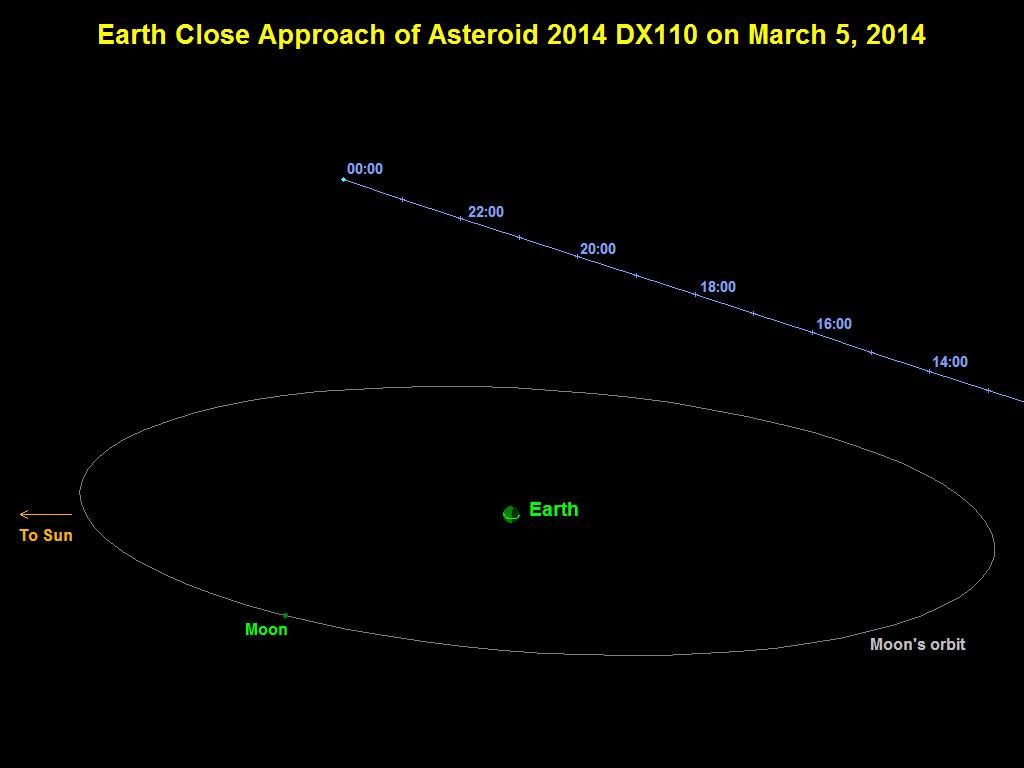
Orbital Radar recorded 46 asteroid approaches inside the Moon’s average distance in its current window. Here is what that count reveals — and why future encounters remain uncertain.
| Active satellites | 16,693 |
| Starlink active | 9,810 |
| Catalogued objects | 32,153 |
| Active close approaches | 21 |
| People in space | 10 |
Orbital Radar tracking data records 46 asteroid close approaches within one lunar distance of Earth between 28 June and 18 November 2026. Asteroids therefore pass closer than the Moon repeatedly, but this observed count is neither a fixed rate nor a complete prediction of future encounters.
One lunar distance is about 384,400 km, the average distance between Earth and the Moon. That gives a useful benchmark for describing a close pass, rather than a timetable for how often one should happen.
Asteroid 2026 PC6 made the closest recorded encounter in this window, passing Earth at 0.05 lunar distances on 12 August 2026, according to Orbital Radar tracking data. The asteroid was roughly 7–15 m across.
No further sub-lunar approaches are currently predicted through 14 February 2027 in Orbital Radar tracking data, but that is not a guarantee that none will occur. Readers can follow the changing encounter list on Orbital Radar’s near-Earth object close-approach page.
What does passing closer than the Moon actually mean?
An asteroid passes “closer than the Moon” when its closest distance from Earth is less than one lunar distance: about 384,400 km. This is the average distance between Earth and the Moon, not the Moon’s exact distance at every moment, which changes as it follows its elliptical orbit.
A sub-lunar approach therefore compares an asteroid’s closest approach with a fixed benchmark. It does not mean the asteroid passes near the Moon itself: the Moon could be elsewhere along its orbit when the asteroid goes past Earth.
The reference point also matters. A distance measured from Earth’s centre is not the same as altitude above its surface, so an encounter distance should not be read as a height above the ground. Orbital Radar tracking data records 46 asteroid approaches within one lunar distance between 28 June 2026 and 18 November 2026.
A near-Earth object, or NEO, is an asteroid or comet whose orbit brings it within 1.3 astronomical units of the Sun, where an astronomical unit is approximately Earth’s average distance from the Sun. This orbital classification, explained in Orbital Radar’s glossary, does not itself mean an object will pass inside the Moon’s distance.
Do these encounters happen at a predictable rate?
Asteroids repeatedly pass closer than the Moon, but this catalogue window does not establish a dependable weekly or annual rate. Orbital Radar tracking data records 46 asteroid approaches within one lunar distance of Earth between 28 June 2026 and 18 November 2026.
That is a count of encounters, not necessarily a count of distinct asteroids: an approach record describes a passage, and the total alone does not establish how many different objects were involved. The records demonstrate repeated occurrence during the historical window, but dividing them into a weekly or annual average would not establish a universal frequency.
A catalogue-window count is also not a complete census of everything that passed nearby, because an asteroid must be discovered and followed sufficiently well for its encounter to become known. Discovery determines which objects enter the catalogue, while follow-up observations help establish their paths; an unrecognised encounter cannot contribute to the recorded total.
Orbital Radar tracking data lists 0 further predicted asteroid approaches within one lunar distance through 14 February 2027. The historical portion of the Orbital Radar close-approach catalogue describes recorded encounters, whereas its future portion describes currently predicted encounters by known objects: joining them into a single, uniform sample would confuse the observing record with the forecast, rather than provide a sound estimate of how often these passages occur.
Which asteroid came closest in the current window?
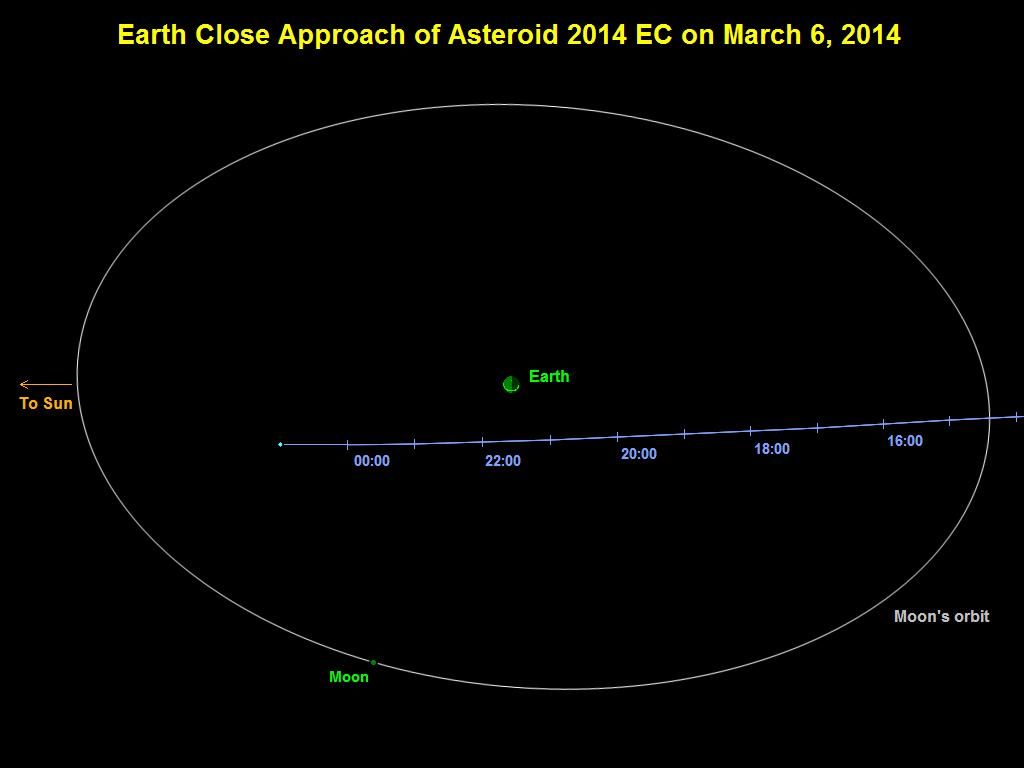
Asteroid 2026 PC6 made the closest encounter in the current window, passing Earth at 0.05 lunar distances on 12 August 2026, according to Orbital Radar tracking data. That makes it the nearest approach in this selection, not the closest asteroid approach ever recorded.
The window covers encounters from 28 June 2026 to 18 November 2026. Within that period, Orbital Radar tracking data records 46 asteroid approaches closer than one lunar distance (about 384,400 km). The distinction matters: a ranking within a defined interval is not an all-time record.
Orbital Radar tracking data gives 2026 PC6 an estimated diameter of roughly 7–15 m and an encounter speed of 14.0 km/s for its 12 August 2026 flyby. Encounter speed means how fast the asteroid was moving relative to Earth during the pass, rather than its speed relative to the Sun.
The diameter range is an estimate of size, not a direct measurement of the asteroid’s shape, composition or mass. It does not tell us whether 2026 PC6 was elongated, what materials it contained or how much it weighed.
Nor does proximity alone establish an impact trajectory: passing near Earth is different from being on a path that intersects it. The encounter’s distance, estimated size and speed can be explored together in Orbital Radar’s near-Earth object catalogue.
How do the other close passes compare?
2026 VL5 passed closer to Earth than 2026 RG15, but neither came as close as 2026 PC6; the largest of these asteroids was not the nearest. According to Orbital Radar tracking data, 2026 VL5 passed Earth at 0.14 lunar distances on 7 November 2026. According to Orbital Radar tracking data, 2026 RG15 passed Earth at 0.25 lunar distances on 15 September 2026.
A lunar distance is the average Earth–Moon separation, about 384,400 km. Against those two encounters, 2026 PC6’s passage at 0.05 lunar distances was nearer to Earth. These distances describe how closely each asteroid approached, not its size or the speed at which it travelled.
The estimated sizes put the objects in a different order: 2026 VL5 was roughly 2–4 m across, compared with 7–15 m for 2026 PC6 and 17–39 m for 2026 RG15. Even allowing for those size ranges, RG15 was the largest of this trio, while VL5 was the smallest. Yet VL5 travelled at 13.7 km/s, faster than RG15’s 9.1 km/s; PC6 was faster still at 14.0 km/s.
Closest, largest and fastest therefore describe different properties, rather than a single scale: encounter distance and speed depend on how an asteroid’s orbit meets Earth’s. These are illustrative comparisons, not a complete ranking of all 46 approaches inside the Moon’s distance in the tracking window. Orbital Radar’s close-approach listings let readers compare distance, estimated size and speed separately.
When is the next asteroid due inside the Moon’s distance?
As of 18 November 2026, Orbital Radar tracking data predict no further asteroid approaches inside one lunar distance through 14 February 2027. That means there is currently no date to give for the next predicted pass closer than the Moon within that window.
This is the present catalogue outlook, not a guarantee that no asteroid will enter that distance before the window ends. One lunar distance is about 384,400 km: an asteroid must pass nearer than that to fall within this article’s sub-lunar threshold.
Asteroid 2026 WJ is predicted to pass Earth at 1.68 lunar distances on 22 November 2026, according to Orbital Radar tracking data. Its estimated diameter is roughly 10–23 m. It is an upcoming listed encounter, but its predicted distance places it outside the closer-than-the-Moon category; it does not fill the gap in the sub-lunar forecast.
The distinction matters when browsing Orbital Radar’s asteroid close-approach list: an upcoming entry is not necessarily a passage inside the Moon’s distance. New discoveries can add encounters that were not previously listed, while further observations can refine an asteroid’s orbit and change its predicted passing distance. The upcoming list can therefore change before February, even though it currently contains no further predicted sub-lunar approaches through the stated end date.
Does a close asteroid pass mean Earth is in danger?
No. A close asteroid pass is not an impact prediction: a small miss distance alone does not establish a collision course. Assessing danger means examining the asteroid’s orbit and whether its path could intersect Earth at the same time, rather than treating proximity as evidence of an impending impact.
Asteroids over 140 m across that can approach within 7.5 million km of Earth are classed as potentially hazardous and tracked continuously. This is a screening classification based on size and orbital proximity, not a warning that a collision is imminent. Orbital Radar’s potentially hazardous objects page explains that distinction.
According to Orbital Radar tracking data, 2026 PC6 passed Earth at 0.05 lunar distances on 12 August 2026, with an estimated diameter of 7–15 m. According to Orbital Radar tracking data, 2026 VL5 passed at 0.14 lunar distances on 7 November 2026, with an estimated diameter of 2–4 m. The estimated diameter of 2026 RG15 was 17–39 m. All are below the 140 m size threshold, but being smaller than that threshold is not a guarantee of harmlessness.
If an asteroid were on an impact trajectory, its size would help determine how much energy it carried, while its composition and structural strength would influence how readily it broke apart. Entry speed and angle would also affect energy release and how that energy reached the atmosphere or ground. Those consequences are a separate question from whether an impact will occur; these close-approach distances alone do not establish an impact probability.
Why can the asteroid forecast change?
The asteroid forecast changes because it depends on what telescopes have detected and how precisely those objects’ orbits have been measured. Astronomers must first detect an asteroid and measure its position against the background stars before calculating its orbit and future close approaches.
Small asteroids can be faint, and observing geometry matters: an object appearing close to the Sun in the sky is difficult to observe from the ground. A short series of position measurements may fit several possible trajectories, leaving uncertainty in the predicted passing distance.
Asteroid 2026 VL5, estimated at roughly 2–4 m across, passed Earth at 0.14 lunar distances on 7 November 2026, according to Orbital Radar tracking data. It illustrates the small objects represented in recorded encounters, not how completely that population has been found.
Additional observations extend the measured track and help narrow the possible orbits, refining predicted distances. Newly discovered asteroids can also add encounters to an apparently empty future window; an empty listing does not mean no objects will pass.
Orbital Radar tracking data records 46 asteroid approaches within one lunar distance between 28 June 2026 and 18 November 2026. No further passes inside that distance are currently predicted through 14 February 2027 in Orbital Radar’s near-Earth object catalogue. Both statements describe the catalogue’s contents, not the full underlying asteroid population: the record can grow as discoveries and orbital measurements accumulate.
How can I check close asteroid approaches on Orbital Radar?
Use Orbital Radar’s close asteroid approaches listing to compare recorded encounters with upcoming predictions. For each entry, read the encounter date alongside the closest distance: a completed pass is a historical event, while a future encounter remains a prediction.
The designation identifies the asteroid, so use it to keep encounters by different objects separate. Wherever displayed, estimated diameter describes the object’s approximate size, usually as a range rather than a measured width; speed describes how fast it passes relative to Earth. Compare the closest distance with one lunar distance (about 384,400 km): a value below one is inside that threshold, and a value above one is outside it.
According to Orbital Radar tracking data, asteroid 2026 PC6 passed Earth at 0.05 lunar distances on 12 August 2026. Orbital Radar tracking data predicts that asteroid 2026 WJ will pass Earth at 1.68 lunar distances on 22 November 2026. These illustrate the distinction: PC6’s encounter was completed inside the Moon-distance threshold, whereas WJ’s predicted encounter lies outside it.
For wider orbital context, consult Orbital Radar’s near-Earth objects page alongside the encounter listing. Revisit the live listing when checking what is approaching next, rather than treating this article’s snapshot as a permanent forecast: newly discovered objects and revised orbital calculations can change the picture.
Key takeaways
- Orbital Radar recorded 46 asteroid approaches within one lunar distance between 28 June and 18 November 2026, demonstrating repeated encounters rather than a fixed timetable.
- The closest encounter in this window was 2026 PC6, which passed at 0.05 lunar distances on 12 August 2026.
- No further sub-lunar approaches are currently predicted in the store through 14 February 2027, but new discoveries can change that outlook.
- The predicted 2026 WJ encounter on 22 November 2026 is outside the threshold at 1.68 lunar distances and can be followed through Orbital Radar’s close-approach listing.
Frequently Asked Questions
Can an asteroid passing closer than the Moon be seen with the naked eye?
How do astronomers estimate an asteroid’s size?
What does the asteroid designation 2026 PC6 mean?
Can Earth’s gravity change an asteroid’s orbit during a flyby?
Are near-Earth objects always asteroids, or can they be comets?
Cite this article
Pick a style, then copy it or download it for your reference manager.Orbital Radar. (2026, November 20). How often do asteroids pass closer than the Moon? Retrieved November 20, 2026, from https://orbitalradar.com/blog/asteroids-closer-than-the-moon
“How often do asteroids pass closer than the Moon?” Orbital Radar, 20 Nov. 2026, orbitalradar.com/blog/asteroids-closer-than-the-moon. Accessed 20 Nov. 2026.
Orbital Radar (2026) How often do asteroids pass closer than the Moon? Available at: https://orbitalradar.com/blog/asteroids-closer-than-the-moon (Accessed: 20 November 2026).
Orbital Radar. “How often do asteroids pass closer than the Moon?” Last modified November 20, 2026. https://orbitalradar.com/blog/asteroids-closer-than-the-moon.
@misc{orbitalradar_blog_asteroids_closer_than_the_moon,
  author       = {{Orbital Radar}},
  title        = {How often do asteroids pass closer than the Moon?},
  year         = {2026},
  month        = nov,
  howpublished = {\url{https://orbitalradar.com/blog/asteroids-closer-than-the-moon}},
  url          = {https://orbitalradar.com/blog/asteroids-closer-than-the-moon},
  urldate      = {2026-11-20},
  note         = {Accessed 2026-11-20}
}
TY - ELEC AU - Orbital Radar, TI - How often do asteroids pass closer than the Moon? PY - 2026 DA - 2026/11/20 PB - Orbital Radar UR - https://orbitalradar.com/blog/asteroids-closer-than-the-moon Y2 - 2026/11/20 LA - en ER -
Live figures change, so keep the date you accessed the page. How to cite Orbital Radar