Bubbling Betelgeuse: a giant star with stubborn hotspots
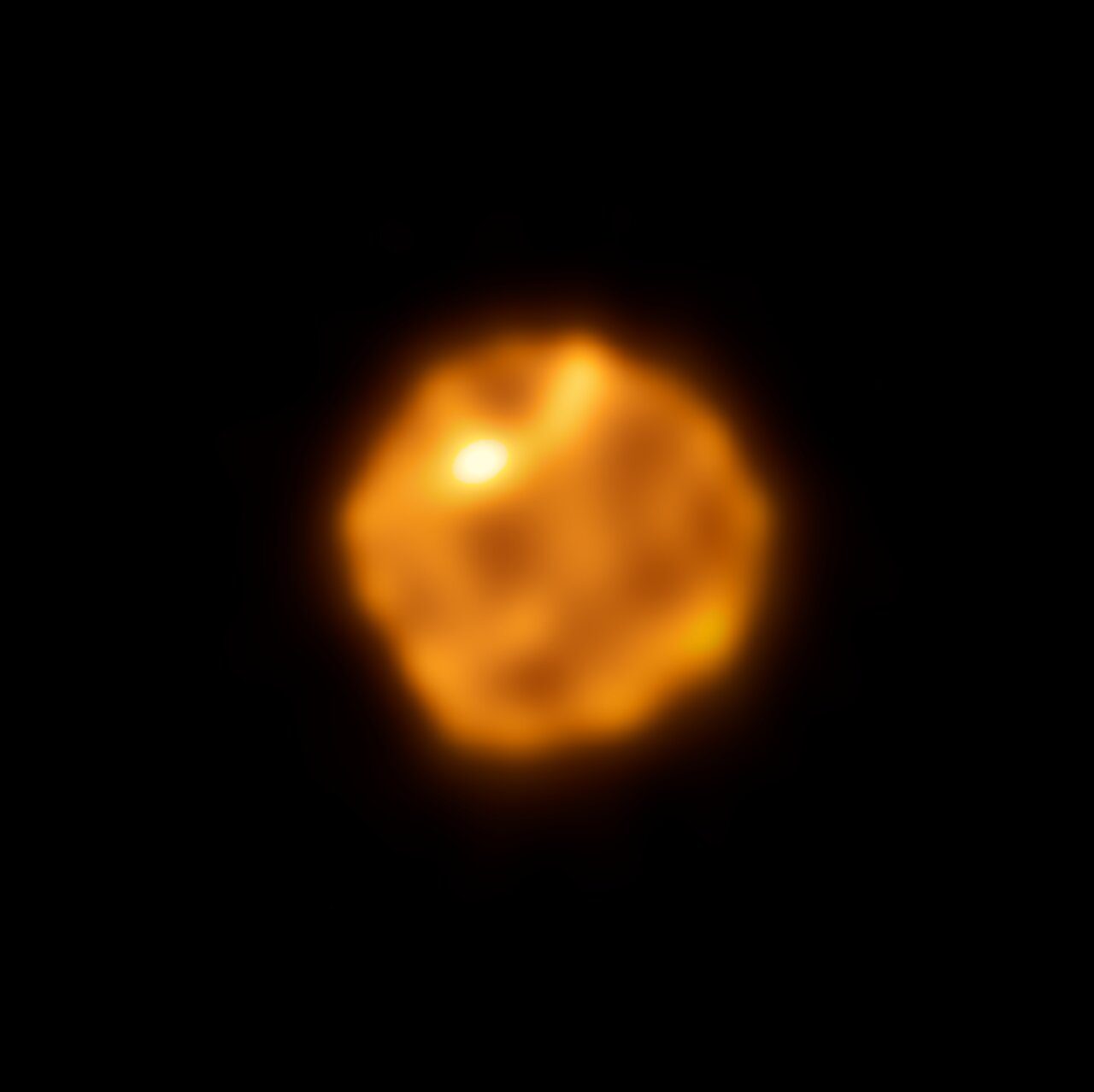
ALMA’s view of Betelgeuse reveals a lumpy stellar surface shaped by rising gas, with a persistent hotspot that challenges models of this ageing red supergiant.
| Active satellites | 16,711 |
| Catalogued objects | 32,149 |
| Starlink active | 9,790 |
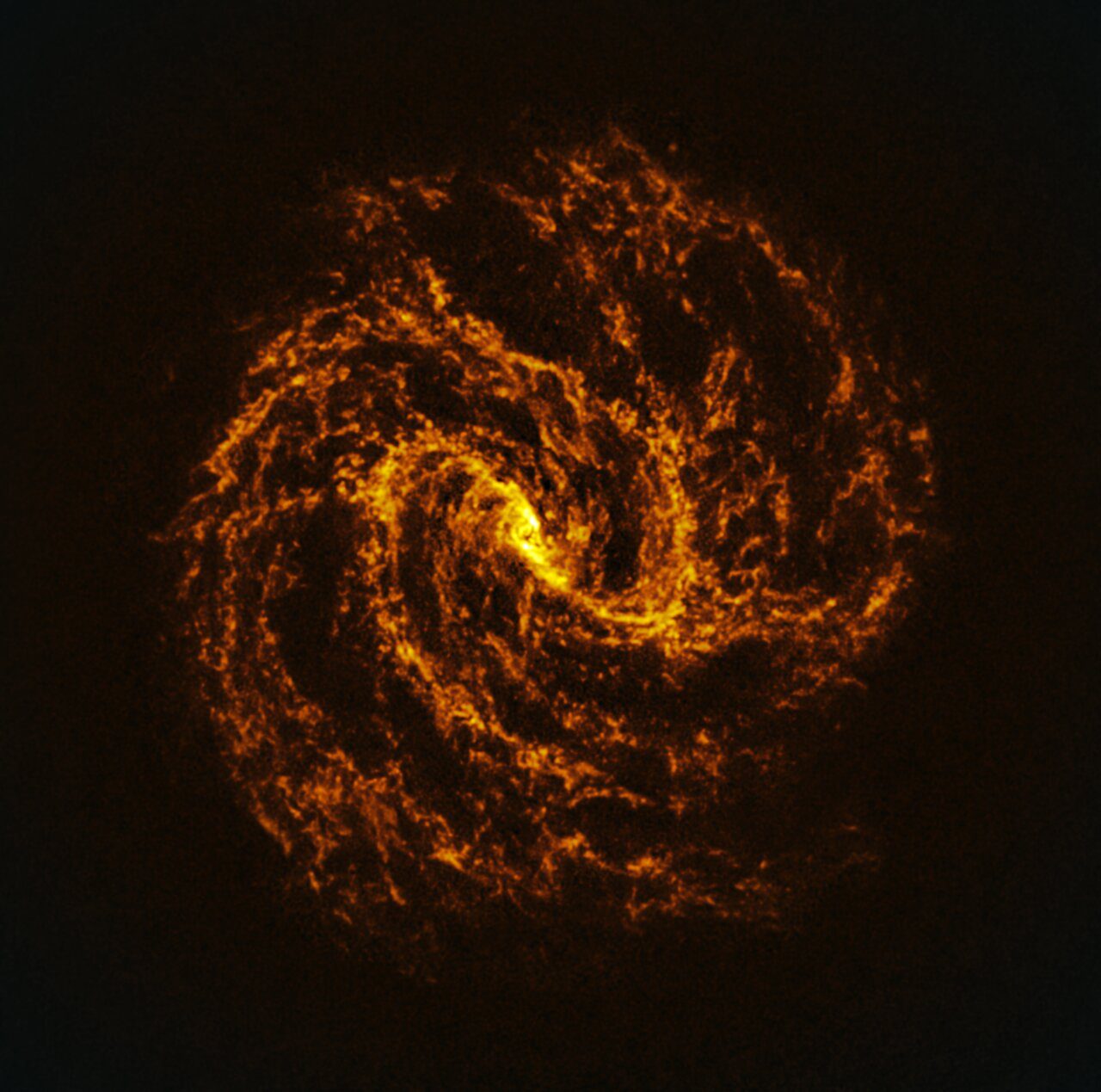
A bright hotspot on Betelgeuse appears in observations separated by seven years — a persistence that current models struggle to explain. This view from the Atacama Large Millimeter/submillimeter Array (ALMA) reveals the uneven surface of the orange star in Orion, about 600 light-years away.
Betelgeuse is a red supergiant, an expanded star approaching the end of its life, almost 800 times larger than the Sun. Its lumpy appearance reflects giant bubbles of hot gas rising from deep inside the star. The researchers suggest that this large-scale gas movement produces the surface hotspots.
A surface that challenges stellar models
The brightest hotspot also appears in the earlier observations, outlasting the lifetimes predicted by current models. Its persistence may be connected to the orbit of a close companion star recently suggested by observations with ESO’s Very Large Telescope; that explanation remains tentative.
The team studied the surface partly to investigate whether hotspots could be related to events such as Betelgeuse’s dramatic dimming in 2020. Understanding its present behaviour also helps astronomers investigate a star destined to explode as a supernova. That eventual explosion should be visible in daylight, but this image does not establish when it will happen.
Separating stellar change from orbital motion
Betelgeuse’s changing surface is a different phenomenon from the moving points of light that cross an observer’s sky. Orbital Radar tracking data records 16,711 active satellites in Earth orbit as of November 2026.
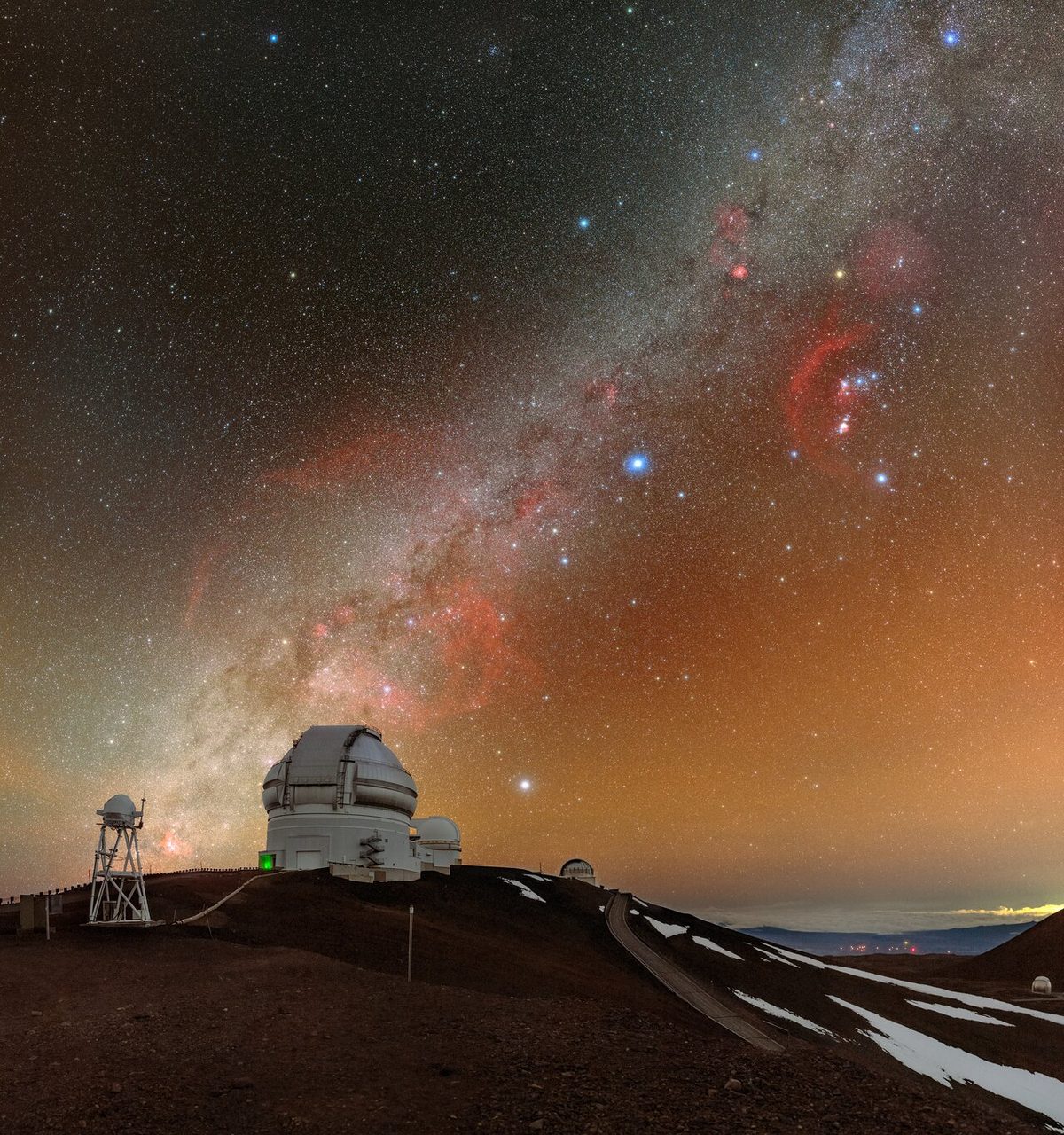
Orbital Radar tracking data records 9,790 active Starlink satellites as of November 2026. For observers distinguishing satellite crossings from the stars beyond, the Orbital Radar Pass Predictor provides a practical companion to an evening looking towards Orion.
Frequently Asked Questions
Why does Betelgeuse look lumpy in the ALMA image?
Does the Betelgeuse hotspot mean it will explode soon?
Cite this article
Pick a style, then copy it or download it for your reference manager.Orbital Radar. (2026, November 20). Bubbling Betelgeuse: a giant star with stubborn hotspots. Retrieved November 20, 2026, from https://orbitalradar.com/blog/cosmic-gallery-2026-11-20
“Bubbling Betelgeuse: a giant star with stubborn hotspots.” Orbital Radar, 20 Nov. 2026, orbitalradar.com/blog/cosmic-gallery-2026-11-20. Accessed 20 Nov. 2026.
Orbital Radar (2026) Bubbling Betelgeuse: a giant star with stubborn hotspots. Available at: https://orbitalradar.com/blog/cosmic-gallery-2026-11-20 (Accessed: 20 November 2026).
Orbital Radar. “Bubbling Betelgeuse: a giant star with stubborn hotspots.” Last modified November 20, 2026. https://orbitalradar.com/blog/cosmic-gallery-2026-11-20.
@misc{orbitalradar_blog_cosmic_gallery_2026_11_20,
  author       = {{Orbital Radar}},
  title        = {Bubbling Betelgeuse: a giant star with stubborn hotspots},
  year         = {2026},
  month        = nov,
  howpublished = {\url{https://orbitalradar.com/blog/cosmic-gallery-2026-11-20}},
  url          = {https://orbitalradar.com/blog/cosmic-gallery-2026-11-20},
  urldate      = {2026-11-20},
  note         = {Accessed 2026-11-20}
}
TY - ELEC AU - Orbital Radar, TI - Bubbling Betelgeuse: a giant star with stubborn hotspots PY - 2026 DA - 2026/11/20 PB - Orbital Radar UR - https://orbitalradar.com/blog/cosmic-gallery-2026-11-20 Y2 - 2026/11/20 LA - en ER -
Live figures change, so keep the date you accessed the page. How to cite Orbital Radar