Iapetus: Saturn's Two-Toned Enigma
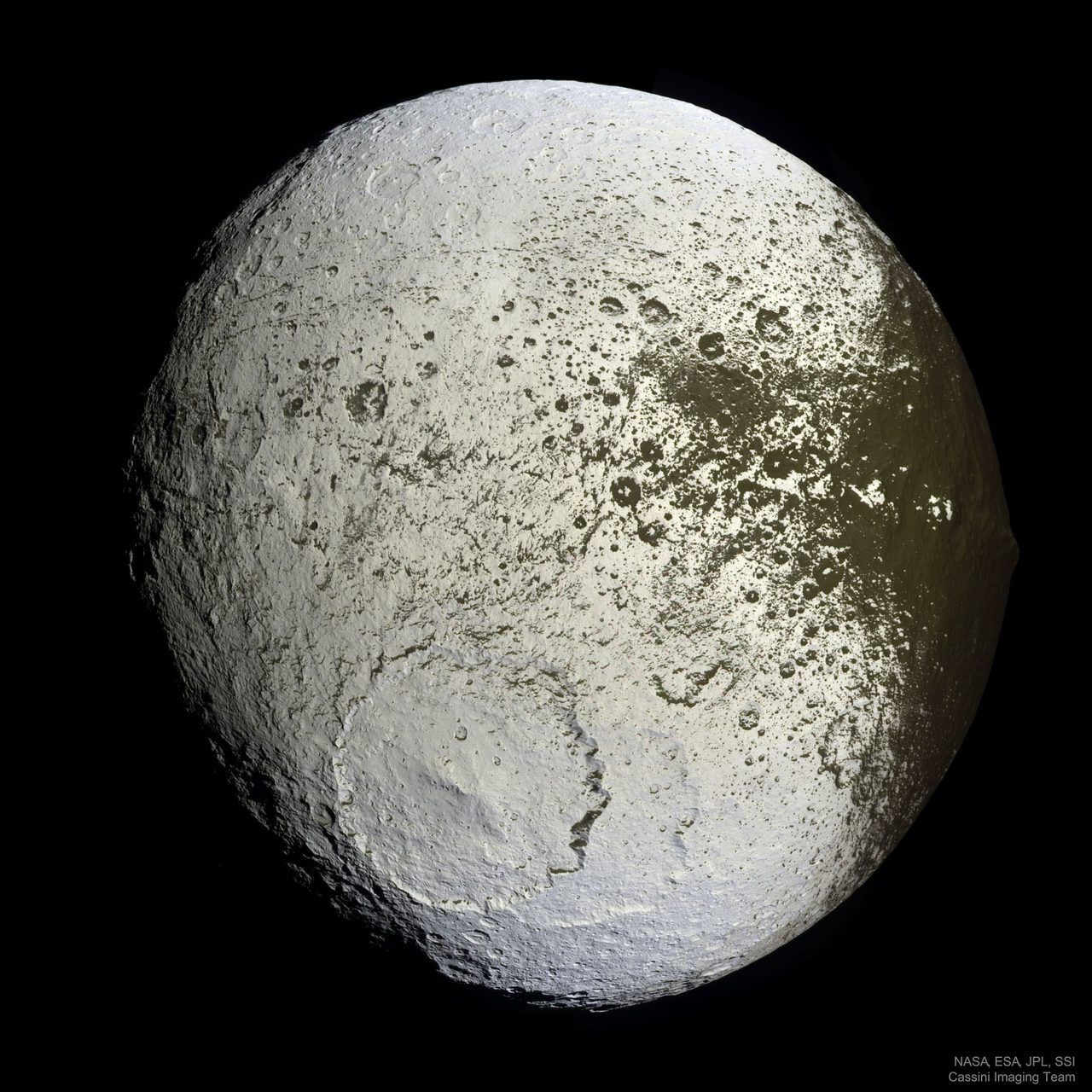
Saturn's moon Iapetus presents a striking contrast with its dark and light hemispheres. Discover the science behind its unique appearance.
Saturn's moon Iapetus is a celestial oddity, renowned for its stark dichotomy between dark and light regions. Captured by NASA's Cassini spacecraft in 2007, Iapetus displays a unique surface with vast areas as dark as coal juxtaposed against bright snowy expanses. This image, taken from approximately 75,000 kilometres away, highlights the trailing hemisphere, featuring a prominent 500-kilometre-wide impact crater. The intriguing dark material, hypothesised to be carbon-rich soil, covers much of the eastern hemisphere, offering clues to the moon's mysterious past.
Unveiling Iapetus's Mysteries
The peculiar appearance of Iapetus has intrigued scientists for decades. One leading theory suggests that the dark material is a result of sublimation, where relatively warm but dirty ice transforms into gas, leaving behind carbon-rich residue. Additionally, the initial dark coating might have originated from debris accreted from other moons, painting Iapetus in its distinctive hues. This phenomenon offers a fascinating glimpse into the processes shaping celestial bodies in our solar system. For those interested in exploring more about such cosmic phenomena, the Space Academy provides valuable resources.
Observing the Celestial Canvas
While Iapetus is not visible to the naked eye from Earth, understanding its unique features enriches our appreciation of the solar system's complexity. For enthusiasts keen on tracking other celestial bodies, the Pass Predictor on Orbital Radar offers insights into visible satellite passes over your location. This tool enables skywatchers to connect with the night sky and observe the intricate dance of satellites and celestial bodies.
Frequently Asked Questions
Why is Iapetus two-toned?
How was Iapetus studied?
📎 Cite this article
Orbital Radar Newsroom. (2026). Iapetus: Saturn's Two-Toned Enigma. Orbital Radar. https://orbitalradar.com/blog/cosmic-gallery-2026-05-01"Iapetus: Saturn's Two-Toned Enigma." Orbital Radar, 1 May 2026, https://orbitalradar.com/blog/cosmic-gallery-2026-05-01.@misc{orbitalradar_cosmic_gallery_2026_05_01,
title = {Iapetus: Saturn's Two-Toned Enigma},
author = {{Orbital Radar}},
year = {2026},
howpublished = {\url{https://orbitalradar.com/blog/cosmic-gallery-2026-05-01}}
}