A cosmic construction project bends distant starlight
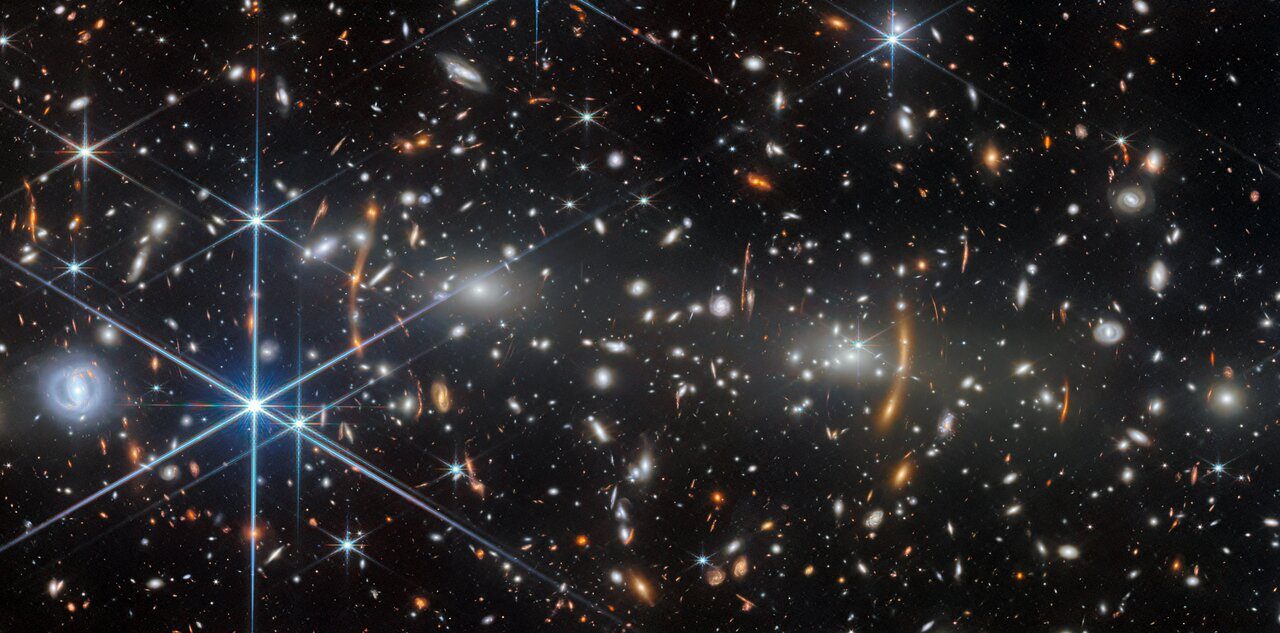
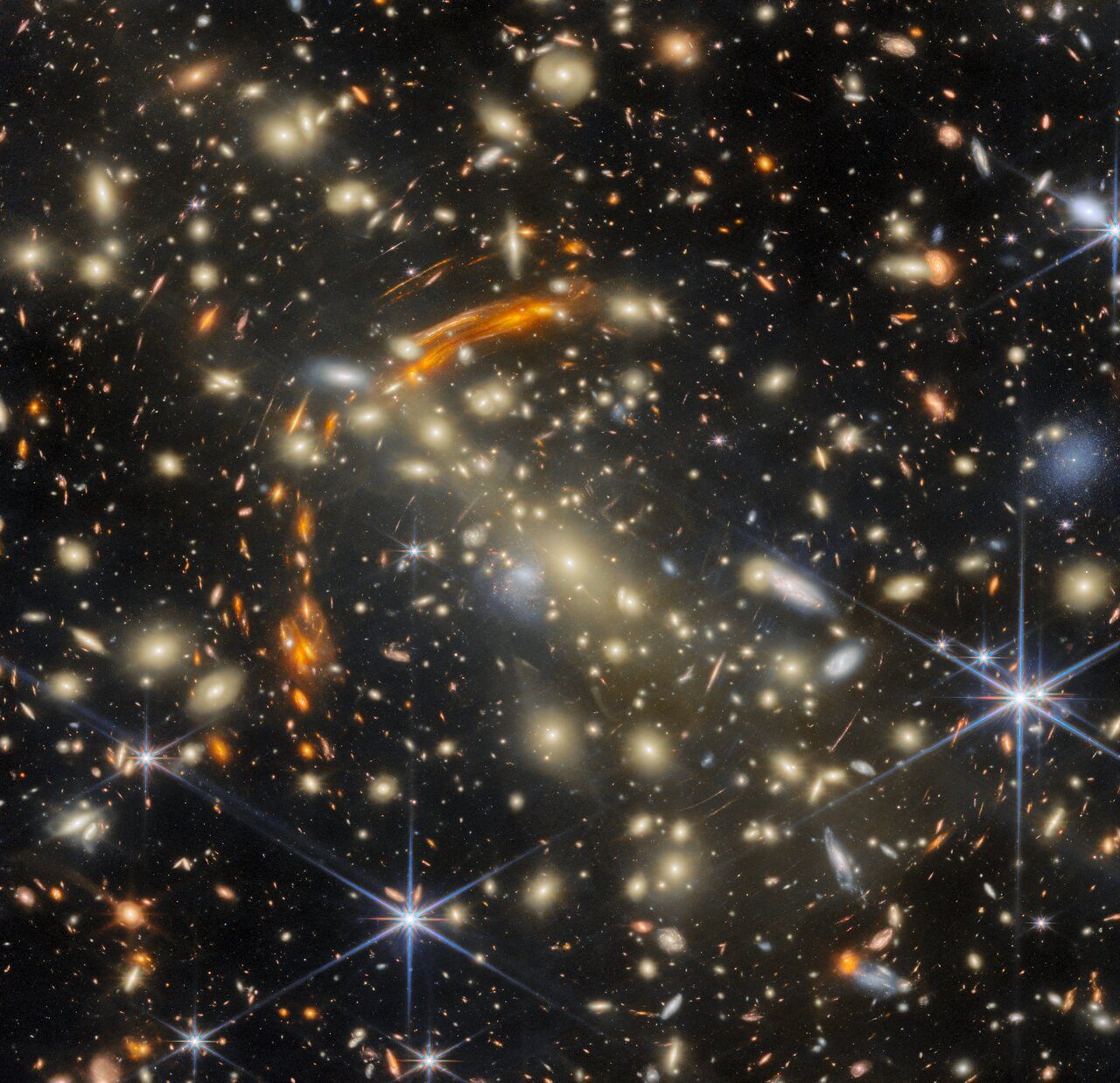
Two merging galaxy groups dominate Webb’s view of MACS J0553.4-3342. Their combined gravity stretches distant background galaxies into luminous orange arcs.
| Active satellites | 15,873 |
| Catalogued objects | 31,839 |
| Starlink active | 10,080 |
Two colliding subclusters are building MACS J0553.4-3342, the galaxy cluster at the centre of this James Webb Space Telescope image. In the constellation Columba, the cluster appears as it was 4.4 billion years ago, its light stretched by cosmic expansion to a redshift of 0.412 (a measure of that stretching).
The roughly equal-mass subclusters have already passed through each other and separated by more than one million light-years. Gravity will draw them back into repeated encounters before they finally merge, while extremely hot gas within the cluster radiates X-rays.
A construction site that doubles as a telescope
The two brightest central points, surrounded by large glowing halos, are massive elliptical galaxies anchoring the subclusters. Smaller white elliptical galaxies belong to the growing system; foreground spirals, dusty discs and bright Milky Way stars also populate the scene.
The orange arcs beside the subclusters reveal gravitational lensing (the bending of light by mass). The left-hand arc’s three connected bright spots are three images of a single background galaxy, not three separate galaxies.
This distortion makes the cluster a scientific instrument as well as a subject. Where alignment is favourable, its gravity magnifies background galaxies and even individual stars that would otherwise be too faint to detect.
From distant galaxies to Earth orbit
Webb’s view probes cosmic structure, while tracking nearer Earth describes a very different population of objects. Orbital Radar tracking data records 15,873 active satellites as of 21 October 2026.
Orbital Radar’s live catalogue contains 31,839 tracked objects, including debris, as of 21 October 2026. For that local perspective, the Orbital Radar space situational awareness toolkit brings together tools for exploring the orbital environment—a distinct task from interpreting the distant galaxies in this image.
Frequently Asked Questions
What is MACS J0553.4-3342?
Why does Webb’s image show orange arcs?
📎 Cite this article · data available
Orbital Radar Newsroom. (2026). A cosmic construction project bends distant starlight. Orbital Radar. https://orbitalradar.com/blog/cosmic-gallery-2026-10-21"A cosmic construction project bends distant starlight." Orbital Radar, 21 October 2026, https://orbitalradar.com/blog/cosmic-gallery-2026-10-21.@misc{orbitalradar_cosmic_gallery_2026_10_21,
title = {A cosmic construction project bends distant starlight},
author = {{Orbital Radar}},
year = {2026},
howpublished = {\url{https://orbitalradar.com/blog/cosmic-gallery-2026-10-21}}
}