Long-distance relationship: Arp 4’s deceptive galaxy pair
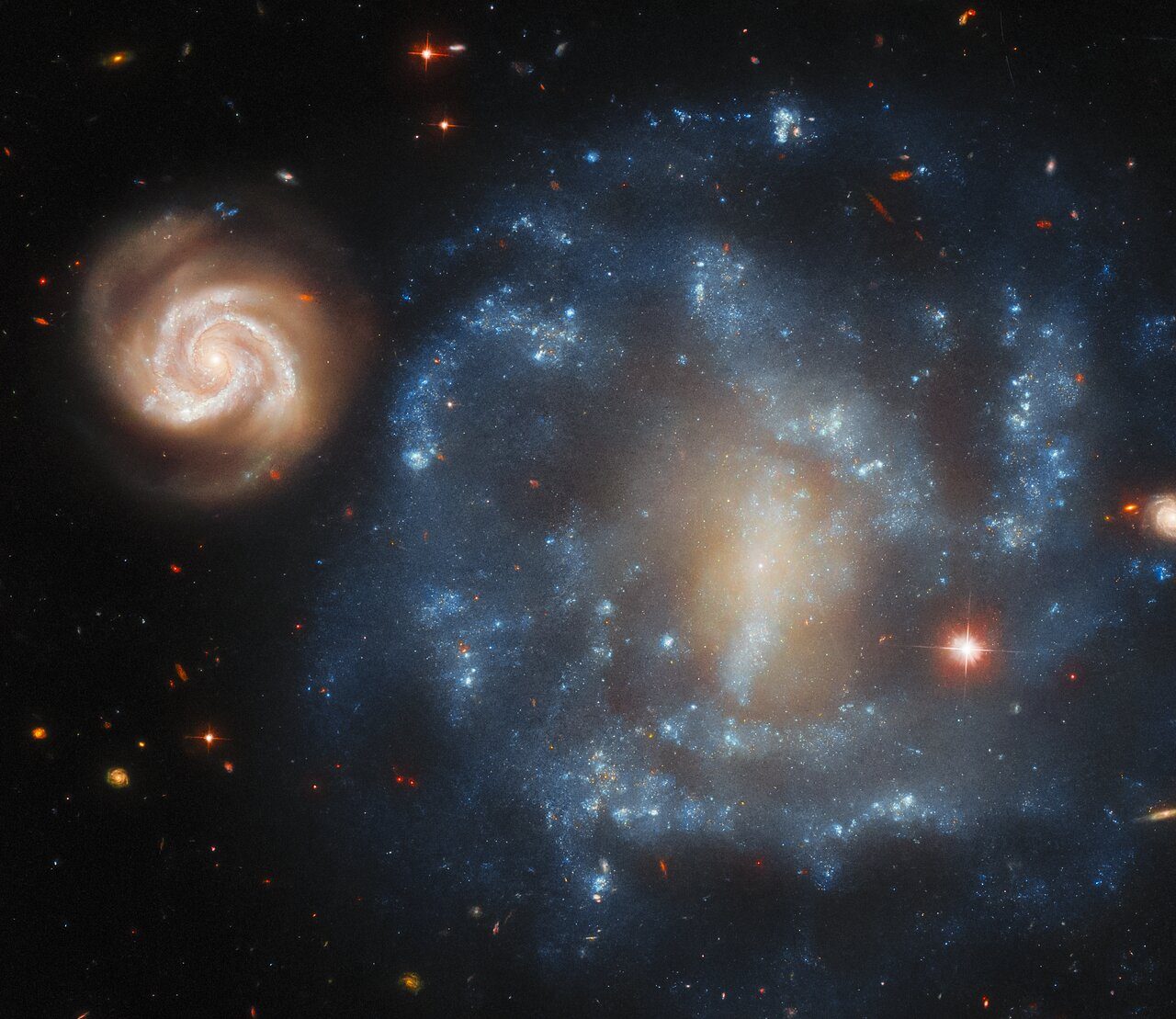
Arp 4 looks like a pair of neighbouring galaxies. Hubble’s view instead reveals a chance alignment, with the brighter spiral more than ten times farther away.
| Active satellites | 15,877 |
| Catalogued objects | 31,827 |
| Starlink active | 10,061 |
These apparently neighbouring galaxies are separated by an enormous gulf in distance: MCG-02-05-050 lies 65 million light-years from Earth, while MCG-02-05-050a lies 675 million light-years away. Together they form the apparent pairing Arp 4, in Cetus, the Whale. Their proximity in this Hubble image is a coincidence of our viewing direction, not evidence of a physical partnership.
The larger-looking blue galaxy dominates the right of the image, with a glowing central bar, fragmentary arms and uneven concentrations of blue. At the upper left, its seemingly smaller companion has a brighter spiral and clearly defined arms. Because that companion is more than ten times farther away, it is likely the physically larger galaxy: apparent size alone can tell a misleading story.
Why perspective matters
Arp 4 takes its name from Halton Arp’s Atlas of Peculiar Galaxies, compiled in the 1960s to help astronomers investigate unusual galactic forms. The nearer galaxy belongs to the atlas’s low surface brightness category: its light is spread faintly across its disc, making it difficult to detect. Its disturbed appearance does not establish that the bright spiral beside it is responsible.
The same distinction between a flat view and a three-dimensional relationship matters closer to Earth, where orbital paths must be assessed rather than judged from apparent proximity. Orbital Radar tracking data lists 15,877 active satellites in orbit today. Orbital Radar tracking data lists 16 active close approaches being tracked today. The Orbital Radar space situational awareness toolkit puts that near-Earth environment in context; Arp 4 offers a much more distant reminder that objects sharing a patch of sky need not share a neighbourhood.
Frequently Asked Questions
Are the galaxies in Arp 4 actually close together?
Why does the more distant galaxy in Arp 4 look smaller?
📎 Cite this article · data available
Orbital Radar Newsroom. (2026). Long-distance relationship: Arp 4’s deceptive galaxy pair. Orbital Radar. https://orbitalradar.com/blog/cosmic-gallery-2026-10-23"Long-distance relationship: Arp 4’s deceptive galaxy pair." Orbital Radar, 23 October 2026, https://orbitalradar.com/blog/cosmic-gallery-2026-10-23.@misc{orbitalradar_cosmic_gallery_2026_10_23,
title = {Long-distance relationship: Arp 4’s deceptive galaxy pair},
author = {{Orbital Radar}},
year = {2026},
howpublished = {\url{https://orbitalradar.com/blog/cosmic-gallery-2026-10-23}}
}