A neighbouring vista: stars sculpt the clouds of N159
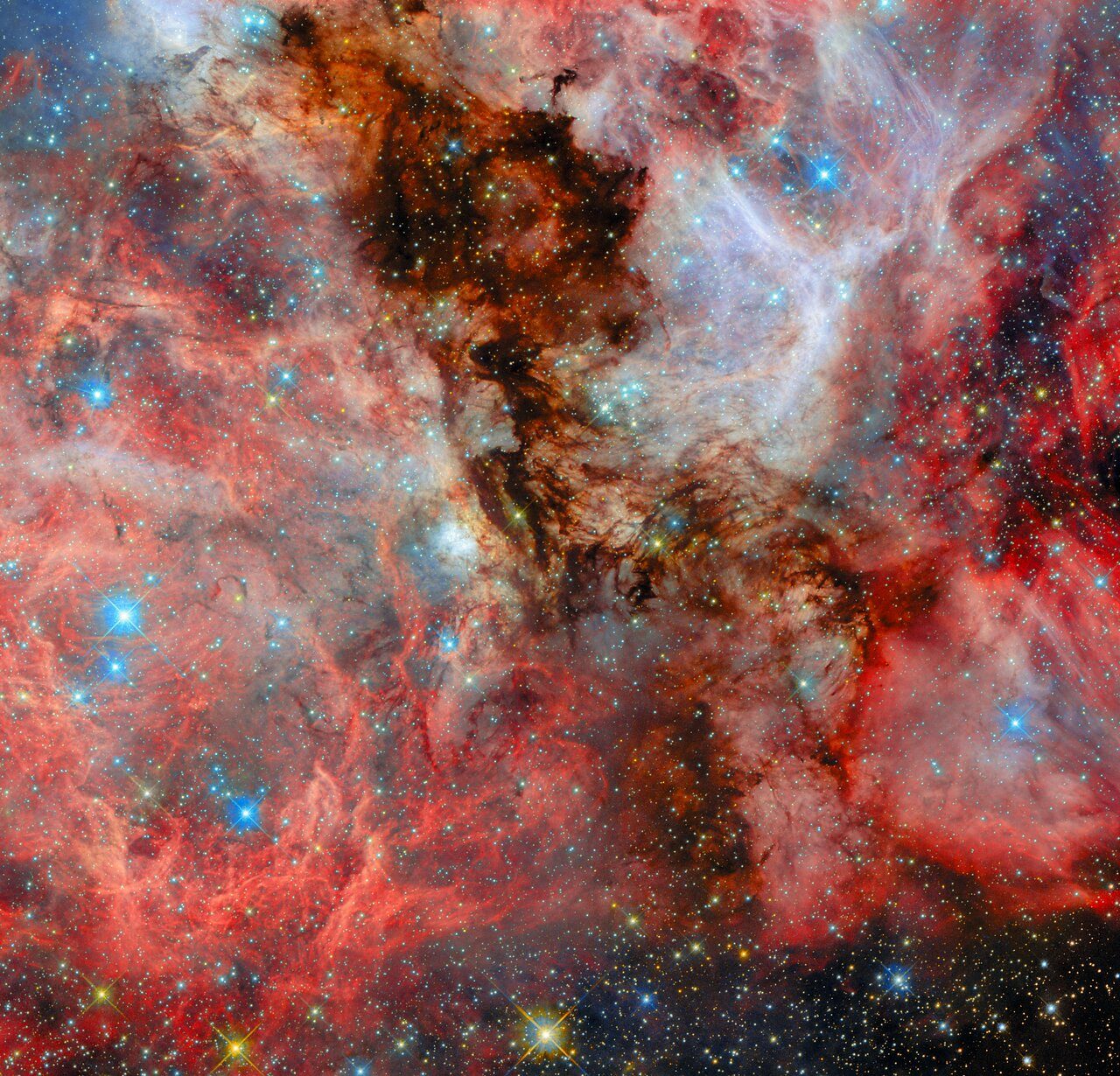
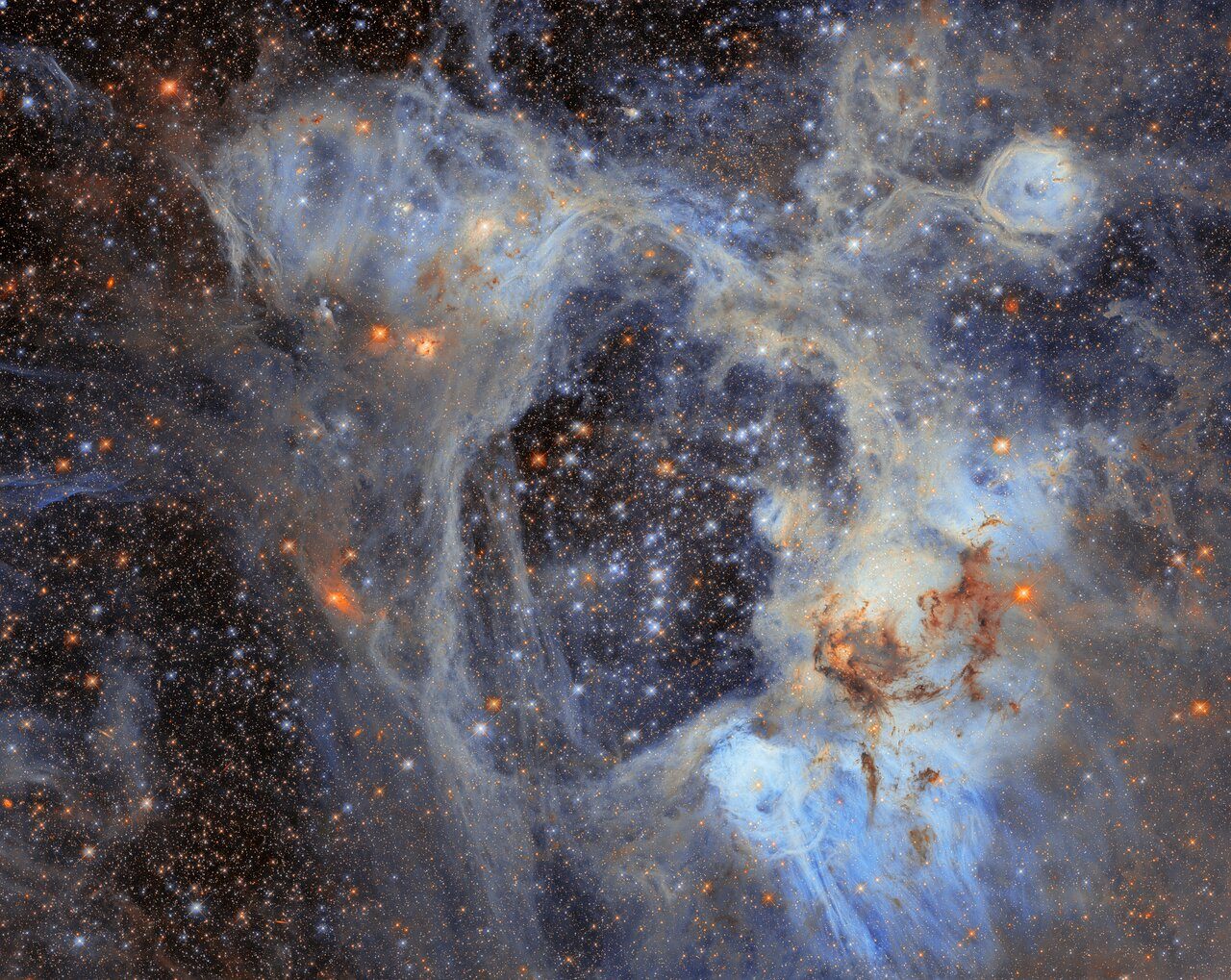
In this ESA/Hubble view of N159, young stars illuminate hydrogen clouds and sculpt cavities, revealing how stellar birth transforms a neighbouring galaxy.
| Active satellites | 15,880 |
| Catalogued objects | 31,835 |
| Starlink active | 10,078 |
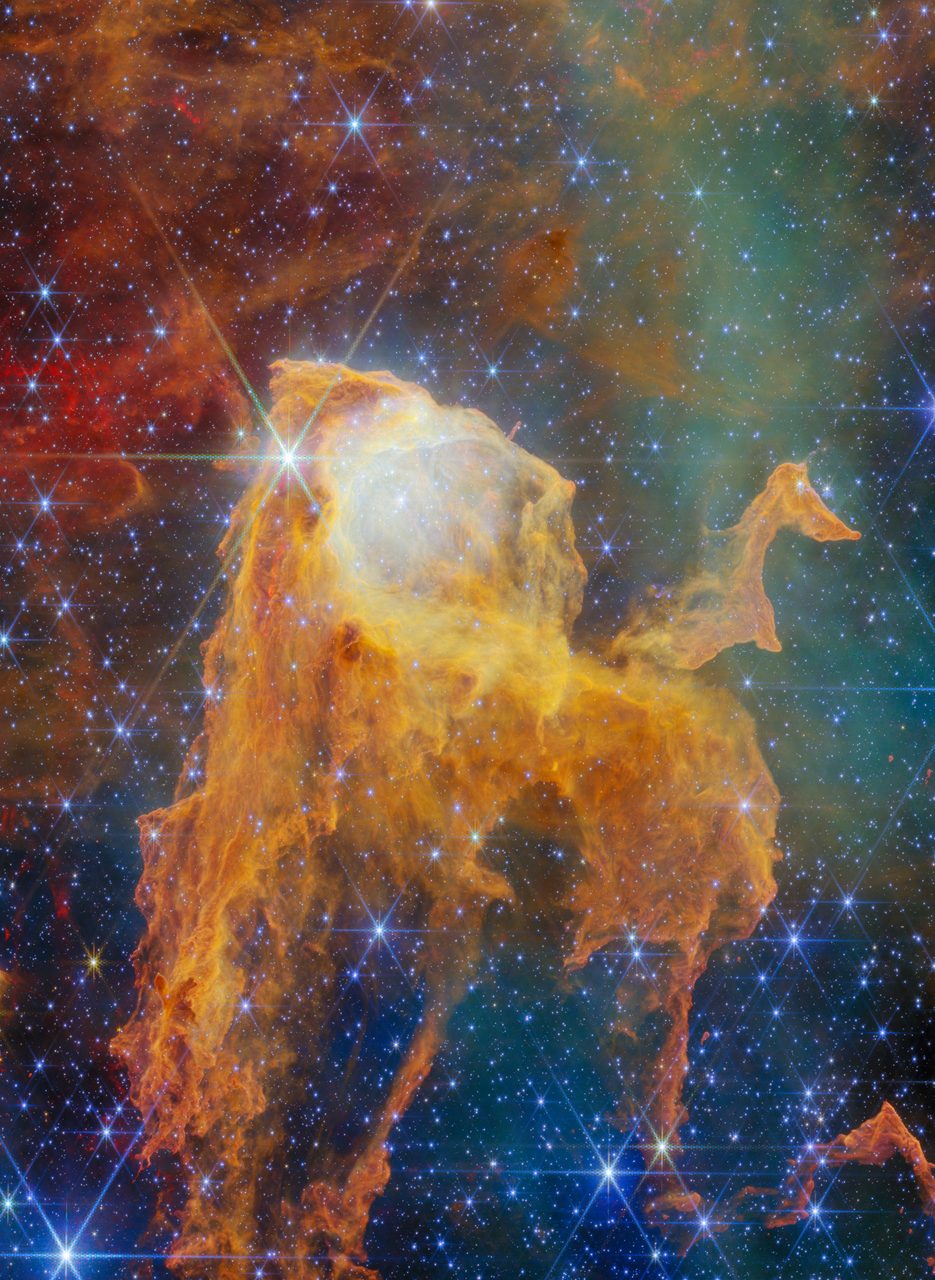
Newly formed stars are reshaping their birthplace in this ESA/Hubble view of N159, a star-forming complex in the Large Magellanic Cloud. Glowing red filaments surround a thick, dark central column, where foreground dust blocks the light of stars behind it.
The scene captures stellar feedback (the effects of stars’ radiation and outflowing material on surrounding gas). Hot, massive young stars make hydrogen glow, while their powerful stellar winds and energetic light carve bubbles and hollow cavities through the clouds. Blue, white and gold stars appear around, within and through the layered material.
This is only a neighbouring portion of a much larger stellar nursery: the N159 complex stretches over 150 light-years across. Its ridges, illuminated clouds and dark foreground structures show that a birthplace of stars is also an environment being continually remodelled by them.
From a stellar nursery to Earth's orbital environment
The Large Magellanic Cloud is a dwarf galaxy orbiting the Milky Way. Studying regions such as N159 helps explain the relationship between newborn stars and the gas from which they emerge: the stars do not simply light the scenery, but physically change it.
Space astronomy also connects these distant environments to the spacecraft population closer to home. Orbital Radar tracking data lists 15,880 active satellites in Earth orbit as of 22 October 2026. Orbital Radar's live catalogue contains 31,835 objects, including debris, as of 22 October 2026.
For the Earth-orbiting side of that story, the Orbital Radar Satellite Library provides a way to explore spacecraft. N159 offers the complementary perspective: a view beyond our orbital neighbourhood, into the material cycle that builds and transforms stars.
Frequently Asked Questions
What does the Hubble image of N159 show?
Why do the clouds in N159 glow red?
📎 Cite this article · data available
Orbital Radar Newsroom. (2026). A neighbouring vista: stars sculpt the clouds of N159. Orbital Radar. https://orbitalradar.com/blog/cosmic-gallery-2026-10-22"A neighbouring vista: stars sculpt the clouds of N159." Orbital Radar, 22 October 2026, https://orbitalradar.com/blog/cosmic-gallery-2026-10-22.@misc{orbitalradar_cosmic_gallery_2026_10_22,
title = {A neighbouring vista: stars sculpt the clouds of N159},
author = {{Orbital Radar}},
year = {2026},
howpublished = {\url{https://orbitalradar.com/blog/cosmic-gallery-2026-10-22}}
}