A superbubble scene: how N44’s stars sculpt their nursery
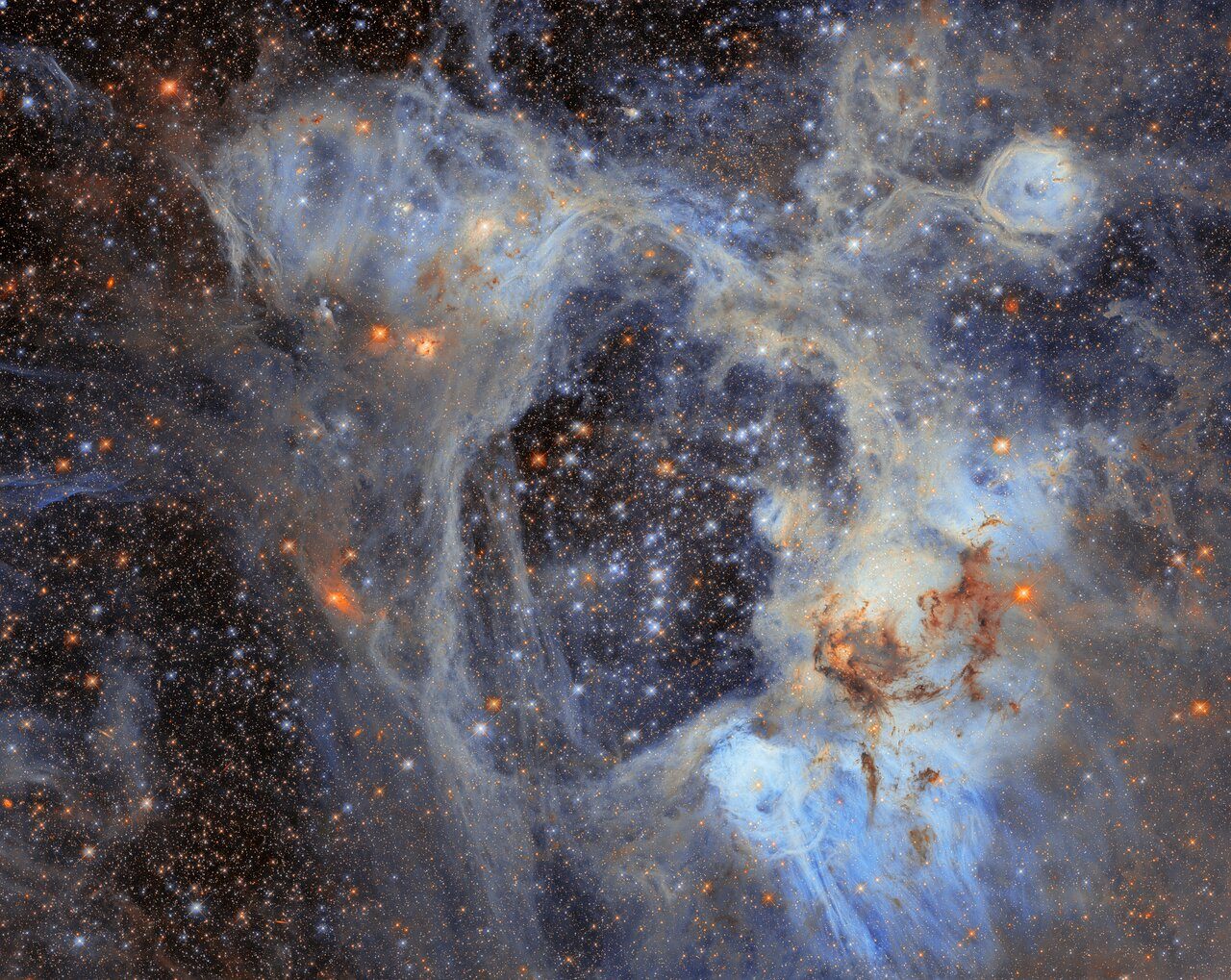
A vast cavity in N44 reveals how stars reshape their birthplace. Hubble’s view traces a cycle of gas clearing, compression and renewed star formation.
| Active satellites | 15,872 |
| Catalogued objects | 31,806 |
| Starlink active | 10,082 |
A cavity roughly 210 by 140 light-years across dominates this Hubble view of N44, a star-forming nebula in the Large Magellanic Cloud. Around this ‘superbubble’ (a vast cavity cleared in interstellar gas), a dense, dusty shell marks where stars have reshaped their birthplace.
The glittering central stars helped excavate the void through stellar winds (streams of particles flowing from stars) and supernovae (stellar explosions). Gas swept outwards accumulated into the surrounding shell, where new stars are forming. Ultraviolet radiation from massive stars energises that gas, making it glow.
A census of stars before ignition
Hubble’s survey catalogued nearly half a million stars in the N44 field, including stars lying in front of the complex. Nearly 30,000 were identified as pre-main-sequence stars: young objects that have not yet begun sustained hydrogen fusion in their cores.
This population helps researchers investigate how long star formation takes, from the collapse of cold gas into dense knots to the ignition of hydrogen fusion. Near the image’s upper-right corner, the smaller bubble N44F offers a contrasting example: its cavity was blown by the stellar winds of a single hot, massive star.
From an orbital observatory to a stellar nursery
Hubble’s sensitivity and ability to distinguish closely spaced objects let researchers identify faint young stars in crowded fields. The image therefore serves as more than a portrait: it supports measurements of how stars develop and what masses newborn stars typically have.
As of today, Orbital Radar tracking data lists 15,872 active satellites in orbit. As of today, Orbital Radar’s live catalogue contains 31,806 objects, including debris.
Those Earth-orbit figures describe a different environment from N44’s stellar nursery. Orbital Radar’s space situational awareness hub provides context for that orbital population, while its Space Academy offers a route into the wider science behind space observation.
Frequently Asked Questions
What created the superbubble in N44?
What did Hubble discover about young stars in N44?
📎 Cite this article · data available
Orbital Radar Newsroom. (2026). A superbubble scene: how N44’s stars sculpt their nursery. Orbital Radar. https://orbitalradar.com/blog/cosmic-gallery-2026-10-19"A superbubble scene: how N44’s stars sculpt their nursery." Orbital Radar, 19 October 2026, https://orbitalradar.com/blog/cosmic-gallery-2026-10-19.@misc{orbitalradar_cosmic_gallery_2026_10_19,
title = {A superbubble scene: how N44’s stars sculpt their nursery},
author = {{Orbital Radar}},
year = {2026},
howpublished = {\url{https://orbitalradar.com/blog/cosmic-gallery-2026-10-19}}
}