Having a Blast at Kitt Peak: A Rocket Catches Sunlight
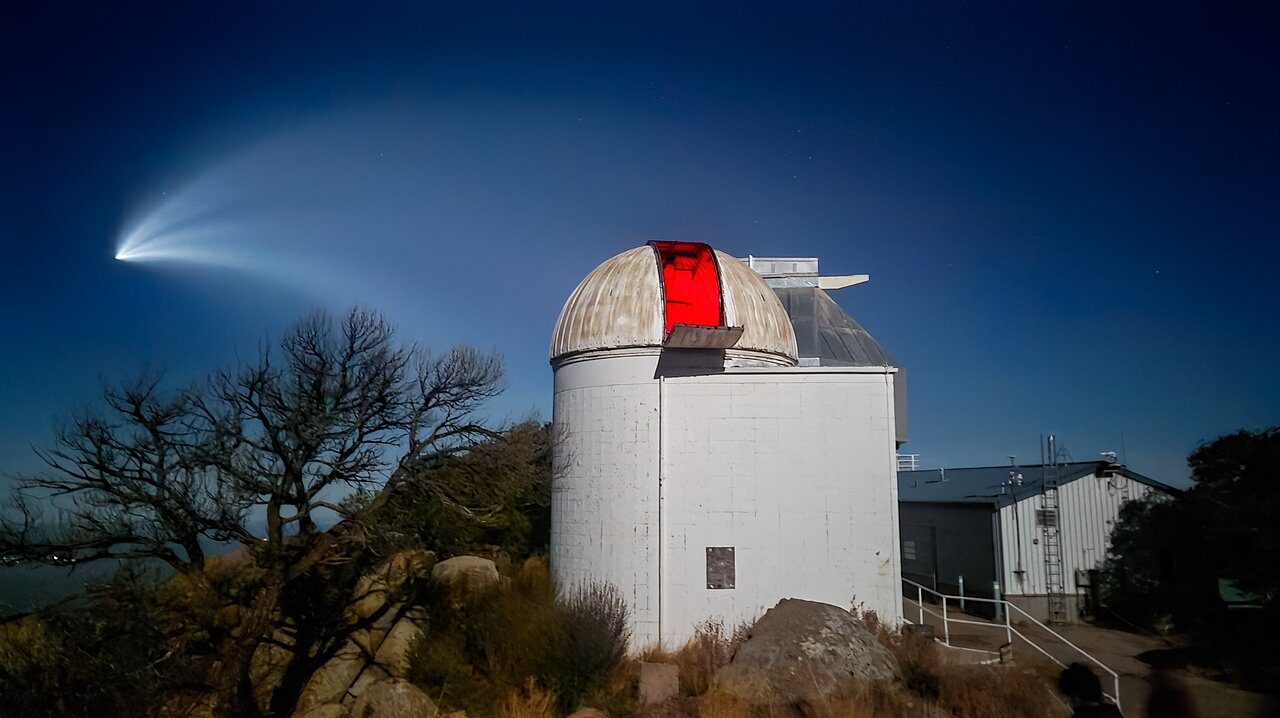
A Falcon 9 launch about 550 miles away lights up the sky above Kitt Peak. Its sunlit exhaust and a red-lit telescope dome reveal contrasting uses of light after sunset.
| Active satellites | 15,922 |
| Catalogued objects | 31,883 |
| Starlink active | 9,980 |
A SpaceX Falcon 9 rocket and its sunlit exhaust plume soar above the Visitor Center Levine 0.4-metre Telescope at Kitt Peak National Observatory. The rocket launched from Vandenberg Space Force Base in California, about 550 miles from the observatory, carrying a satellite towards Earth orbit. The striking contrast comes from sunlight reaching the rocket long after sunset on the ground.
Sunset does not put every altitude into darkness at once. From sufficiently high above Earth, the Sun remains visible even when the planet blocks it for observers below; here, that sunlight illuminates the rocket and its exhaust. The dome’s red glow serves a different purpose: red lighting disturbs human low-light vision less than other colours, helping visitors preserve their dark adaptation (the eyes’ adjustment to faint light).
From a luminous plume to a crowded orbit
Orbital Radar tracking data records 15,922 active satellites in Earth orbit as of 29 October 2026. The photograph captures the ascent towards that orbital environment, rather than the familiar passage of a satellite already circling Earth. Reaching orbit requires more than gaining height: a spacecraft must also acquire enough sideways speed to keep falling around Earth rather than back to its surface.
Orbital Radar’s live catalogue contains 31,883 objects, including debris, as of 29 October 2026. For readers following launches like this, Orbital Radar’s Launch Vehicles directory provides context on rockets including Falcon 9, while the Pass Predictor helps identify opportunities to watch satellites from the ground. Such passes offer a quieter example of the same lighting principle: an object overhead can remain sunlit while its observer stands in darkness.
Frequently Asked Questions
Why is the Falcon 9 plume visible after sunset at Kitt Peak?
Why does the Kitt Peak telescope dome glow red?
📎 Cite this article · data available
Orbital Radar Newsroom. (2026). Having a Blast at Kitt Peak: A Rocket Catches Sunlight. Orbital Radar. https://orbitalradar.com/blog/cosmic-gallery-2026-10-29"Having a Blast at Kitt Peak: A Rocket Catches Sunlight." Orbital Radar, 29 October 2026, https://orbitalradar.com/blog/cosmic-gallery-2026-10-29.@misc{orbitalradar_cosmic_gallery_2026_10_29,
title = {Having a Blast at Kitt Peak: A Rocket Catches Sunlight},
author = {{Orbital Radar}},
year = {2026},
howpublished = {\url{https://orbitalradar.com/blog/cosmic-gallery-2026-10-29}}
}