Stars brewing in N159: Webb reveals a nebulous cauldron
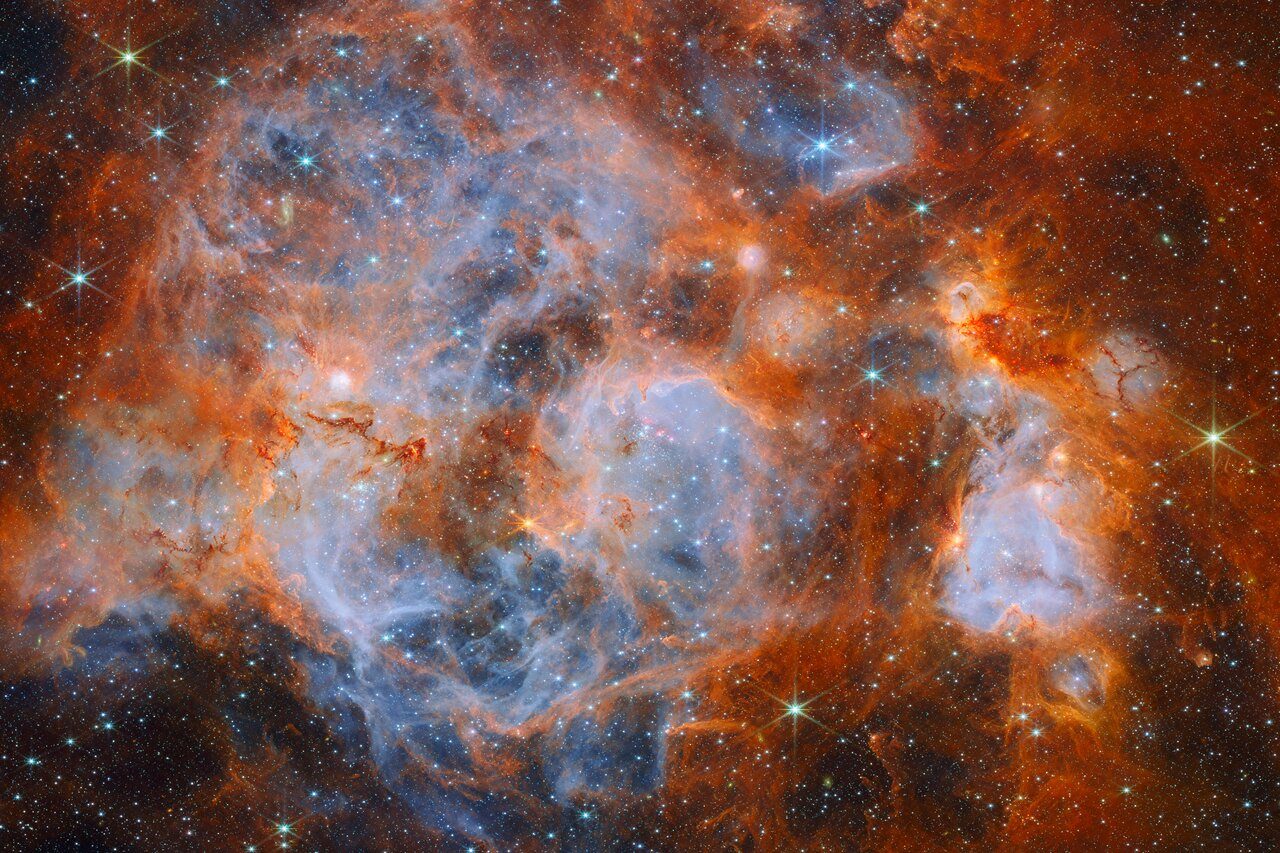
Webb’s view of N159 reveals young stars sculpting their birthplace, while dense filaments protect others still forming inside this turbulent stellar nursery.
| Active satellites | 15,880 |
| Catalogued objects | 31,804 |
| Starlink active | 10,008 |
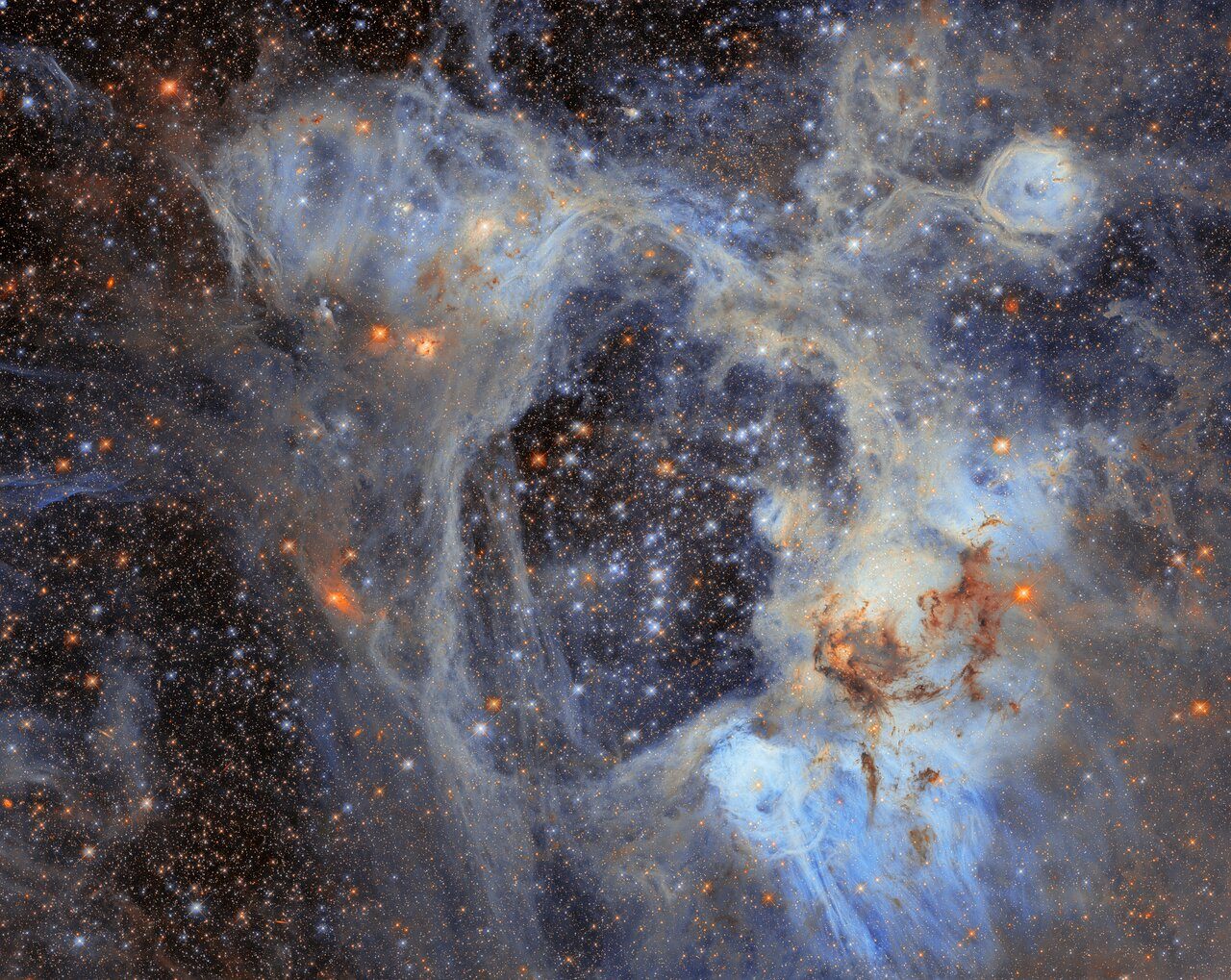
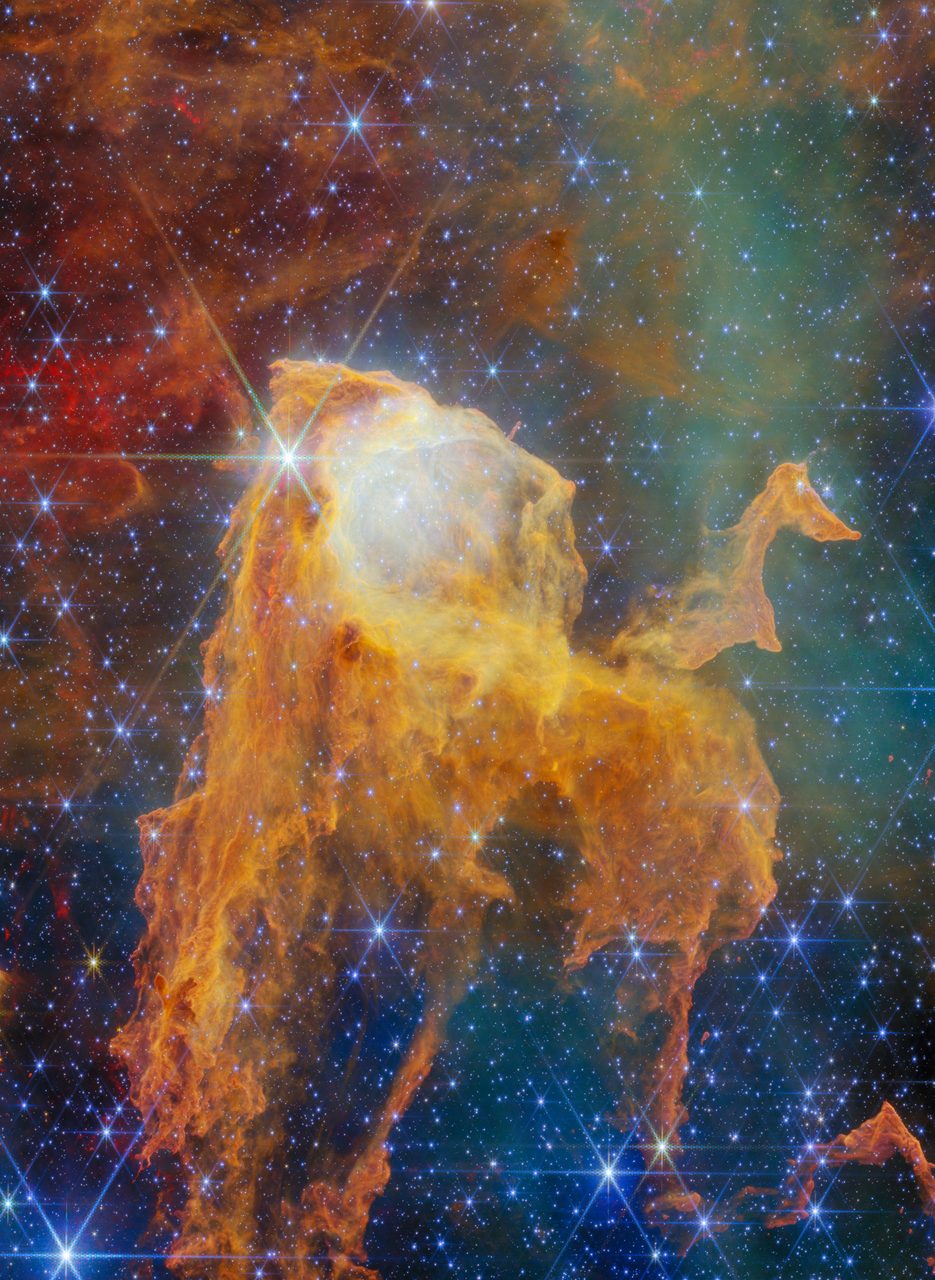
Young stars are carving cavities into their birthplace in N159, a turbulent stellar nursery in the Large Magellanic Cloud, a satellite galaxy of the Milky Way. This James Webb Space Telescope image spans about 230 light-years, revealing glowing gas, smoky orange clouds and dark red filaments.
N159 is an H II region (a cloud containing hydrogen ionised by stellar radiation). Massive, hot stars flood their surroundings with ultraviolet light, stripping electrons from hydrogen atoms; the gas emits light as electrons recombine with ions. Stellar winds help sculpt the ridges and cavities captured by Webb’s Near-Infrared Camera.
Sheltered stars in a harsher environment
The colours distinguish different ingredients in this stellar nursery. Pale blue marks ionised hydrogen, light orange traces emission from polycyclic aromatic hydrocarbons (carbon-based molecules), and dark red filaments contain cool molecular hydrogen.
Those dense filaments shield developing stars from radiation and stellar winds. Points of starlight appear embedded within them and within small orange pillars reaching into the blue bubbles; eventually, these protective structures will disperse.
N159 is less than three million years old. Its surroundings contain a lower proportion of elements heavier than hydrogen and helium than the Milky Way does, giving astronomers a way to investigate star formation under conditions more like those in the early Universe.
From distant nurseries to nearby orbits
Space telescopes reveal environments beyond Earth, while orbital tracking examines the increasingly occupied space around our planet. Orbital Radar tracking data records 15,880 active satellites as of 26 October 2026.
Orbital Radar’s live catalogue contains 31,804 objects, including debris, as of 26 October 2026. Readers interested in that nearer environment can explore the Orbital Radar space situational awareness toolkit; Webb’s image instead examines the birthplaces of stars.
Frequently Asked Questions
What does Webb’s image of N159 show?
Why is N159 useful for studying star formation?
📎 Cite this article · data available
Orbital Radar Newsroom. (2026). Stars brewing in N159: Webb reveals a nebulous cauldron. Orbital Radar. https://orbitalradar.com/blog/cosmic-gallery-2026-10-26"Stars brewing in N159: Webb reveals a nebulous cauldron." Orbital Radar, 26 October 2026, https://orbitalradar.com/blog/cosmic-gallery-2026-10-26.@misc{orbitalradar_cosmic_gallery_2026_10_26,
title = {Stars brewing in N159: Webb reveals a nebulous cauldron},
author = {{Orbital Radar}},
year = {2026},
howpublished = {\url{https://orbitalradar.com/blog/cosmic-gallery-2026-10-26}}
}