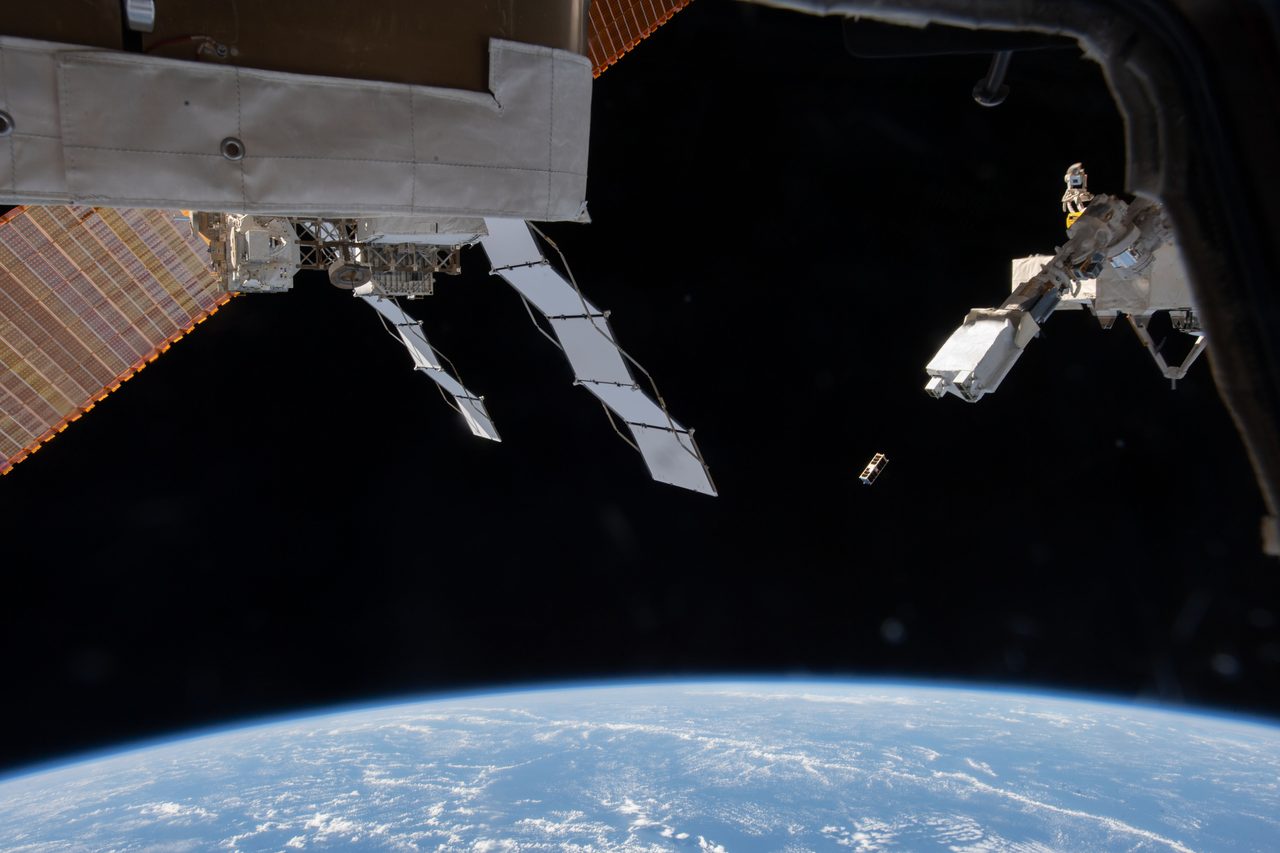
How Often Do Satellites Almost Collide? Near Misses in Orbit
Orbital Radar recorded 536 approaches within 1 km in the latest 30 days. Its conjunction history reveals a longer-term rise, but proximity alone does not establish collision risk.
| Active close approaches | 21 |
| People in space | 10 |
Orbital Radar tracking data recorded 536 close approaches within 1 km and 9,586 within 5 km in the 30 days to 29 October 2026. These figures show how often tracked objects came close, not how often satellites narrowly escaped a collision.
A conjunction (a close approach between orbiting objects) can involve working satellites, inactive spacecraft, rocket bodies and debris. Counting these encounters measures proximity; it does not, by itself, establish that a collision was likely or that an operator needed to manoeuvre.
Orbital Radar's conjunction history recorded 559 approaches within 1 km in 2014. The same history recorded 9,052 approaches within 1 km in 2025. This article compares the recent rolling monthly window with the annual record since 2014, keeping their different timescales distinct rather than treating a month as an annual trend.
Orbital Radar's live conjunctions page provides the current reference for following close approaches and putting the latest counts alongside that longer history.
How many close approaches happen within 1 km and 5 km?
Orbital Radar tracking data recorded 536 close approaches within 1 km and 9,586 within 5 km in the rolling 30 days to 29 October 2026. These figures describe encounters between orbiting objects, rather than the number of individual satellites involved.
Orbital Radar screened 36,789 close approaches across the rolling 30-day window, according to Orbital Radar tracking data. That is the broader screening volume: the encounters assessed, not the number that passed within either of the narrower distance thresholds. The 1 km and 5 km counts identify subsets of that screened total.
The thresholds overlap. Every approach within 1 km is also within 5 km, so the 536 closest encounters are already included in the 9,586 figure. Adding those counts together would count the closest encounters twice, rather than produce a meaningful total.
The window is a rolling monthly snapshot, not a calendar-month tally. As it advances, older encounters leave the window and newer ones enter, so these counts should not be read as a fixed forecast of how often close approaches will happen in future. Orbital Radar’s close-approach page provides the context for following these encounters; when comparing snapshots, keep the distance threshold and the length of the reporting window consistent.
How have approaches within a kilometre changed since 2014?
Recorded approaches within a kilometre rose broadly from 559 in 2014 to 9,052 in 2025, but growth was not uninterrupted. The annual total fell in 2017 and again in 2025, after reaching its highest level in this series in 2024.
Orbital Radar tracking data recorded 12,092 close approaches within 1 km in 2024. The chart below shows annual recorded conjunction activity (close approaches between orbiting objects), not a collision-rate series.
Annual recorded approaches within 1 km, 2014–2025
Year — approach count; bars show relative annual totals.
- 2014 — 559 ▌
- 2015 — 1,782 ██
- 2016 — 4,246 ████
- 2017 — 3,468 ███▌
- 2018 — 3,808 ████
- 2019 — 4,015 ████
- 2020 — 4,550 ████▌
- 2021 — 6,696 ███████
- 2022 — 7,107 ███████
- 2023 — 9,012 █████████
- 2024 — 12,092 ████████████
- 2025 — 9,052 █████████
The early archive shows a substantial rise through 2016, followed by a decline to 3,468 in 2017. Totals then increased each year through 2024 before falling to 9,052 in 2025—still above every annual total before 2024. Neither decline, by itself, establishes that orbit became safer.
Separate recent snapshot: the latest 30 days
Orbital Radar tracking data recorded 536 approaches within 1 km in the 30 days to 29 October 2026. That window contained 36,789 screened close approaches overall, including 9,586 within 5 km.
This recent snapshot is not another annual entry and should not be read as a direct comparison with a full calendar year. Readers can follow current activity on Orbital Radar’s conjunctions page, keeping its rolling window separate from the historical chart.
Does passing within a kilometre mean a collision was likely?
No: passing within a kilometre does not, by itself, mean a collision was likely. Miss distance is the separation between objects at closest approach; for a predicted encounter, it is calculated from their estimated trajectories. Crossing a distance threshold flags proximity, not a measured probability of impact.
Orbital Radar tracking data recorded 536 approaches within 1 km in the 30 days to 29 October 2026. Orbital Radar screened 36,789 close approaches over that period, according to Orbital Radar tracking data. The narrower count should not be described as collisions narrowly avoided: it identifies encounters meeting a distance criterion, without establishing how likely the objects were to touch.
Orbital uncertainty (imperfect knowledge of an object's position and trajectory) means each predicted position has a range of possible errors. Assessing collision probability requires information about those uncertainties, the objects' sizes and encounter geometry (their relative paths and orientation at closest approach). The same predicted miss distance can therefore imply different risks, depending on how the possible positions overlap and how much space the objects occupy.
A predicted encounter is a forecast based on orbital estimates, not an independently verified physical passage at the quoted separation. Subsequent tracking can refine the estimated closest approach, but a listing alone does not establish that the separation was independently confirmed. Orbital Radar's explanation of a conjunction distinguishes an orbital close approach from a collision; its conjunction assessment guide explains how proximity and uncertainty inform the assessment.
Why can a close approach be listed as 0.00 km?
A displayed separation of 0.00 km does not establish physical contact: rounding can hide a small non-zero distance, and the calculation depends on estimates of each satellite’s orbit. Orbital Radar tracking data lists SDA-NG-T1TL-302 and SDA-NG-T1TL-320 at a separation of 0.00 km on 15 October 2026. That is a catalogue result, not a verified report of an impact.
The distinction is between display precision and knowledge of the satellites’ actual positions. A rounded distance cannot reveal the full calculated separation, while uncertainty in the underlying orbital estimates limits how confidently that calculation describes reality. Neither the displayed value nor its apparent precision settles whether the spacecraft touched.
Orbital Radar tracking data also lists SDA-NG-T1TL-302 and SDA-NG-T1TL-316 at 0.00 km on 15 October 2026. Another entry for that date pairs SDA-NG-T1TL-303 with SDA-NG-T1TL-304, again displaying 0.00 km. These listings do not, by themselves, establish why the calculated separations appear this way.
Readers should therefore treat these entries as close-approach catalogue results rather than confirmed incidents. Orbital Radar’s guide to conjunction assessment provides context for interpreting a conjunction (a close approach between orbiting objects), where a distance estimate must be considered alongside its uncertainty.
Why might recorded close-approach counts rise?
Recorded close-approach counts can rise because more satellites create more opportunities for encounters, and because tracking and screening capture more events. A larger total does not, by itself, establish that the collision risk facing each satellite has increased.
Orbital Radar tracking data estimated 15,922 operational satellites as of 29 October 2026, counting payloads not known to have ended operations. Starlink accounts for 9,980 operational satellites in that estimate, illustrating the scale of today's constellations rather than proving that a particular operator caused the historical increase. Orbital Radar's satellite population overview provides the wider context.
Objects do not encounter every other satellite equally: altitude, inclination (the tilt of an orbit relative to Earth's equator) and clustering determine which paths can bring them close together. Satellites concentrated in overlapping altitude bands have different encounter opportunities from those separated in height; orbital orientation and timing also matter.
Orbital Radar's conjunction history recorded 12,092 approaches within 1 km in 2024, compared with 9,052 in 2025. That decline is a reminder that recorded totals need not rise steadily alongside satellite numbers.
Wider tracking coverage and a more complete catalogue can reveal encounters previously missed. Changes to screening practices (how predicted orbital paths are checked for close approaches), including which objects are compared and what reporting thresholds apply, can also change recorded totals without an equivalent change in physical danger.
The historical counts alone cannot quantify each cause's contribution. Assessing risk per satellite requires comparable tracking and screening, attention to orbital location, and collision-probability estimates—not simply a rising encounter total.
Which orbiting objects are involved besides working satellites?
Defunct satellites, spent rocket stages and fragments can all be involved in close approaches, alongside working spacecraft. Orbital Radar tracking data lists 10,028 debris objects and 2,205 rocket bodies as of 29 October 2026.
A payload is an object placed in orbit to perform a mission, such as communications or Earth observation; the label does not mean it remains operational. Rocket bodies are launch vehicle stages left in orbit, while debris includes fragments from break-ups and discarded hardware. Object classifications can be explored in the Orbital Radar Satellite Library.
Inactive objects complicate avoidance because they cannot generally respond to a warning with a controlled manoeuvre (a deliberate change of orbit). A functioning spacecraft with suitable propulsion may be able to move; an abandoned satellite or fragment usually cannot.
Orbital Radar tracking data recorded 36,789 screened close approaches in the 30 days to 29 October 2026. The debris and rocket-body totals describe the tracked environment, not a known share of those encounters.
Kessler syndrome describes a potential feedback in which collisions create fragments that cause further collisions, generating still more debris. Close-approach counts alone do not demonstrate that such a cascade is happening: they record encounters, not impacts or the production of new fragments.
How do satellite operators decide whether to manoeuvre?
Satellite operators decide whether to manoeuvre by assessing collision risk, not miss distance alone. They review the predicted time and distance of closest approach, evaluate orbital uncertainty (the range of possible positions around each estimated orbit), seek updated tracking and compare avoidance options.
Neither 1 km nor 5 km is a universal automatic manoeuvre trigger: distance alone does not describe the uncertainty, encounter geometry or spacecraft’s ability to respond. Fresh observations can change the assessment, so operators weigh the benefit of waiting for better information against the time needed to act safely.
Orbital Radar tracking data recorded 536 close approaches within 1 km in the 30 days to 29 October 2026. That is not a manoeuvre total: a conjunction warning flags a predicted close approach, an avoidance manoeuvre changes a spacecraft’s trajectory, and a confirmed collision requires evidence of physical contact. These are distinct events, not interchangeable measures of orbital danger.
Avoidance also has costs: propulsion uses finite fuel, and changing orbit can interrupt observations or communications. Operators must assess the revised trajectory for further close approaches rather than assume that moving makes everything safer. Orbital Radar’s guide to conjunction assessment explains that decision process; its satellite manoeuvre tracker provides a separate view of orbital changes, which should not automatically be interpreted as collision avoidance.
How can I check close approaches live on Orbital Radar?
Open Orbital Radar’s conjunctions page to consult the current close-approach listings. Orbital Radar tracking data lists 21 active close approaches as of 29 October 2026. This is a live watchlist, not a replacement for the historical total of 36,789 approaches screened over the preceding 30-day window.
For each encounter, identify the named objects, then note the predicted closest-approach time and separation wherever these are shown. A conjunction (a close approach between orbiting objects) listing describes a prediction, not a confirmed outcome. Even after the listed time has passed, the prediction alone does not establish the separation actually achieved or confirm a collision.
When revisiting an encounter, match the object pair and closest-approach time rather than treating every changed estimate as a new event. Fresh orbital measurements can revise the predicted time or separation. Those revisions describe an updated assessment of the same encounter, not necessarily additional distinct encounters.
To follow changes in frequency, compare equal reporting periods and the same distance thresholds. A current watchlist and a historical screening total answer different questions; neither should be substituted for the other when judging whether close approaches are becoming more frequent.
Use the satellite library at /library for background on the objects involved. Orbital Radar’s Pass Predictor at /satellite-pass-predictions answers a different question: when a satellite may be visible from your location on the ground, rather than how closely it may pass another object in orbit.
Key takeaways
- Orbital Radar recorded 536 approaches within 1 km and 9,586 within 5 km in the latest 30-day window, but these are proximity counts rather than collision probabilities.
- Annual approaches within 1 km rose from 559 in 2014 to 9,052 in 2025, with a higher count of 12,092 in 2024.
- A displayed separation of 0.00 km is not sufficient evidence of a collision.
- Orbital Radar's conjunctions page separates the current encounter picture from the longer-term history needed to judge changes in recorded frequency.
Frequently Asked Questions
Have satellites ever collided with each other?
Can the International Space Station move out of the way of debris?
Can satellites belonging to the same operator collide?
Can small pieces of space debris escape tracking?
Are close approaches more dangerous in low Earth orbit than in geostationary orbit?
📎 Cite this article · data available
Orbital Radar Newsroom. (2026). How Often Do Satellites Almost Collide? Near Misses in Orbit. Orbital Radar. https://orbitalradar.com/blog/how-often-do-satellites-nearly-collide"How Often Do Satellites Almost Collide? Near Misses in Orbit." Orbital Radar, 30 October 2026, https://orbitalradar.com/blog/how-often-do-satellites-nearly-collide.@misc{orbitalradar_how_often_do_satellites_nearly_collide,
title = {How Often Do Satellites Almost Collide? Near Misses in Orbit},
author = {{Orbital Radar}},
year = {2026},
howpublished = {\url{https://orbitalradar.com/blog/how-often-do-satellites-nearly-collide}}
}