James Webb Space Telescope at L2: A Deep Space Observatory
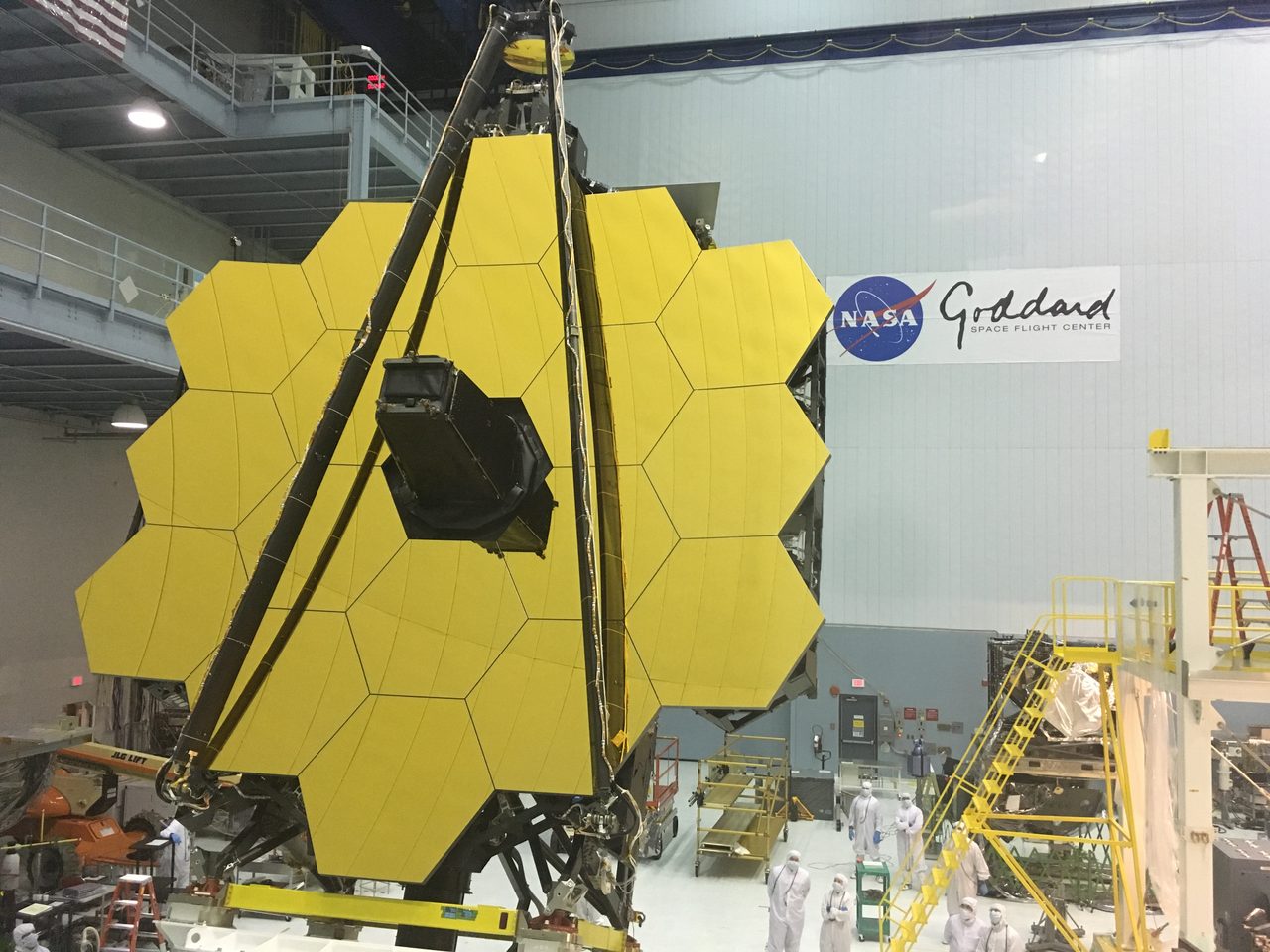
The James Webb Space Telescope (JWST) is a large, space-based observatory designed to complement and extend the discoveries of the Hubble Space Telescope. Launched on 25 December 2021, JWST is a collaborative project of NASA, the European Space Agency (ESA), and the Canadian Space Agency (CSA).
| Active satellites | 18,032 |
| Catalogued objects | 29,414 |
| Starlink active | 9,813 |
What is the James Webb Space Telescope?
The James Webb Space Telescope (JWST) is a large, space-based observatory designed to complement and extend the discoveries of the Hubble Space Telescope. Launched on 25 December 2021, JWST is a collaborative project of NASA, the European Space Agency (ESA), and the Canadian Space Agency (CSA). It is designed to observe the universe in infrared wavelengths, allowing it to peer through cosmic dust and study the earliest galaxies, star formation, and planetary systems. The telescope's primary mirror has a diameter of 6.5 metres, significantly larger than Hubble's 2.4 metres, enabling it to capture more light and see further into the universe.
Mission and Purpose
JWST's mission is to explore four main scientific themes: the end of the dark ages and the formation of the first galaxies, the assembly of galaxies, the birth of stars and protoplanetary systems, and planetary systems and the origins of life. By operating primarily in the infrared spectrum, JWST can observe objects that are too cool or too distant for Hubble to see. Its advanced instruments are designed to study everything from the atmospheres of exoplanets to the formation of stars and galaxies in the early universe. The telescope's findings are expected to revolutionise our understanding of the cosmos.
Orbital Characteristics
The James Webb Space Telescope is positioned at the second Lagrange point (L2), approximately 1.5 million kilometres from Earth. This location allows it to maintain a stable position relative to the Earth and Sun, providing a clear, unobstructed view of the universe. The telescope's orbit around L2 is a halo orbit, which helps it avoid the shadow of the Earth and maintain a constant temperature. The NORAD ID for JWST is 50463, and its unique position at L2 is crucial for its mission objectives, as it minimises interference from Earth's atmosphere and thermal emissions.
Significance and Legacy
JWST is expected to have a profound impact on astronomy and astrophysics, much like its predecessor, the Hubble Space Telescope. Its ability to observe the universe in infrared will allow scientists to study the formation of the first galaxies, the evolution of stars, and the potential habitability of exoplanets. The telescope's discoveries are anticipated to address fundamental questions about the origins of the universe and the possibility of life beyond Earth. JWST's findings will likely influence scientific research and space exploration for decades to come.
Current Status
As of now, the James Webb Space Telescope is fully operational and continues to send back data that is transforming our understanding of the universe. It has already made significant contributions to the study of exoplanets and distant galaxies, with many more discoveries expected in the coming years. The telescope's status and upcoming observation schedules can be monitored through Orbital Radar's satellite library and tracking tools.
📎 Cite this article · data available
Orbital Radar Newsroom. (2026). James Webb Space Telescope at L2: A Deep Space Observatory. Orbital Radar. https://orbitalradar.com/blog/james-webb-space-telescope-l2"James Webb Space Telescope at L2: A Deep Space Observatory." Orbital Radar, 9 September 2026, https://orbitalradar.com/blog/james-webb-space-telescope-l2.@misc{orbitalradar_james_webb_space_telescope_l2,
title = {James Webb Space Telescope at L2: A Deep Space Observatory},
author = {{Orbital Radar}},
year = {2026},
howpublished = {\url{https://orbitalradar.com/blog/james-webb-space-telescope-l2}}
}