Parker Solar Probe: Touching the Sun
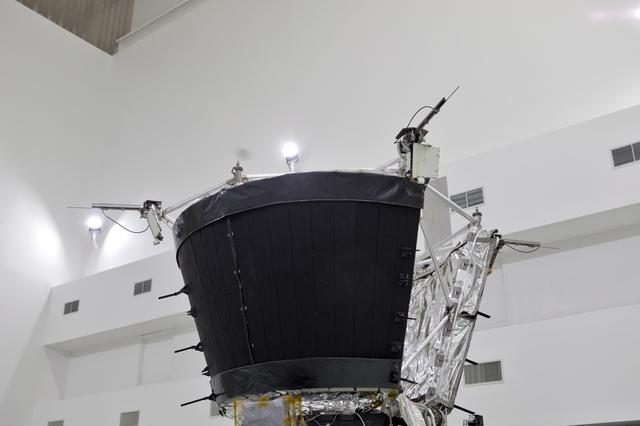
The Parker Solar Probe is a NASA spacecraft designed to study the outer corona of the Sun. Launched on 12 August 2018, it is the first mission to fly into the Sun's atmosphere, aiming to unravel longstanding mysteries about the solar corona and solar wind.
What is the Parker Solar Probe?
The Parker Solar Probe is a NASA spacecraft designed to study the outer corona of the Sun. Launched on 12 August 2018, it is the first mission to fly into the Sun's atmosphere, aiming to unravel longstanding mysteries about the solar corona and solar wind. The probe is named after Dr. Eugene Parker, who first theorised the existence of the solar wind in 1958.
Mission and Purpose
The primary mission of the Parker Solar Probe is to trace the flow of energy and understand the heating of the solar corona. It seeks to explore the dynamics of solar wind and solar energetic particles. By flying closer to the Sun than any previous spacecraft, the probe aims to provide unprecedented data that could help improve our understanding of solar phenomena and their impact on space weather, which can affect satellites and power grids on Earth.
Orbital Characteristics
The Parker Solar Probe follows a highly elliptical orbit, with its closest approach, or perihelion, bringing it within approximately 6.16 million kilometres (about 3.83 million miles) of the Sun's surface. This orbit allows it to travel at speeds of up to 700,000 kilometres per hour (about 430,000 miles per hour), making it the fastest human-made object. The probe's orbit is inclined at about 3.4 degrees to the solar equator, and its mission involves seven Venus flybys to gradually shrink its orbit closer to the Sun. Its NORAD ID is 43592.
Significance and Legacy
The Parker Solar Probe's mission is significant for its potential to revolutionise our understanding of the Sun. By directly sampling the solar corona, it provides insights into the mechanisms driving solar wind and the high temperatures of the corona, which are hotter than the Sun's surface itself. The data collected could lead to better predictions of solar storms, helping to safeguard satellites and terrestrial technology. The probe's groundbreaking journey represents a major milestone in heliophysics.
Current Status
As of the latest updates, the Parker Solar Probe continues its mission, completing multiple orbits around the Sun. It has already provided valuable data, contributing to several scientific discoveries about solar magnetic fields and particle acceleration. The probe is expected to continue its operations until at least 2025, with its final orbits bringing it even closer to the Sun. For more detailed tracking of its current position and mission updates, refer to the Orbital Radar Satellite Library.
📎 Cite this article
Orbital Radar Newsroom. (2026). Parker Solar Probe: Touching the Sun. Orbital Radar. https://orbitalradar.com/blog/parker-solar-probe-touching-the-sun"Parker Solar Probe: Touching the Sun." Orbital Radar, 24 August 2026, https://orbitalradar.com/blog/parker-solar-probe-touching-the-sun.@misc{orbitalradar_parker_solar_probe_touching_the_sun,
title = {Parker Solar Probe: Touching the Sun},
author = {{Orbital Radar}},
year = {2026},
howpublished = {\url{https://orbitalradar.com/blog/parker-solar-probe-touching-the-sun}}
}