Telstar 1 satellite: live TV, failure and its orbit today
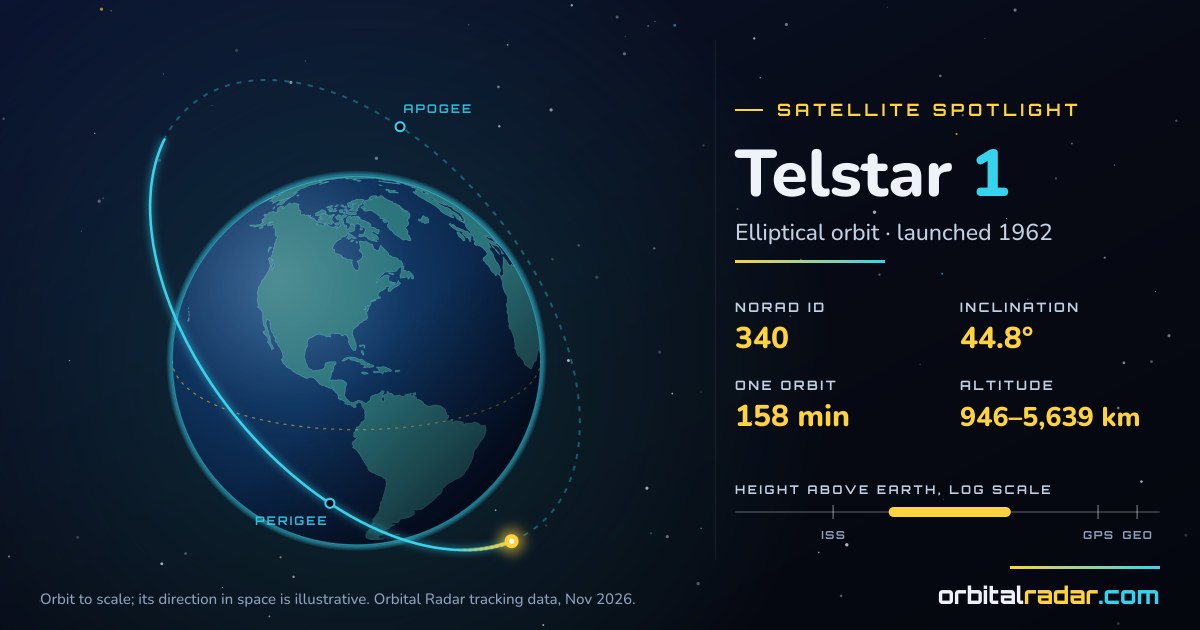
Telstar 1 helped bring live transatlantic television to life, then fell silent after radiation damage. Its working life ended, but the satellite remains in orbit.
| Catalogue number | 340 |
| International designator | 1962-029A |
| Launched | 10 July 1962 |
| Lowest and highest point | 946 and 5,639 km |
| Inclination | 44.8° |
| One orbit every | 158 min |
Telstar 1 is the pioneering communications satellite that relayed live television across the Atlantic in 1962 and remains in orbit today. Its electronics stopped working, but the spacecraft continued circling Earth, preserving a physical link between early television experiments and modern satellite communications.
Its distinction is specific: Telstar 1 helped establish active transatlantic television relay, receiving signals from the ground and transmitting them back towards another continent. It was not the first communications satellite of any kind. That distinction matters because the history of satellite communications includes earlier experiments, not all of which involved live television or an active relay.
Telstar 1 orbited between about 946 km and 5,639 km above Earth as of 26 November 2026, according to Orbital Radar tracking data. The silent spacecraft is no longer a working television link, but its journey continues independently of its failed electronics. Its current position and local passes can be checked on Orbital Radar’s Telstar 1 page.
Why was Telstar 1 a milestone for live television?
Telstar 1 made live transatlantic television possible, allowing audiences on opposite sides of the Atlantic to watch events as they happened rather than wait for recordings to arrive. It demonstrated that television pictures could cross an ocean through space, changing expectations about how quickly distant events could reach viewers.
Telstar 1 launched on 10 July 1962, as recorded in Orbital Radar's live catalogue. It was an active communications satellite, a spacecraft that receives a signal and retransmits it towards Earth. Unlike a passive reflector, which simply bounces radio waves back, Telstar used onboard electronics to amplify and retransmit the incoming signal.
The first experimental television relays established that the connection worked; the subsequent public broadcasts brought that capability to wider audiences. These were distinct milestones: successfully transmitting a test picture was not the same event as presenting a scheduled programme to viewers across the Atlantic.
Telstar demonstrated technical possibility, not an immediately continuous or worldwide television service. Transmissions depended on the satellite being within reach of the ground stations involved, so the connection was available only during suitable parts of its orbit.
Telstar 1 remains in orbit as catalogue number 340 as of 27 November 2026, according to Orbital Radar tracking data. Its present location is shown on Orbital Radar's Telstar 1 page.
How did Telstar 1 launch and reach its first broadcasts?
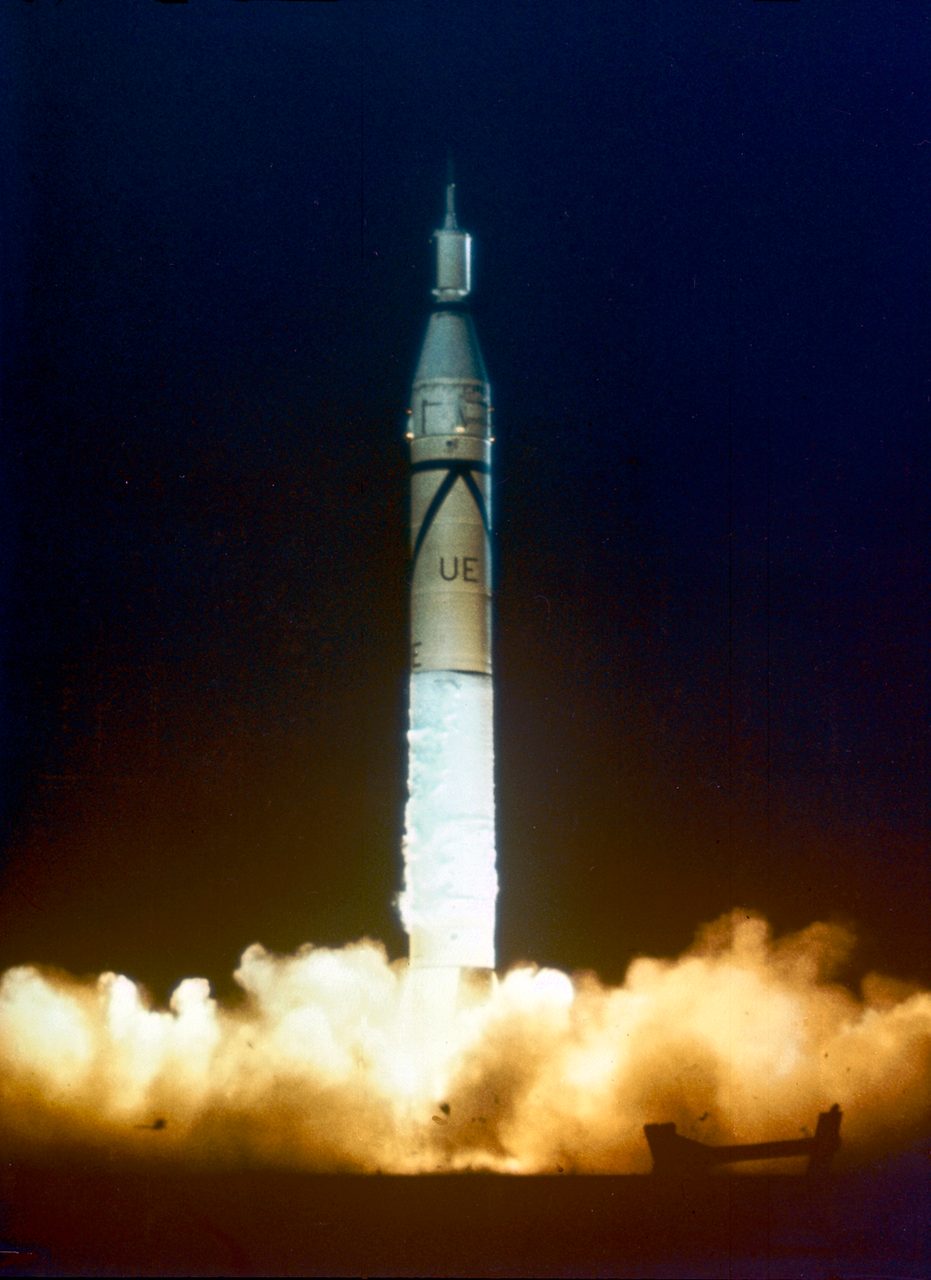
Telstar 1 launched from Cape Canaveral aboard a Thor-Delta rocket on 10 July 1962. NASA provided the launch service, rather than building or owning the satellite. The mission came during the early development of civilian satellite communications, when engineers were still establishing how reliably an orbiting relay could carry telephone and television signals between continents.
Reaching orbit was the first step, not the completion of the demonstration. Ground teams then had to establish contact, check the spacecraft’s equipment and test whether signals transmitted from Earth could be received, amplified and sent back down. Telstar 1 carried its first experimental television transmission on 10 July 1962.
Those initial engineering tests prepared the way for public transatlantic broadcasts, allowing audiences on opposite sides of the Atlantic to see television relayed through space. This was a scheduled experiment, not a continuous television service: operators had to coordinate the spacecraft, ground equipment and programme feeds within a usable viewing window.
A successful link required Telstar 1 to be above the horizon at both participating ground stations simultaneously. Each station also needed to point its antenna accurately as the satellite crossed the sky. That changing geometry remains relevant to understanding satellite passes; Orbital Radar’s Telstar 1 page shows its present position and local pass opportunities.
Who built Telstar 1, and who operated it?
AT&T owned Telstar 1 and backed the project; Bell Telephone Laboratories, its research and engineering organisation, designed and built the spacecraft. NASA supplied launch services and tracking support, rather than owning the satellite or running its experimental communications service.
Telstar 1 launched on 10 July 1962, as recorded in Orbital Radar's live catalogue. The division of responsibilities matters: AT&T provided the commercial project, Bell Labs developed the spacecraft and communications technology, and NASA provided the means to reach orbit and support flight operations.
On the ground, the experiment depended on an international network. Andover, Maine, was the principal American station; Britain's Goonhilly station in Cornwall and France's Pleumeur-Bodou station in Brittany formed the European links. These facilities belonged to participating national telecommunications organisations, not to a single worldwide satellite operator.
The ground teams coordinated tests, transmitted signals and received broadcasts when the satellite passed within reach. Operating the communications experiment therefore involved both the spacecraft's American engineering team and the organisations running the overseas terminals.
Telstar 1 remains in orbit on 27 November 2026, according to Orbital Radar tracking data. It has no functioning service operator today: historical ownership does not mean anyone is flying an active mission. Its Orbital Radar satellite page shows its tracked position and local passes, not an operational communications service or evidence of continuing control.
How did Telstar 1 send television across the Atlantic?
Telstar 1 sent television across the Atlantic by receiving a radio signal from a ground station, amplifying it and retransmitting it towards a receiving station on the other side. It carried a transponder, equipment that receives a radio signal and retransmits it at another frequency, not a television camera.
Telstar 1 launched on 10 July 1962. For a television relay, the transmitting station directed a radio beam carrying the programme towards the spacecraft. Its electronics received the weak incoming signal, amplified it and shifted its frequency before sending it back towards Earth. Using different frequencies helped keep the outgoing transmission separate from the incoming signal.
Solar cells on the spacecraft converted sunlight into electricity to run its electronics and charge rechargeable batteries. Those batteries supplied power when the satellite passed through Earth's shadow. The equipment aboard handled the radio relay; the pictures originated with television cameras on the ground.
Large ground antennas concentrated the transmitted beam and collected the faint returning signal. They also had to steer continuously because Telstar 1 moved across the sky rather than remaining above a fixed location.
Telstar 1 completes an orbit every 158 minutes, according to Orbital Radar tracking data dated 26 November 2026. A relay required both stations to see the spacecraft above their horizons simultaneously; coverage ended when that shared view was lost. Its movement can be followed on Orbital Radar's Telstar 1 page.
Why did Telstar 1 stop working?
Telstar 1 stopped working because radiation damaged semiconductor electronics in its command system, eventually preventing reliable responses to instructions from Earth. This was an electrical failure, not a collision or a mechanical breakup.
Energetic particles can deposit electrical charge in insulating layers and disrupt the microscopic structures inside transistors (semiconductor devices that switch or amplify electrical signals). Accumulated damage can alter their behaviour until a circuit no longer recognises commands correctly, even though the spacecraft around it remains intact.
Telstar 1 encountered both Earth's natural radiation belts, regions where the magnetic field traps charged particles, and an environment intensified by high-altitude nuclear testing. The Starfish Prime explosion on 9 July 1962, just before Telstar's launch, injected energetic electrons into the surrounding space environment. This artificial radiation contributed to the damage; attributing the failure solely to ordinary wear or a physical impact would miss the central cause.
The loss of service was not uninterrupted. Command-system problems disabled operations in November 1962, but engineers developed procedures that restored communications in January 1963. That recovery proved temporary: Telstar 1 ceased responding again on 21 February 1963, ending its working life.
Electronic silence did not cancel the satellite's orbital motion: gravity continued to bend its path around Earth without requiring working radios or command circuits. Telstar 1 remained in orbit on 27 November 2026, with a period of 158 minutes, according to Orbital Radar tracking data. Its continuing flight can be followed on Orbital Radar's Telstar 1 page.
What orbit does Telstar 1 follow today?
As of 26 November 2026, Telstar 1 followed an orbit ranging from about 946 km to 5,639 km above Earth, according to Orbital Radar tracking data. It remains in an elliptical orbit, an elongated path that carries it closer to Earth and then farther away on each circuit.
The lowest point of an Earth orbit is called perigee, while the highest is apogee, as explained in Orbital Radar's guide to apogee and perigee. These heights describe the satellite's distance above Earth's surface, not its distance from the planet's centre. Telstar 1 therefore travels through a substantial range of altitudes rather than following a circular track at a constant height.
Telstar 1's orbital inclination is 44.8 degrees, according to Orbital Radar tracking data. Inclination describes the tilt of its orbital plane relative to Earth's equator, so its path takes it north and south of the equator. Its orbital period is 158 minutes: the time needed to circle Earth.
Unlike a satellite in geostationary orbit, which appears fixed above a point on the equator, Telstar 1 moves across the sky relative to an observer on the ground. Its elevated orbit helps explain its persistence: even at its lowest point, atmospheric drag is much weaker than in lower orbits, so it loses orbital energy more slowly. Remaining in orbit does not require working transmitters or an active electrical system, and its continued presence does not establish a reliable re-entry date.
How can you check where Telstar 1 is now?
Open Telstar 1’s Orbital Radar page to see its mapped position and predicted passes for your location. As of 27 November 2026, Orbital Radar's live catalogue lists Telstar 1 under NORAD catalogue number 340 and international designator 1962-029A.
Select your observing location using the page’s location controls, then read the pass predictions for that site. Use the listed times to establish when a pass is expected, and any direction and elevation information to understand where to look. Elevation means the angle above your local horizon, rather than the spacecraft’s height above Earth.
The map and the pass information answer different questions. A point on the map shows where the satellite is above Earth; it does not directly show its direction in your sky. That direction depends on where you are standing, so predictions for another location may not apply to you.
The mapped position is calculated from orbital tracking information. It is not a live photograph, nor is it a transmission from Telstar 1: the silent spacecraft can still be tracked even though its communications equipment no longer works.
A predicted pass overhead is not a promise of naked-eye visibility. The spacecraft must receive sunlight while your observing site is sufficiently dark, and its distance and brightness also affect whether you could see it. Treat the predictions as a guide to Telstar 1’s movement, not as a guarantee of a visible sighting.
What did Telstar 1 change about satellite communications?
Telstar 1 demonstrated that an active satellite relay, which receives, amplifies and retransmits radio signals, could carry television and other communications between continents. It made space-based international links a practical engineering proposition rather than simply a theoretical possibility. Telstar 1 launched on 10 July 1962, according to Orbital Radar's live catalogue.
Its limitation was continuity: ground stations could communicate through it only during windows when the spacecraft was visible to both ends of the link. As of 27 November 2026, Orbital Radar tracking data gives Telstar 1 an orbital period of 158 minutes. Later geostationary communications satellites, which appear fixed above the equator by matching Earth's rotation, offered persistent coverage of the same regions rather than intermittent passes.
The mission also illustrated why radiation tolerance matters: energetic particles can damage electronic components and shorten a spacecraft's useful life. Radiation-resistant electronics, shielding and resilient circuit design remain important, but their development reflects experience across many missions and research programmes, not Telstar alone.
Telstar's historical importance should not be confused with an operational role today. Its continuing presence can be followed on Orbital Radar's Telstar 1 page, but the object being tracked is a surviving experimental spacecraft, not part of today's working broadcast network.
Key takeaways
- Telstar 1 demonstrated active live television relay across the Atlantic, a landmark in international communications.
- AT&T and Bell Telephone Laboratories developed the spacecraft, with NASA providing launch support and international ground stations enabling the broadcasts.
- Radiation damage ended Telstar 1's working life without bringing the satellite out of orbit.
- Telstar 1's Orbital Radar page shows its calculated position and local pass predictions, not a live signal from the spacecraft.
Frequently Asked Questions
Did Telstar 1 carry telephone calls as well as television?
Did Telstar 1 have a camera on board?
Was Telstar 1 crewed?
What is the difference between Telstar 1 and Telstar 2?
Was the song Telstar named after the satellite?
Cite this article
Pick a style, then copy it or download it for your reference manager.Orbital Radar. (2026, November 27). Telstar 1 satellite: live TV, failure and its orbit today. Retrieved November 27, 2026, from https://orbitalradar.com/blog/telstar-1-satellite
“Telstar 1 satellite: live TV, failure and its orbit today.” Orbital Radar, 27 Nov. 2026, orbitalradar.com/blog/telstar-1-satellite. Accessed 27 Nov. 2026.
Orbital Radar (2026) Telstar 1 satellite: live TV, failure and its orbit today. Available at: https://orbitalradar.com/blog/telstar-1-satellite (Accessed: 27 November 2026).
Orbital Radar. “Telstar 1 satellite: live TV, failure and its orbit today.” Last modified November 27, 2026. https://orbitalradar.com/blog/telstar-1-satellite.
@misc{orbitalradar_blog_telstar_1_satellite,
  author       = {{Orbital Radar}},
  title        = {Telstar 1 satellite: live TV, failure and its orbit today},
  year         = {2026},
  month        = nov,
  howpublished = {\url{https://orbitalradar.com/blog/telstar-1-satellite}},
  url          = {https://orbitalradar.com/blog/telstar-1-satellite},
  urldate      = {2026-11-27},
  note         = {Accessed 2026-11-27}
}
TY - ELEC AU - Orbital Radar, TI - Telstar 1 satellite: live TV, failure and its orbit today PY - 2026 DA - 2026/11/27 PB - Orbital Radar UR - https://orbitalradar.com/blog/telstar-1-satellite Y2 - 2026/11/27 LA - en ER -
Live figures change, so keep the date you accessed the page. How to cite Orbital Radar