Celestial Jewels: The Corona Australis Cloud and Chandelier Cluster
Discover the Corona Australis Cloud, a nearby star-forming region, and the distant Chandelier Cluster, a cosmic dance of young and ancient stars.
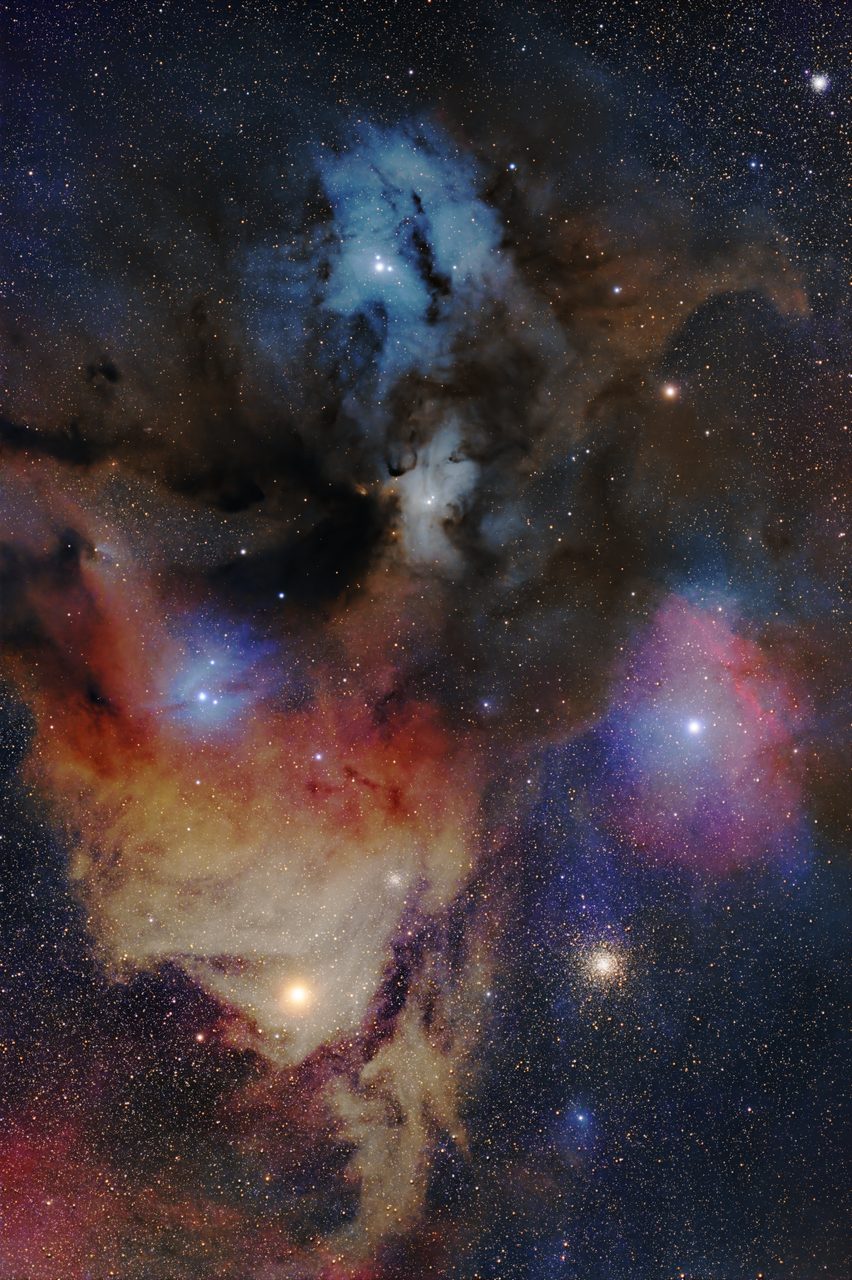
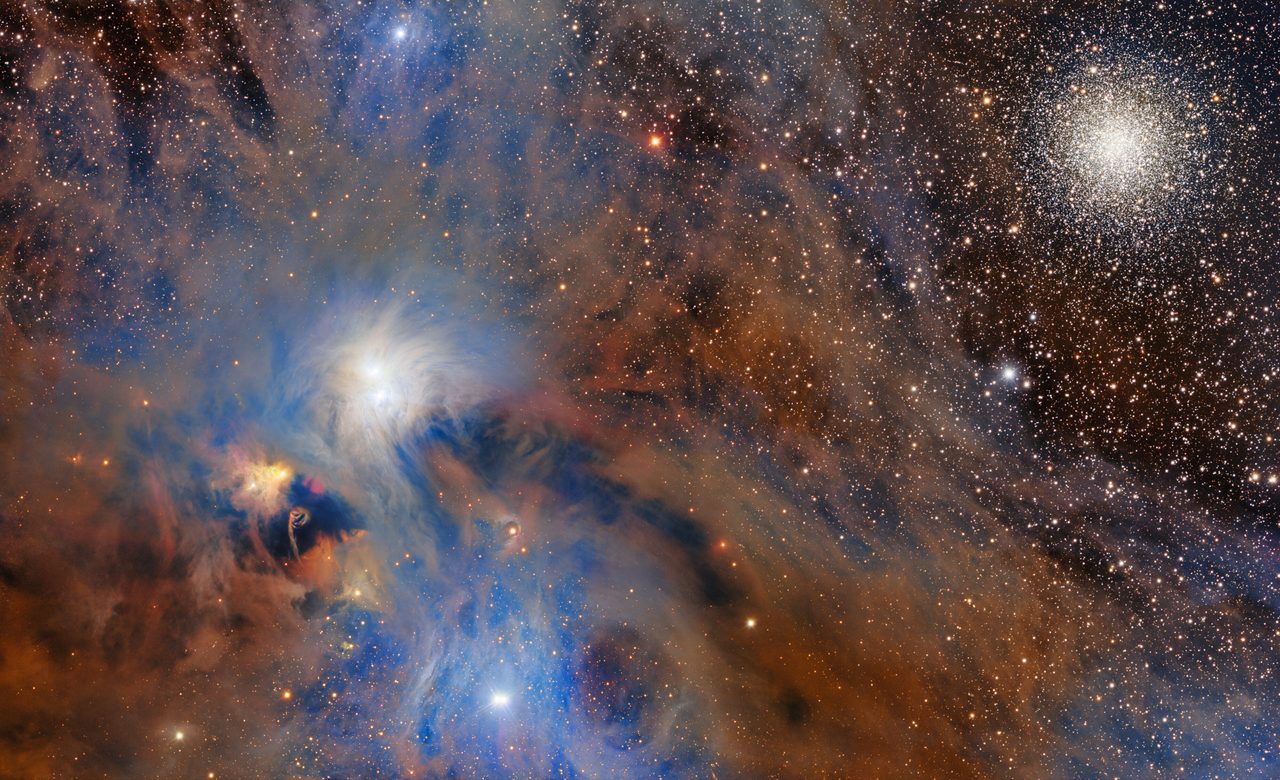
The Corona Australis Molecular Cloud, located just 430 light years from Earth, is a fascinating star-forming region. This cosmic tapestry is a blend of reflection and emission nebulae, where gas cool enough to form protostars resides. The blue hues seen in the image are the result of newly formed stars reflecting light off the surrounding dust. The binary system R Coronae Australis plays a pivotal role in this celestial scene, with its younger star ionising nearby gas to create a glowing nebula, NGC 6729.
A Cosmic Contrast
While the Corona Australis Cloud is a nearby nursery for stars, the Chandelier Cluster (NGC 6723) is a distant assembly of ancient stars. Despite their proximity in the sky, NGC 6723 is tens of thousands of light years further away. This globular cluster has seen multiple star formation events, resulting in stars that are nearly as old as the universe itself. The juxtaposition of these two celestial objects provides a striking example of the diverse processes at play in our galaxy.
Observing the Southern Crown
For those interested in observing the Corona Australis region, it is best viewed from the southern hemisphere. The constellation is visible from June to September. While observing, one might wonder about the satellites passing overhead. The Orbital Radar pass predictor can help identify visible satellite passes during your stargazing session.
Frequently Asked Questions
What is the Corona Australis Molecular Cloud?
How far is the Chandelier Cluster from Earth?
📎 Cite this article
Orbital Radar Newsroom. (2026). Celestial Jewels: The Corona Australis Cloud and Chandelier Cluster. Orbital Radar. https://orbitalradar.com/blog/cosmic-gallery-2026-05-09"Celestial Jewels: The Corona Australis Cloud and Chandelier Cluster." Orbital Radar, 9 May 2026, https://orbitalradar.com/blog/cosmic-gallery-2026-05-09.@misc{orbitalradar_cosmic_gallery_2026_05_09,
title = {Celestial Jewels: The Corona Australis Cloud and Chandelier Cluster},
author = {{Orbital Radar}},
year = {2026},
howpublished = {\url{https://orbitalradar.com/blog/cosmic-gallery-2026-05-09}}
}