Saturn's Majestic Moons: A Telescopic Family Portrait
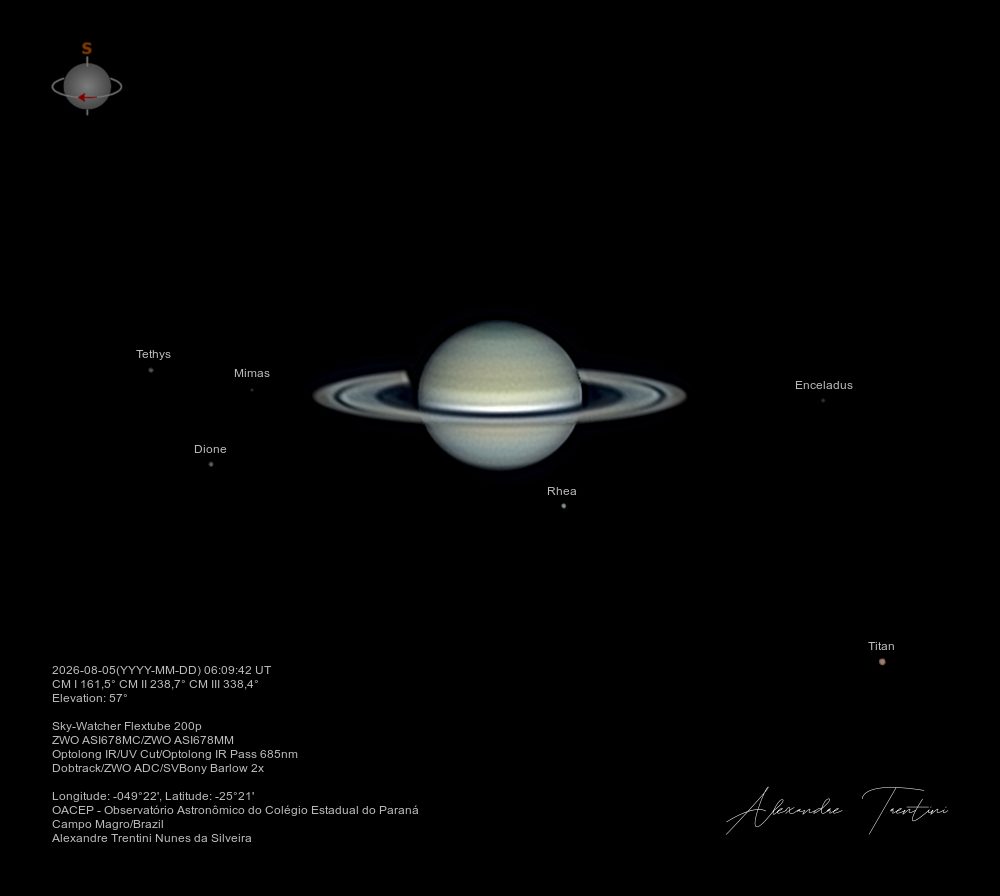
A telescopic image captures Saturn's six largest moons, including Titan and Enceladus, highlighting the planet's rich satellite system.
In this striking image, six of Saturn's largest moons are captured in a telescopic portrait, revealing the diversity and scale of the planet's satellite system. Among these, Titan stands out at the lower right, larger than Earth's Moon and even Mercury, with a diameter of 5,150 kilometres. Discovered in 1655 by Christiaan Huygens, Titan is enveloped in a thick atmosphere, making it a subject of great interest for planetary scientists. Alongside Titan, the icy moons Mimas, Tethys, Enceladus, Dione, and Rhea are visible, each contributing to our understanding of the complex dynamics at play in Saturn's orbit.
Saturn's Expanding Moon Count
As of June 2026, Saturn boasts 293 confirmed moons, surpassing Jupiter's 115. This growing catalogue of natural satellites includes many small, irregular bodies, often just a few kilometres across. These moons are typically found in tilted, outer orbits, a testament to the dynamic processes that govern Saturn's gravitational domain. The discoveries made by the Voyager and Cassini missions have significantly expanded our knowledge of these celestial bodies, revealing diverse geological features and complex interactions with Saturn's rings and magnetic field.
Observing the Saturnian System
For those interested in observing Saturn and its moons, a telescope with moderate magnification is sufficient to reveal some of the larger satellites. Titan, due to its size and brightness, is often the easiest to spot. Enthusiasts can use the Orbital Radar pass predictor to determine the best viewing times based on their location. As Saturn continues its orbit around the Sun, the relative positions of its moons offer a dynamic and ever-changing spectacle for observers on Earth.
Frequently Asked Questions
How many active satellites are currently in orbit?
What is space debris and why is it a concern?
📎 Cite this article
Orbital Radar Newsroom. (2026). Saturn's Majestic Moons: A Telescopic Family Portrait. Orbital Radar. https://orbitalradar.com/blog/cosmic-gallery-2026-08-11"Saturn's Majestic Moons: A Telescopic Family Portrait." Orbital Radar, 12 August 2026, https://orbitalradar.com/blog/cosmic-gallery-2026-08-11.@misc{orbitalradar_cosmic_gallery_2026_08_11,
title = {Saturn's Majestic Moons: A Telescopic Family Portrait},
author = {{Orbital Radar}},
year = {2026},
howpublished = {\url{https://orbitalradar.com/blog/cosmic-gallery-2026-08-11}}
}