Mars' Turtle Rock: A Geological Marvel Explored by Curiosity
Mars' Turtle Rock, a 15-metre geological formation, offers insights into the planet's erosive history, captured by Curiosity.
The photograph this article describes is by Thomas Thomopoulos (processing of NASA/JPL-Caltech/MSSS data) and isn’t shown here. View the original photograph
The image of Turtle Rock on Mars, captured by NASA's Curiosity rover, reveals a striking geological formation that bears an uncanny resemblance to a terrestrial tortoise. This 15-metre outcrop, named Miraflores, stands out in the Martian landscape due to its layered structure and the orange sand that adorns its top. Such formations are not uncommon on Earth, with similar structures known as yardangs found in deserts like China's Qaidam. These features form through the process of wind erosion, where softer material is worn away, leaving behind more resistant rock. The stratified layers visible beneath the 'shell' of Turtle Rock suggest a history of sediment deposition, possibly shaped by ancient Martian winds and groundwater.
Connecting Mars' Past to Present Missions
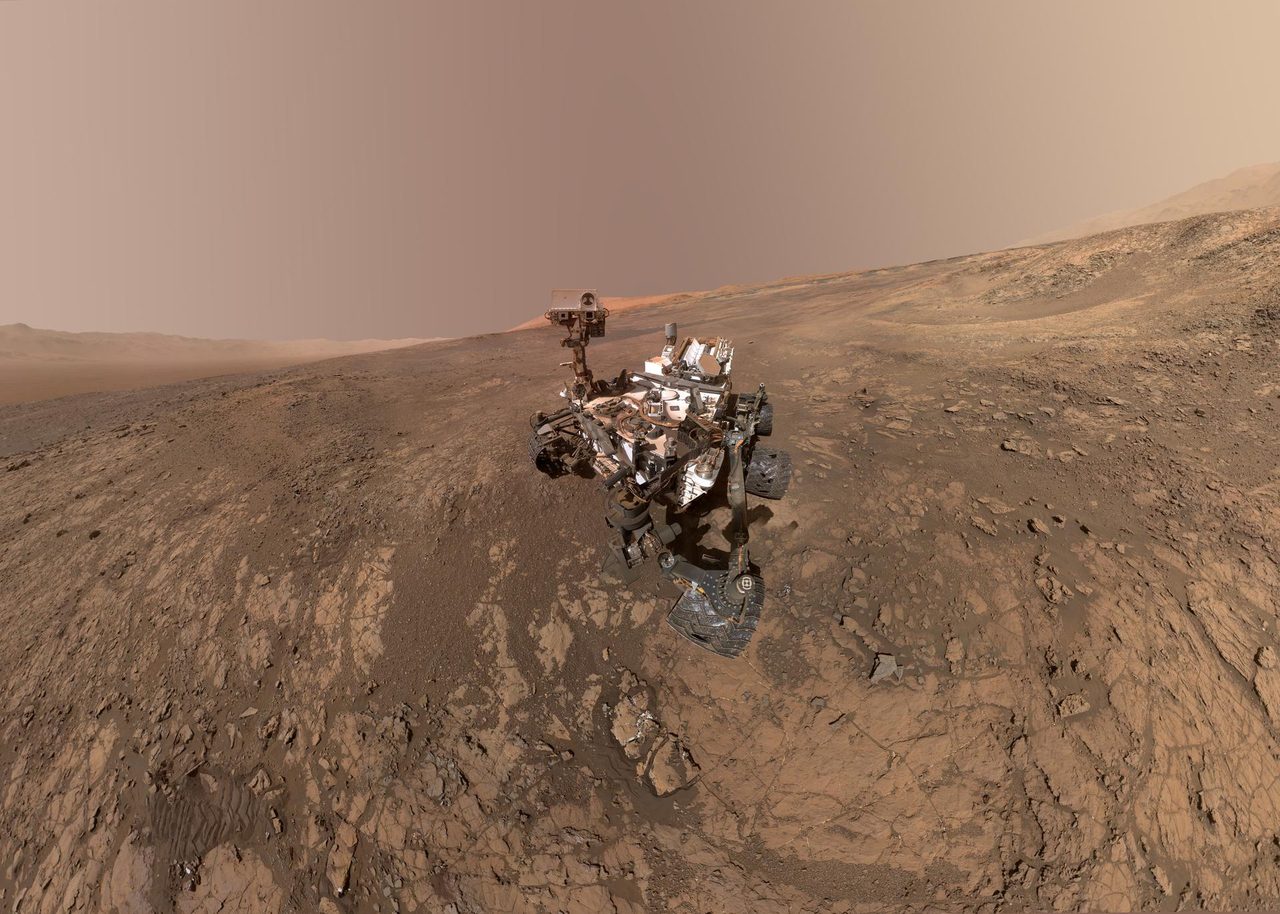
Curiosity's discovery of Turtle Rock adds to our understanding of Mars' geological past, offering clues about the planet's environmental conditions over millennia. The rover, alongside its counterpart Perseverance, continues to explore the Martian surface, searching for signs of past life and analysing rock formations to reconstruct the planet's history. As of today, the Curiosity rover has been operational for over 4900 Martian days, contributing significantly to our knowledge of Mars. This ongoing mission aligns with broader efforts to study Mars' atmosphere and surface, which are crucial for future human exploration. For those interested in tracking Curiosity's journey, detailed mission logs can be found in our Mars Rovers section.
Observing Mars from Earth
While we cannot observe Turtle Rock directly from Earth, Mars is often visible in the night sky. Using the Pass Predictor on Orbital Radar, enthusiasts can find the best times to view Mars and other celestial bodies. This tool provides precise timings for when Mars will be visible, allowing for a closer connection to the ongoing explorations on the Red Planet.
Frequently Asked Questions
What is Miraflores on Mars?
How does Miraflores relate to Earth's geology?
📎 Cite this article
Orbital Radar Newsroom. (2026). Mars' Turtle Rock: A Geological Marvel Explored by Curiosity. Orbital Radar. https://orbitalradar.com/blog/cosmic-gallery-2026-07-21"Mars' Turtle Rock: A Geological Marvel Explored by Curiosity." Orbital Radar, 22 July 2026, https://orbitalradar.com/blog/cosmic-gallery-2026-07-21.@misc{orbitalradar_cosmic_gallery_2026_07_21,
title = {Mars' Turtle Rock: A Geological Marvel Explored by Curiosity},
author = {{Orbital Radar}},
year = {2026},
howpublished = {\url{https://orbitalradar.com/blog/cosmic-gallery-2026-07-21}}
}