Satellite Radio Propagation: Finding the Best Contact Times
A satellite’s position is only part of a successful radio link. Learn how to interpret propagation heatmaps alongside pass predictions, space weather and your station’s limits.
Satellite radio propagation is the travel of radio signals between satellites and receivers through space and Earth’s atmosphere. The best communication times depend on the satellite’s position, operating frequency, atmospheric conditions and the receiving station—not simply the hour of the day.
Orbital Radar’s Propagation Heatmap provides a visual starting point for investigating those conditions. A heatmap represents numerical values with colours, making patterns easier to identify than in a list of readings; its usefulness depends on understanding the displayed variable, units, location and time.
The Orbital Radar tracking data snapshot supplied for this 19 October 2026 guide lists 15,872 active satellites. That growing population makes careful planning valuable, but an active spacecraft overhead is not necessarily one your radio can receive: frequency, coverage, antenna direction and access arrangements still determine whether a link is possible.
What a Propagation Heatmap Can Tell You
A propagation heatmap helps reveal how a radio-related measurement or modelled condition varies across the dimensions shown on its axes. Depending on the underlying product, those dimensions might be geographical position, time or frequency. The supplied information does not specify this tool’s axes, colour scale, inputs or update interval, so those details must be checked on the page rather than assumed.
Start with the legend, not the brightest patch. A warm colour might indicate a stronger signal, a larger disturbance or a higher value of some other quantity; it does not inherently mean better reception. Equally, a map of ionospheric conditions is not automatically a prediction of signal strength at your antenna.
The practical value is context: identifying a condition worth investigating before combining it with a specific satellite pass. Try the satellite radio propagation heatmap, check its displayed labels and timestamps, and establish exactly what its colours represent before choosing a contact window.
Why Orbit and Elevation Often Decide the Best Time
For most direct satellite links, the first requirement is line of sight: an unobstructed radio path between spacecraft and antenna. Low Earth orbit satellites move rapidly across the sky, creating relatively brief contact windows. Geostationary satellites orbit above the equator at the same angular rate as Earth’s rotation, appearing nearly fixed from a suitable ground location.
Elevation—the angle above your local horizon—is particularly important. A low-elevation satellite is generally farther away than the same spacecraft high overhead, while its signal also follows a longer path through the atmosphere. Buildings, trees and nearby terrain can obstruct the link, making your usable horizon different from the ideal horizon in a prediction.
Free-space path loss is the reduction in received signal power as radio energy spreads over distance. For otherwise identical links, increasing distance or frequency increases this loss, although antenna gain and other system choices can compensate. A higher pass often offers better geometry, but antenna pointing, polarisation and the satellite’s antenna pattern can alter the result.
Use Orbital Radar’s amateur radio satellite passes page to investigate contact opportunities alongside propagation conditions. Where a pass prediction provides rise, culmination and set times, culmination means the satellite’s highest elevation during that pass—not a guarantee of the strongest received signal.
Frequency Determines Which Atmospheric Effects Matter
The ionosphere is an electrically charged region of the upper atmosphere, shaped by sunlight and space weather. It can refract radio waves, delay signals and alter their polarisation, with effects that depend strongly on frequency. A condition useful for a terrestrial high-frequency radio path may therefore be irrelevant—or unhelpful—to a satellite link.
Many amateur satellite links use very high frequency, or VHF, and ultra-high frequency, or UHF, bands. These generally support direct paths through the ionosphere rather than the long-distance ionospheric reflection familiar to shortwave operators. Nevertheless, ionospheric irregularities and polarisation changes can affect reception, and a fixed-polarisation antenna may experience fading as the received signal’s orientation changes.
At higher microwave frequencies, rain attenuation—the absorption and scattering of radio energy by precipitation—can become a major limitation. Water vapour, atmospheric gases and clouds also contribute frequency-dependent losses. A clear orbital path is therefore not the same thing as a weather-proof link, particularly for some broadband and high-data-rate services.
There is consequently no universal best frequency or best daily time for satellite radio propagation. A useful assessment must match the environmental information to the intended link: an amateur radio downlink, a navigation signal and a commercial broadband terminal have different sensitivities and operating constraints.
Space Weather Adds Another Layer of Uncertainty
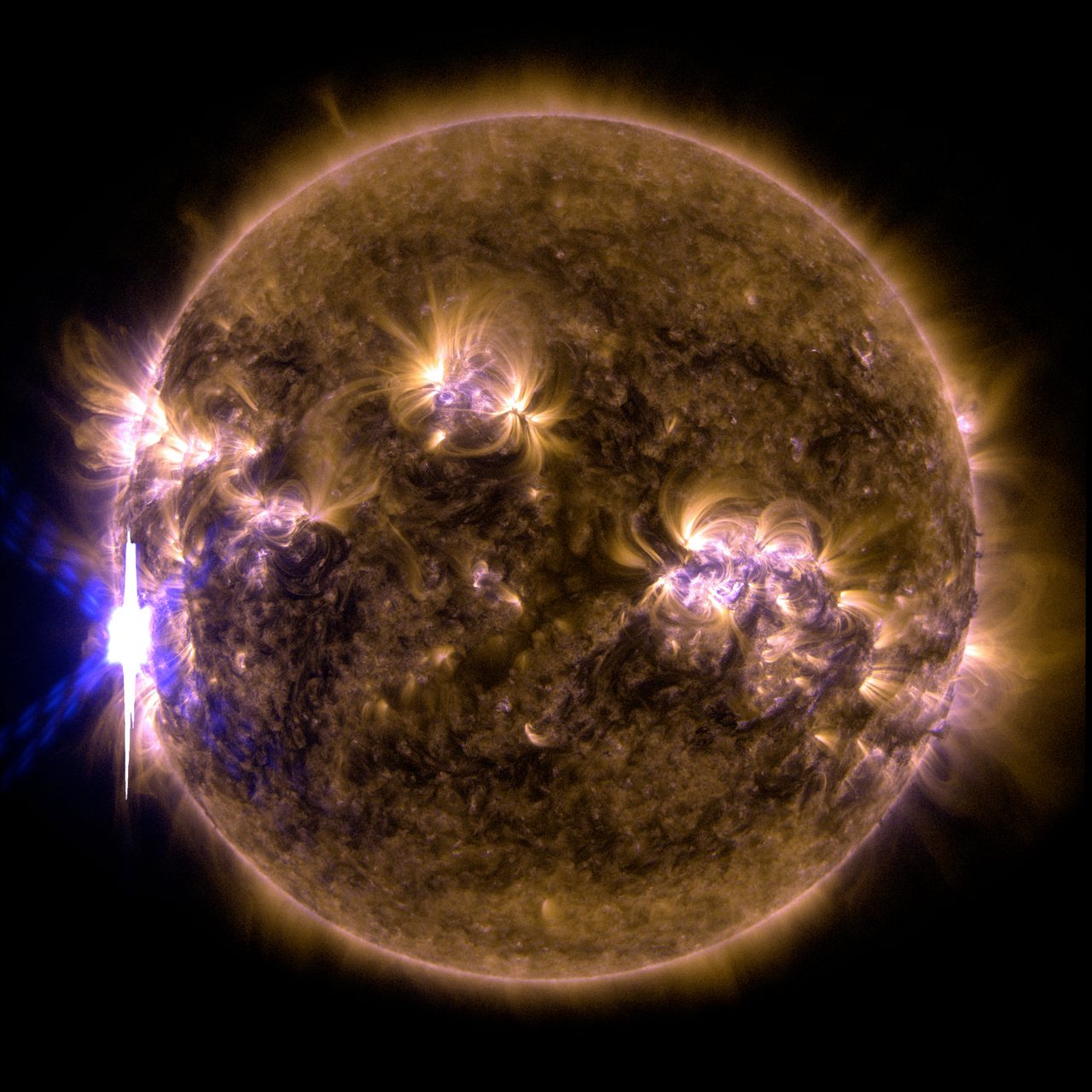
Solar radiation and disturbances in near-Earth space can change the ionosphere, affecting satellite signals even when local skies are clear. Total electron content, or TEC, describes the number of free electrons along a path through the ionosphere. For satellite navigation, changing electron content introduces frequency-dependent signal delays that receivers must estimate or correct.
Scintillation is rapid fluctuation in a radio signal’s amplitude or phase caused by small-scale ionospheric irregularities. It can make a receiver’s signal tracking less reliable, and its occurrence depends on location, time and geomagnetic conditions. A broad regional indicator cannot necessarily resolve the irregularities along one station-to-satellite path.
Orbital Radar’s guide to space weather and GPS explains why navigation performance and atmospheric conditions are connected. Use that context when interpreting a propagation display, but do not treat a geomagnetic index as a direct forecast of your received signal strength. A disturbed environment raises questions to investigate; it does not establish that every satellite link will fail.
How to Turn the Heatmap into a Contact Plan
Begin with a defined target and a realistic station description. Confirm the satellite’s published downlink frequency, modulation and operating status through authoritative mission or operator information, then check that your receiver and antenna are suitable. Receiving an accessible signal and having permission to transmit are separate matters; uplinks may require an amateur radio licence or explicit operator authorisation.
Next, identify a pass with a clear local horizon and workable elevation. Open the heatmap and inspect the quantity, units, geographic coverage, timestamp and any explanation of the data source. If those details are absent, treat the visualisation as limited context rather than a station-specific forecast; this guide cannot verify which measurements or models the tool incorporates.
Compare like with like. A current atmospheric observation should not be assumed to describe a future pass, and a forecast should retain its stated uncertainty. Satellite positions also depend on the age and quality of orbital data: two-line element sets, a common orbital-data format, support predictions but can become less reliable after manoeuvres or as they age.
During a suitable pass, record reception against time, elevation and local conditions. Note antenna orientation, obstructions and receiver settings so that repeated observations remain comparable. Moving satellites also cause Doppler shift—a change in received frequency due to relative motion—which may require manual or automatic tuning independently of any propagation changes.
Key Takeaways: Better Conditions Are Not a Guaranteed Link
The Orbital Radar tracking data snapshot supplied for this 19 October 2026 guide lists 10,082 operational Starlink satellites. That figure describes a constellation’s operational population, not the number visible from your location or available to a particular terminal. Fleet totals cannot substitute for coverage information or a link assessment.
For practical planning, keep three questions separate: is the satellite geometrically accessible, are conditions favourable at its frequency, and can your equipment establish the required link? The strongest contact window is where those answers overlap. High elevation and a clear horizon are useful starting points, but local interference, antenna performance and service restrictions can still dominate.
Use the Propagation Heatmap as one layer in that decision, alongside pass predictions and frequency-relevant weather information. Check the legend and timestamp each time, then test your expectations against actual reception. That approach turns a colour display into evidence for better planning without mistaking it for a guarantee.
Frequently Asked Questions
What is the best time of day for satellite radio propagation?
How do I read a satellite radio propagation heatmap?
Does space weather affect VHF and UHF satellite communication?
Can a propagation heatmap predict whether I will receive a satellite?
Why does my satellite signal fade during a high-elevation pass?
📎 Cite this article
Orbital Radar Newsroom. (2026). Satellite Radio Propagation: Finding the Best Contact Times. Orbital Radar. https://orbitalradar.com/blog/propagation-heatmap-guide"Satellite Radio Propagation: Finding the Best Contact Times." Orbital Radar, 29 July 2026, https://orbitalradar.com/blog/propagation-heatmap-guide.@misc{orbitalradar_propagation_heatmap_guide,
title = {Satellite Radio Propagation: Finding the Best Contact Times},
author = {{Orbital Radar}},
year = {2026},
howpublished = {\url{https://orbitalradar.com/blog/propagation-heatmap-guide}}
}